 Getting Started
Introduction & Overview
Every product you buy, every job your neighbors go to, and every app on your phone exists because of business. The American Business merit badge takes you behind the scenes of the economic engine that shapes daily life in the United States. You will learn how businesses start, grow, compete, and serve their communities — and you might discover a career path that excites you.
Business is not just about making money. It is about solving problems, creating value, and building something that matters. Whether you dream of launching your own company, managing a team, or simply want to understand why the economy works the way it does, this badge gives you the foundation to think like a business leader.
Then and Now
Then — Building a Nation of Commerce
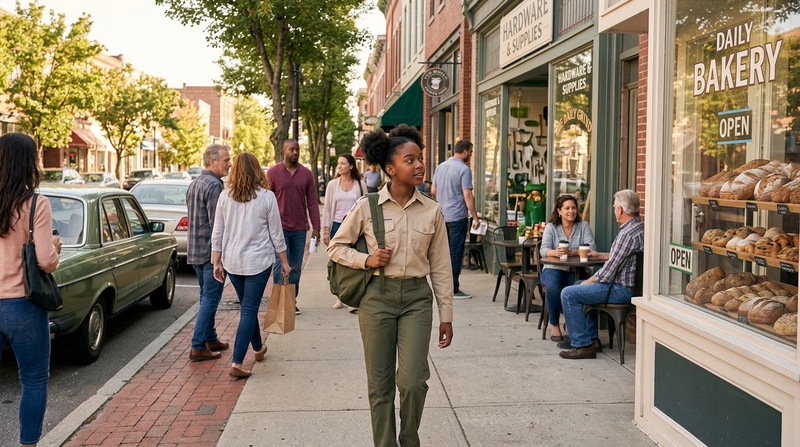
When the United States was young, business looked very different. Colonial merchants traded furs, tobacco, and lumber with Europe. Blacksmiths, cobblers, and printers ran small shops on main streets. The Constitution gave Congress the power to regulate commerce between states, creating the framework for a unified national economy.
In the 1800s, the Industrial Revolution transformed everything. Factories replaced workshops. Railroads connected coasts. Entrepreneurs like Andrew Carnegie, John D. Rockefeller, and Madam C.J. Walker built empires that changed how Americans lived and worked.
- Purpose: Survival, trade, nation-building
- Mindset: Build something from nothing — opportunity awaits those who work hard
Now — A Global Economic Powerhouse
Today the United States has the largest economy in the world. American companies lead in technology, healthcare, finance, entertainment, and agriculture. A teenager with a laptop can start a business from a bedroom. Small businesses employ nearly half of all American workers, while large corporations operate across dozens of countries.
- Purpose: Innovation, problem-solving, global impact
- Mindset: Adapt quickly, think globally, create value for customers and communities
Get Ready! You are about to explore how the American business system works — from the corner store to the Fortune 500. The skills you learn here will serve you whether you start a company, manage your personal finances, or simply want to be a smarter citizen.
Kinds of Business
Businesses come in many shapes and sizes. Before you dive into the requirements, here is a look at the main types you will encounter in the American economy.
Small Business
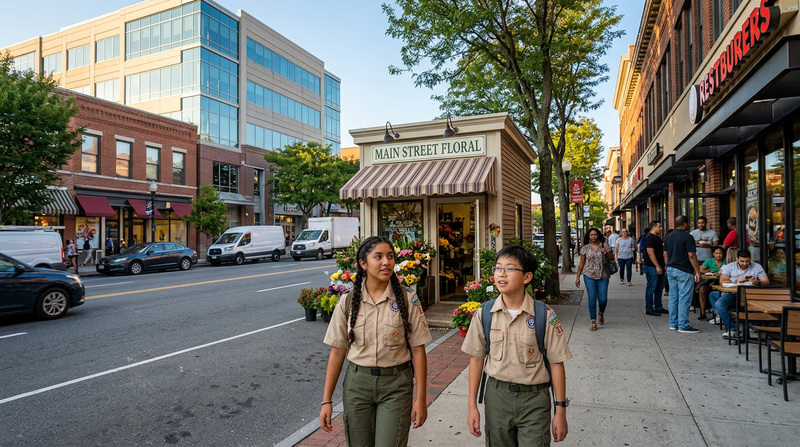
Small businesses are the backbone of the American economy. They include everything from a neighborhood bakery to a local landscaping company to a freelance graphic designer. The U.S. Small Business Administration defines a small business as one with fewer than 500 employees, but most have far fewer — many are run by just one or two people.
Small businesses often start with a simple idea and a willingness to take a risk. They create jobs, serve their communities, and keep money circulating locally.
Corporations
A corporation is a business that is legally separate from the people who own it. Corporations can sell shares of stock to raise money, which means thousands — or millions — of people can own a small piece of one company. Think of companies like Apple, Walmart, or Disney.
Corporations have complex structures with boards of directors, executive officers, and thousands of employees. They often operate in multiple countries and generate billions of dollars in revenue.
Nonprofit Organizations
Not every business exists to make a profit. Nonprofits are organizations that use their revenue to pursue a mission — like feeding the hungry, protecting the environment, or funding medical research. The Boy Scouts of America is itself a nonprofit organization.
Nonprofits still need to manage money carefully, hire employees, and market their services. The difference is that any surplus goes back into the mission, not into the pockets of owners or shareholders.
Franchise Businesses
A franchise is a business model where an individual (the franchisee) pays for the right to operate under an established brand. Fast-food restaurants like McDonald’s and Subway are classic examples. The franchisee gets a proven system, brand recognition, and support. In return, they pay fees and follow the franchisor’s rules.
Franchises are a popular path for people who want to own a business but prefer to start with a tested blueprint rather than building from scratch.
Online and Digital Businesses
The internet has created entirely new kinds of businesses. E-commerce stores sell products without a physical storefront. Software companies offer apps and subscriptions. Content creators earn revenue through platforms like YouTube or Etsy. Some digital businesses operate with just a handful of people yet reach millions of customers worldwide.
Online business has lowered the barriers to entry — you do not need a building, a warehouse, or a large staff to get started. But you still need a solid plan, financial skills, and a product or service that people want.
Now that you have a sense of what American business looks like, it is time to dig into the foundations — starting with the free enterprise system that makes it all possible.