Req 1b — The Industrial Revolution
What Was the Industrial Revolution?
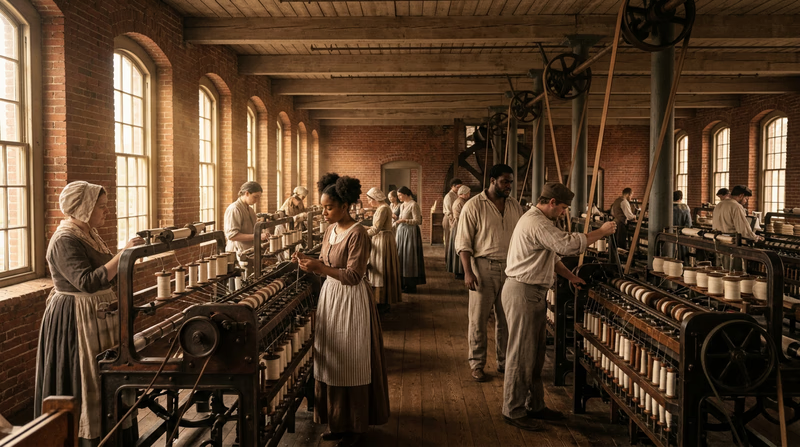
The Industrial Revolution was a period of massive change that transformed how goods were made, how people worked, and how the economy operated. It began in Great Britain in the mid-1700s and reached the United States by the early 1800s. Before the Industrial Revolution, most products were made by hand in small workshops or at home. Afterward, machines in large factories could produce goods faster, cheaper, and in much larger quantities.
This was not just a change in technology — it was a change in how people lived. Families moved from farms to cities. New jobs were created. Entire industries appeared almost overnight. The way Americans earned a living, traveled, and communicated was permanently altered.
Major Developments in the U.S.
Several key developments marked the beginning of the modern industrial era in America:
The Factory System
In 1793, Samuel Slater built the first successful water-powered cotton mill in Pawtucket, Rhode Island, using designs he memorized from English factories. This marked the beginning of the American factory system. Instead of individual craftspeople making goods one at a time, workers now operated machines in centralized locations.
The Cotton Gin (1794)
Eli Whitney’s cotton gin could clean cotton fifty times faster than a person working by hand. This invention made cotton enormously profitable and fueled the growth of the textile industry — though it also tragically increased the demand for enslaved labor in the South.
Railroads
By the 1860s, railroads connected cities and towns across the continent. The Transcontinental Railroad, completed in 1869, linked the East Coast to the West Coast for the first time. Railroads moved raw materials to factories and finished goods to markets faster than ever before.
The Telegraph
Samuel Morse’s telegraph (1844) allowed instant communication over long distances. For the first time, a business owner in New York could send a message to a partner in Chicago and get a reply the same day. This sped up commerce and made national business networks possible.
Mass Production
Henry Ford did not invent the automobile, but in 1913 he perfected the assembly line — a system where each worker performed one specific task as the product moved down the line. This made cars affordable for ordinary families and became the model for manufacturing around the world.
Three Influential Business Leaders
The requirement asks you to discuss three people who greatly influenced American business or industry. Here are several examples to consider — pick the ones that interest you most, or research others on your own.
Andrew Carnegie (1835–1919)
Carnegie immigrated to the United States from Scotland as a poor child and eventually built the largest steel company in the world. He introduced the Bessemer process for making steel cheaply and efficiently, which made steel the building material of choice for bridges, railroads, and skyscrapers. Carnegie later sold his company for $480 million (roughly $17 billion today) and spent the rest of his life giving his fortune away — funding libraries, universities, and concert halls across the country. He believed in what he called the “Gospel of Wealth,” the idea that the rich have a duty to use their money for the public good.
Madam C.J. Walker (1867–1919)
Born Sarah Breedlove, Madam C.J. Walker became one of the first female self-made millionaires in America. She developed a line of hair care products for Black women at a time when few business opportunities existed for women or African Americans. Walker built a national company, trained thousands of sales agents, and used her wealth to support civil rights causes and educational institutions. Her story shows how entrepreneurship can break barriers.
Henry Ford (1863–1947)
Ford revolutionized manufacturing with the moving assembly line and transformed the automobile from a luxury item into an everyday necessity. He also pioneered the idea of paying workers well — his famous $5-a-day wage in 1914 was roughly double the industry average. Ford believed that if workers could afford the products they made, the entire economy would benefit.
Other Leaders to Consider
You are not limited to the examples above. Here are a few more names worth researching:
- John D. Rockefeller — Founded Standard Oil and dominated the petroleum industry
- Thomas Edison — Inventor and businessman who created the modern electric utility industry
- Steve Jobs — Co-founded Apple and transformed personal computing, music, and mobile phones
- Oprah Winfrey — Built a media empire and pioneered new models of brand-driven business
You have seen how American industry was born and who shaped it. Next, let’s look at the five main areas that every business operates within.