Req 1e — Business & the Economy
Business and the Economy Are Connected
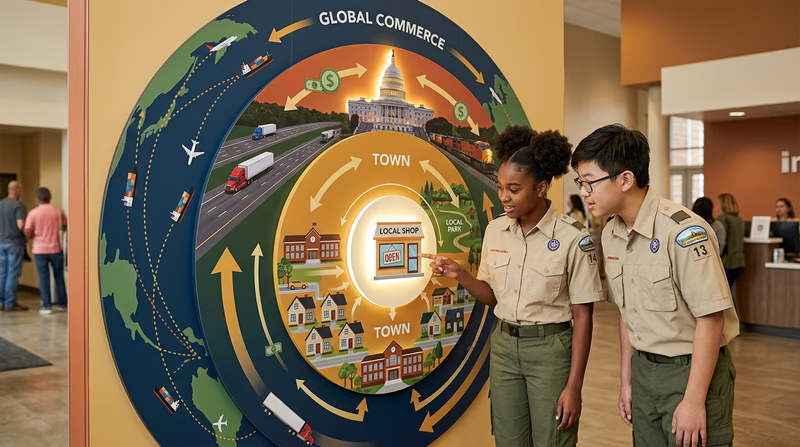
Every business, no matter how small, creates ripples in the economy. When a new restaurant opens in your town, it hires employees, buys supplies from other businesses, pays taxes, and gives people a place to spend their money. Those ripples spread outward — from your neighborhood to the nation to the world.
Understanding these connections will help you see why business matters at every level.
Local Impact
Your local economy is the one you can see and touch. It is the shops on Main Street, the employers in your community, and the tax base that funds your schools and parks.
Jobs and income. Local businesses are often the largest employers in a community. When a factory, hospital, or retail center opens, it brings jobs. Workers earn wages and spend that money at other local businesses — grocery stores, gas stations, restaurants — creating even more jobs. Economists call this the multiplier effect.
Tax revenue. Businesses pay property taxes, sales taxes, and licensing fees that fund local government services — everything from road repairs to fire departments to public libraries.
Community identity. Businesses shape the character of a town. Think about your own community — the restaurants, shops, and services that make it unique are all part of the local business landscape.
National Impact
When you zoom out from your community, business activity adds up to the national economy — the total value of all goods and services produced in the country, measured as Gross Domestic Product (GDP).
Employment. American businesses collectively employ over 160 million people. Major industries like healthcare, retail, technology, manufacturing, and finance each support millions of workers and families.
Innovation. American businesses drive technological and scientific progress. The smartphone in your pocket, the medications at the pharmacy, and the streaming service you watch at night all came from businesses investing in research and development.
Trade. American businesses sell their products to customers around the world (exports) and buy materials and goods from other countries (imports). This trade activity connects the U.S. economy to every other nation.
Standard of living. Business productivity — how efficiently goods and services are produced — directly affects how well people live. When businesses operate efficiently, products become more affordable and wages can rise.
Global Impact
American businesses do not operate in isolation. The global economy connects countries through trade, investment, and shared supply chains.
Supply chains. A single product might involve raw materials from South America, manufacturing in Asia, design in California, and sales across Europe. Global supply chains make products cheaper and more varied, but they also mean that a disruption in one country — like a natural disaster or a trade dispute — can affect businesses thousands of miles away.
Multinational corporations. Companies like Apple, Amazon, and Coca-Cola operate in dozens of countries. Their decisions about where to build factories, hire workers, and sell products have enormous impact on local economies around the world.
Currency and trade agreements. The value of the U.S. dollar, trade agreements between countries, and tariffs (taxes on imported goods) all influence how businesses compete globally. When the dollar is strong, American products are more expensive for foreign buyers. When it is weak, American exports become more competitive.
Shared challenges. Climate change, labor standards, and economic inequality are global issues that businesses both contribute to and can help solve. Increasingly, companies are expected to consider their impact on the world, not just their bottom line.
Discussion Prep
Points to cover with your counselor
- Local: How businesses create jobs, pay taxes, and shape your community
- National: How business drives GDP, innovation, and the standard of living
- Global: How supply chains, trade, and multinational companies connect the world’s economies
- The multiplier effect: How one business’s activity creates ripple effects
You have completed the foundations. Now it is time to follow the money — starting with the financial statements that every business uses to keep score.