Extended Learning
A. Introduction
You have completed the American Cultures merit badge — congratulations! You have attended cultural events, imagined new worlds, compared traditions, researched remarkable people, and led a discussion on understanding. But the real work of cultural understanding does not stop when the badge is earned. The more you learn about the people around you, the richer your world becomes.
B. Deep Dive: The Power of Food as a Cultural Bridge
One of the fastest ways to connect with a different culture is through its food. Every dish tells a story — of geography, history, trade, migration, and family. When you sit down to eat food from another culture, you are experiencing centuries of tradition in a single bite.
Consider how many “American” foods actually come from other cultures. Pizza arrived with Italian immigrants. Tacos came from Mexican culinary traditions. Sushi was introduced by Japanese Americans. Gumbo was born from the blending of West African, French, Spanish, and Native American cooking traditions in Louisiana. Even the hamburger traces its roots to German immigrants from Hamburg.
Food also shows how cultures change when they meet. Tex-Mex cuisine is not Mexican food and it is not Texan food — it is something entirely new that was created when two traditions collided and collaborated. Korean-Mexican fusion tacos, which became a sensation in Los Angeles, were invented by a Korean American chef who grew up eating both cuisines. These blended dishes are living proof that cultural mixing creates something greater than the sum of its parts.
If you want to go deeper, try cooking a dish from one of the cultures you studied. Find an authentic recipe — ideally from a member of that community or a cookbook written by someone from that background. Pay attention to the ingredients, the techniques, and the way the meal is meant to be shared. Better yet, cook with someone from that culture and learn the stories behind the recipes. You will discover that a kitchen is one of the best classrooms in the world.
C. Deep Dive: How Language Shapes Culture
Language is far more than a tool for communication — it is a window into how a culture sees the world. The words a language has (and the words it lacks) reveal what that culture values, fears, celebrates, and prioritizes.
For example, the Inuit languages of Alaska and northern Canada have dozens of words for different types of snow and ice, reflecting the critical importance of understanding frozen landscapes for survival. The Japanese concept of wabi-sabi — finding beauty in imperfection and impermanence — has no direct English translation because it reflects a philosophical outlook deeply rooted in Japanese culture. The Spanish word sobremesa describes the time spent lingering at the table after a meal, talking and enjoying each other’s company. English does not have a word for this because the concept is not as culturally central — but many Hispanic families practice it every day.
In the United States, language diversity is staggering. More than 350 languages are spoken across the country. Spanish is spoken by over 40 million people. Chinese (in its many dialects), Tagalog, Vietnamese, Arabic, French, Korean, and German each have millions of speakers. And there are approximately 170 Native American languages still spoken, though many are endangered — some by only a handful of elderly speakers.
Learning even a few words in another language is a powerful act of respect. When you greet someone in their native language, you are saying, “I see you. Your culture matters.” You do not need to become fluent — even learning to say “hello,” “thank you,” and “please” in another language opens doors and builds goodwill.
D. Deep Dive: Being a Cultural Ally
Understanding other cultures is valuable on its own, but the real impact comes when you put that understanding into action. Being a “cultural ally” means using what you know to stand up for people who are being treated unfairly because of their background — even when it is uncomfortable.
What does that look like in practice? It starts small. If someone at school makes a joke that stereotypes a cultural group, an ally speaks up — not with anger, but with honesty: “That is not cool. That is a real group of people you are talking about.” If a classmate is being excluded because they dress differently, speak with an accent, or practice an unfamiliar religion, an ally makes space for them — sits with them at lunch, asks about their day, treats them like a person rather than an outsider.
Being an ally also means educating yourself. Do not rely on people from other groups to explain their entire culture to you. Read books by authors from different backgrounds. Watch films and documentaries that tell stories from perspectives different from your own. Follow news sources that cover communities you do not normally hear about. The more you know, the better equipped you are to challenge stereotypes when you encounter them.
It also means being humble. You will make mistakes. You might mispronounce a name, misunderstand a custom, or say something unintentionally insensitive. When that happens, apologize sincerely, learn from it, and move on. Nobody expects perfection — but people do notice effort.
The Scout Law says a Scout is friendly, courteous, and kind. Being a cultural ally is simply living those values across the lines of race, ethnicity, and religion. It is Scouting at its best.
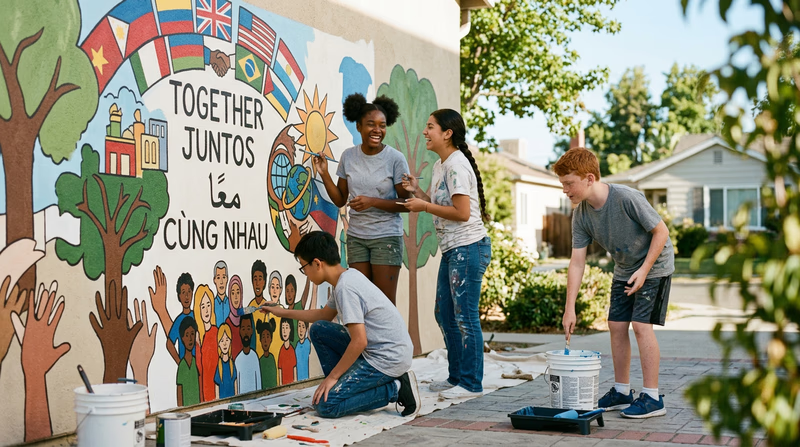
E. Real-World Experiences
Take your cultural learning beyond the badge with these hands-on experiences.
Attend a Powwow
Visit the Smithsonian National Museum of African American History and Culture
Volunteer at a Refugee Resettlement Organization
Take a Cultural Walking Tour
Participate in an Interfaith Dialogue
F. Organizations
These organizations are dedicated to cultural understanding, preservation, and education.
Part of the Smithsonian, dedicated to the life, languages, literature, history, and arts of Native Americans.
Works to stop the defamation of the Jewish people and to secure justice and fair treatment for all. Offers educational programs on bias and bullying.
America’s oldest and largest civil rights organization, working to ensure the political, educational, social, and economic equality of all people.
A national affiliation of five organizations advancing the civil and human rights of Asian Americans and Pacific Islanders through advocacy, education, and litigation.
The largest national Hispanic civil rights and advocacy organization in the United States, working on issues from education to immigration to health.
Builds interfaith cooperation on college campuses and in communities, helping young people from different religious and non-religious backgrounds work together on shared concerns.