Req 1 — Cultural Experiences
This requirement is your chance to step into someone else’s world. You will choose two of the five options below, and each one must involve a different cultural group. For example, you might attend a Diwali festival (Hindu tradition) for one option and visit a historically Black university for another.
Before you dive in, take a moment to think about the groups you want to explore. Choose communities that are genuinely new to you — that is where the real learning happens.
Option A: Attend a Festival or Celebration
Cultural festivals are some of the most exciting and welcoming ways to experience another group’s traditions. Many communities hold public celebrations that are open to everyone.
What to look for:
- Food — What dishes are served? What ingredients and flavors are common?
- Music and dance — Are there live performances? What instruments are used?
- Clothing — Do people wear traditional dress? What does it represent?
- Rituals or ceremonies — Are there speeches, prayers, or symbolic acts?
- Art and crafts — Are there displays, demonstrations, or items for sale?
Where to find festivals:
- Local community calendars and event listings
- Cultural centers and community organizations
- City or county websites listing public events
- Social media pages for local cultural groups
Option B: Visit a Place of Worship, School, or Institution
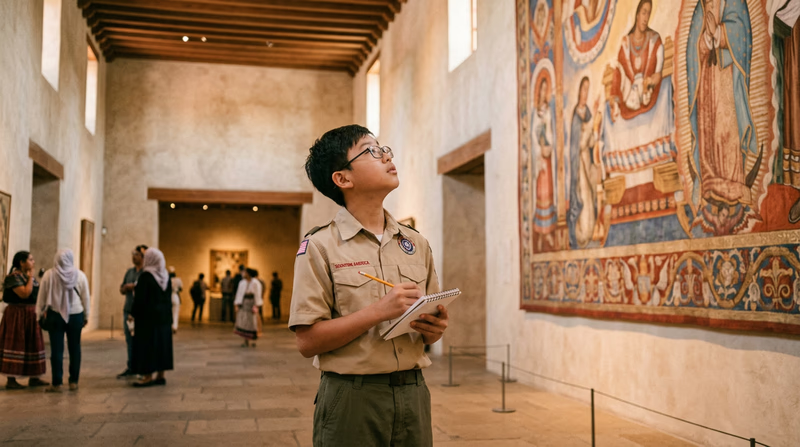
Institutions tell you a lot about what a community values. A place of worship reveals spiritual beliefs and rituals. A school shows how a community educates its children and preserves its language. A cultural center or museum shows how a group wants to be remembered and understood.
Ideas for visits:
- A mosque, synagogue, temple, gurdwara, or church serving a community different from your own
- A tribal college or historically Black college or university (HBCU)
- A cultural heritage center or community organization
- A language school (Chinese school, Hebrew school, etc.)
What to observe:
- How is the space designed? What symbols, artwork, or architecture stand out?
- What activities take place there? Services, classes, community meals?
- How does the institution connect people within the group?
- What role does it play in the surrounding neighborhood?
Option C: Talk with a Person from the Group
A one-on-one conversation can teach you things no book or website ever could. Hearing someone describe their own heritage — in their own words — gives you a personal connection to a culture that statistics and history lessons cannot match.
How to find someone to talk to:
- Ask your merit badge counselor, Scout leader, or teacher for a recommendation
- Reach out to local cultural organizations or community leaders
- Talk to classmates, neighbors, or family friends from a different background
Good questions to ask:
- “What traditions are most important to your family?”
- “What holidays or celebrations do you observe?”
- “What is something about your heritage that you wish more people understood?”
- “How do you keep your traditions alive in everyday life?”
- “What has changed about your community’s traditions over time?”
Option D: Learn and Teach a Song, Dance, Poem, or Story
This option asks you to go beyond observing — you actually learn a piece of a culture and then share it with others. Teaching something forces you to understand it deeply. And when you share a tradition with your friends, you are building a small bridge between cultures.
What to choose:
- Songs — folk songs, spirituals, hymns, or traditional melodies. Many cultural traditions have songs that tell stories or mark important moments.
- Dances — folk dances, ceremonial dances (only if appropriate to share), or social dances tied to a cultural tradition.
- Poems — classic or traditional poetry from a culture’s literary heritage.
- Stories — folk tales, creation stories, or oral history traditions.
Where to learn:
- Ask a member of the cultural group to teach you directly (this counts for Option C too!)
- Visit your local library for recordings, books of folk tales, or poetry anthologies
- Look for community classes or workshops in traditional dance or music
- Museums and cultural centers often have educational programs
When you teach it:
- Explain the cultural background — where does this song, dance, poem, or story come from? What does it mean to the people who created it?
- Be respectful of the tradition’s significance. Some cultural expressions are sacred and not meant to be performed casually — if in doubt, ask a member of the group.
- Have fun with it! Your friends will learn something new, and you will gain confidence as a cultural ambassador.
Option E: Visit a Library or Museum Program
Libraries and museums are treasure troves of cultural knowledge. Many host rotating exhibits, film screenings, lectures, and hands-on programs that bring a culture to life.
Where to look:
- Local public libraries — Check their events calendar for cultural programs, author talks, or film series
- History museums — State and local history museums often feature exhibits on the communities that shaped the region
- National museums — The Smithsonian Institution has multiple museums dedicated to cultural heritage (see links below)
- University museums and galleries — College campuses often host free exhibits on cultural topics
What to pay attention to:
- What story is the exhibit or program telling? Whose perspective is represented?
- What artifacts, images, or media are used to tell the story?
- What surprised you? What did you learn that you did not know before?
- How does this group’s history connect to the broader American story?
Writing Your Report
No matter which two options you choose, you will need to report on what you see and learn. Your report does not need to be a formal essay — but it should be thoughtful. Here is a framework:
Report Framework
Cover these points in your report
- Which cultural group did you explore?
- What specific event, place, person, or program did you engage with?
- What did you observe or learn that was new to you?
- What traditions or values seem especially important to this group?
- How did this experience change or expand your understanding?
Now that you have experienced two different cultures firsthand, you are ready to start thinking more deeply about what happens when cultures share the same space.