Req 5 — Leading a Discussion
This is the capstone of the American Cultures merit badge. Everything you have learned — the festivals you attended, the customs you compared, the contributions you researched — comes together here. You will share what you have discovered and then guide your audience through a real conversation about understanding across differences.
This requirement has two parts: a talk (you present information) and a discussion (you ask questions and help others share their ideas). Both matter.
Part 1: Your Talk
Your talk should be 5–10 minutes long and cover how people from different cultural groups have lived alongside each other in America — the good, the hard, and the hopeful.
Planning Your Talk
Start with an outline. Here is a structure that works well:
Opening (1–2 minutes):
- Hook your audience with a surprising fact, a personal story from your badge work, or a question
- Tell them what you are going to talk about
Body (3–5 minutes):
- Share examples of how different groups have gotten along — real stories of cooperation, shared traditions, or moments when people came together across differences
- Be honest about challenges too — misunderstanding and prejudice are part of the story
- Use specific examples from your own badge experiences (festivals, conversations, research)
Closing (1–2 minutes):
- Summarize your main point
- Bridge into the discussion by posing a question to the group
Delivery Tips
Talk Delivery Checklist
Before and during your talk
- Practice your talk at least twice out loud before the real thing.
- Make eye contact with different people in the audience.
- Speak slowly and clearly — nerves make most people rush.
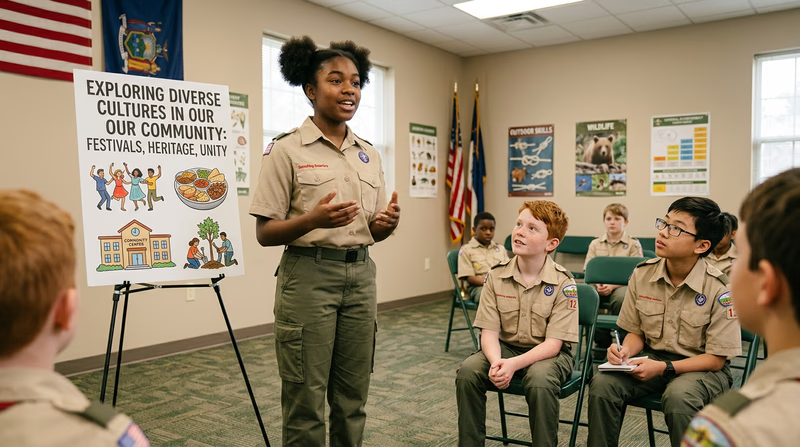
- Use a visual aid if it helps (a poster, a map, photos from your badge experiences).
- Keep your notes on index cards, not a full script. Talk to your audience, not at your paper.
- It is okay to be nervous. Your audience wants you to succeed.
Part 2: Leading the Discussion
After your talk, you shift from presenter to facilitator. Your job is no longer to share your ideas — it is to help others share theirs.
Good Discussion Questions
Here are some questions you can use to get the conversation started:
About personal experience:
- “Has anyone here attended a cultural event or celebration different from their own? What was it like?”
- “Have you ever had a friend from a very different background? What did you learn from each other?”
About understanding:
- “Why do you think misunderstandings happen between different groups?”
- “What is the difference between knowing about a culture and actually understanding it?”
About action:
- “What could our Scout unit (or school) do to help people from different backgrounds understand each other better?”
- “What is one thing each of us could do this week to learn about a group different from our own?”
How to Facilitate Well
Leading a discussion is different from giving a talk. Here is how to do it:
Listen more than you talk. Your role is to guide, not lecture. After asking a question, wait. Give people time to think. Silence is okay.
Encourage participation. If the same two people are doing all the talking, gently invite others: “What do other people think?” or “Does anyone have a different perspective?”
Stay neutral. As the facilitator, your job is to keep the conversation respectful and productive — not to push your own opinion. If someone says something you disagree with, ask a follow-up question rather than correcting them.
Handle disagreement with respect. If people disagree, that is healthy. Say something like, “It sounds like we have different perspectives on this — can each of you explain why you see it that way?” Keep the tone curious, not confrontational.
Wrap up with action. End the discussion by asking: “Based on what we have talked about, what is one thing we could actually do?” A discussion that leads to action is more powerful than one that stays abstract.
Learning for Justice — Facilitating Critical Conversations Practical strategies for leading productive conversations about culture, identity, and justice — useful for anyone facilitating a group discussion.Putting It All Together
This requirement brings your entire American Cultures journey full circle. You started by exploring cultures firsthand. You imagined how cultures shape societies. You compared customs and found common ground. You researched individuals who made America stronger. And now you are helping others think about these ideas too.
The ability to talk about culture respectfully, listen to different perspectives, and help people find common ground is one of the most valuable skills you can develop — not just for Scouting, but for life.