American Heritage Merit Badge — Complete Digital Resource Guide
https://merit-badge.university/merit-badges/american-heritage/guide/
Introduction & Overview
American Heritage is about understanding the ideas, people, symbols, and stories that shaped the United States. It is more than memorizing dates — it is discovering why those dates matter and how the past connects to your life right now.
This merit badge invites you to explore the founding documents that launched a nation, the leaders and everyday citizens who changed its course, and the symbols that unite Americans across generations. You will also dig into local history and your own family’s story — because American heritage is not just something in a textbook. It is something you carry with you.
Then and Now
Then — Building a New Nation
In 1776, a group of colonists did something radical: they wrote down exactly why they believed they had the right to govern themselves. The Declaration of Independence was not just a letter to a king — it was a promise to the world that ordinary people could build a nation based on liberty and equality. From that moment forward, each generation of Americans has wrestled with what those ideals actually mean in practice.
- Key moments: The Revolutionary War, the writing of the Constitution, westward expansion, the Civil War, the civil rights movement
- Big idea: Every generation inherited the promise — and the responsibility — of making those founding ideals real for more people
Now — Heritage in a Connected World
Today, Americans engage with their heritage in ways the founders never imagined. You can browse the original Declaration of Independence online at the National Archives, take a virtual tour of a Civil War battlefield, or record your grandparents’ stories on your phone. Heritage preservation is now a recognized profession, and communities across the country work to protect the places and traditions that tell America’s story.
- Key moments: National Register of Historic Places, digital archives, ongoing debates about monuments and memory
- Big idea: Heritage is not frozen in the past — it is a living conversation about who we are and who we want to be
Get Ready! You are about to explore some of the most powerful ideas in human history — and discover how they connect to your hometown, your family, and your future. Let’s dig in.
Kinds of American Heritage
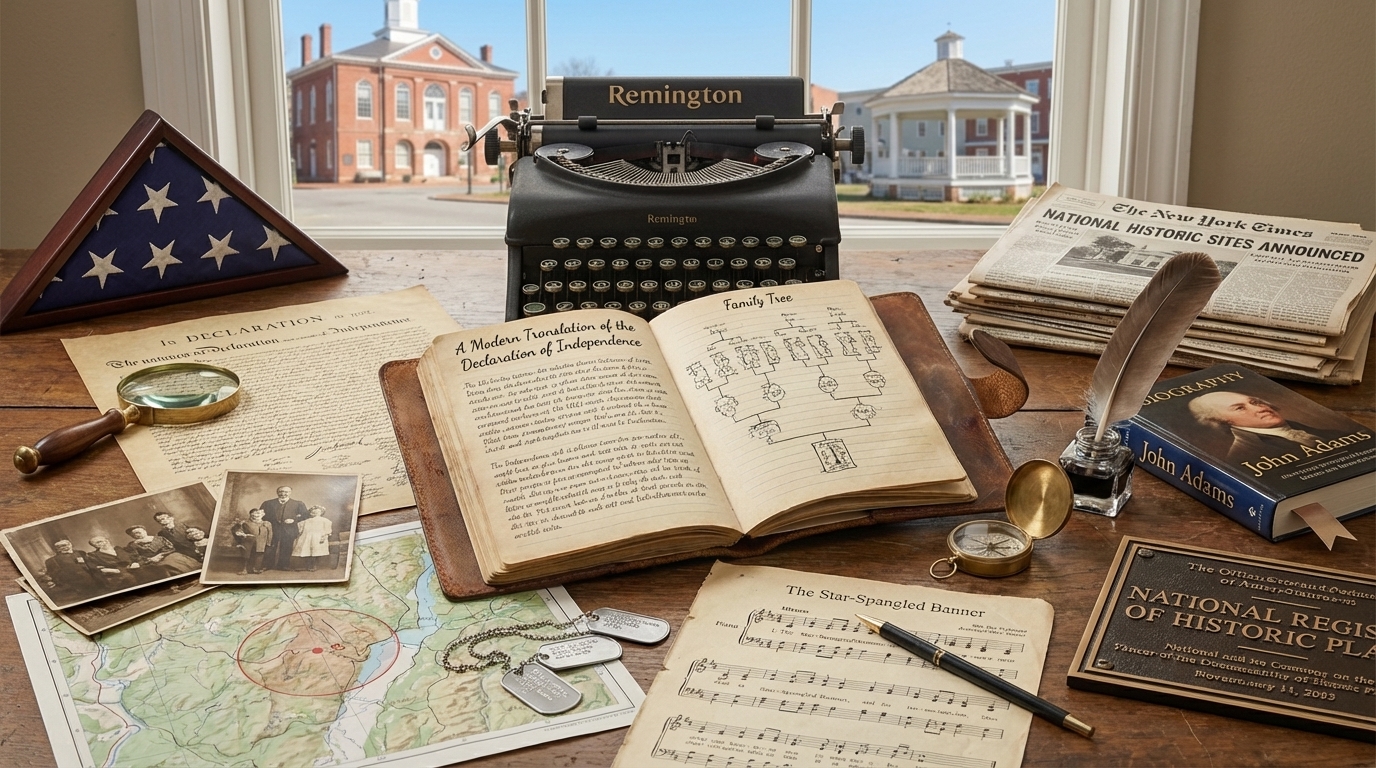
American heritage is not one thing — it is a rich tapestry woven from many threads. Here are the major categories you will explore in this merit badge.
Documents & Ideas
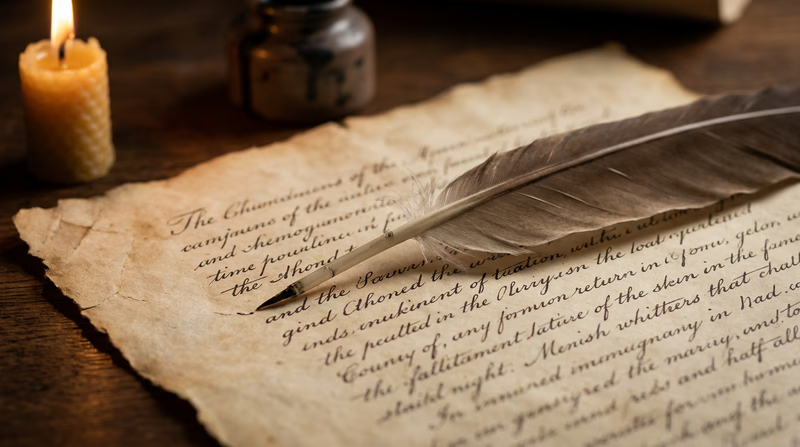
The Declaration of Independence, the Constitution, and the Bill of Rights are more than old papers under glass. They are the operating instructions for a democracy. The ideas in these documents — liberty, equality, self-governance — have inspired movements around the world and continue to shape American law and life.
People & Movements
From presidents and generals to writers, activists, and ordinary citizens, American heritage is shaped by people who stood up for what they believed. Some are famous — like Abraham Lincoln and Harriet Tubman. Others are people whose names you may never learn, but whose courage changed the country.
Symbols & Traditions
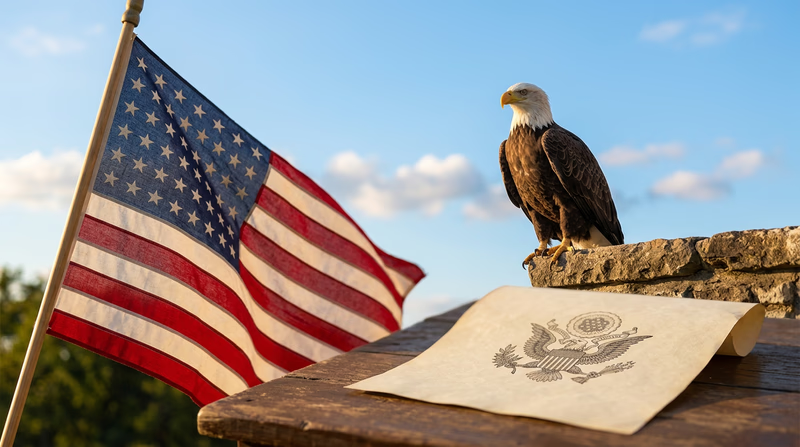
The American flag, the Pledge of Allegiance, the Great Seal, the national anthem, the bald eagle — these symbols carry deep meaning. They unite a diverse nation under shared ideals. Understanding where they came from and how they have changed over time helps you appreciate what they represent.
Places & Landmarks
Every community has places where history happened. Battlefields, courthouses, trails, homes, and monuments tell stories that textbooks cannot capture. The National Register of Historic Places recognizes more than 95,000 properties across the country — and there is almost certainly one near you.
Stories & Culture
Music, film, literature, and family stories are powerful ways to experience heritage. A folk song from the Civil War era can make you feel what soldiers felt. A family immigration story can connect you to a chapter of American history that is uniquely yours.
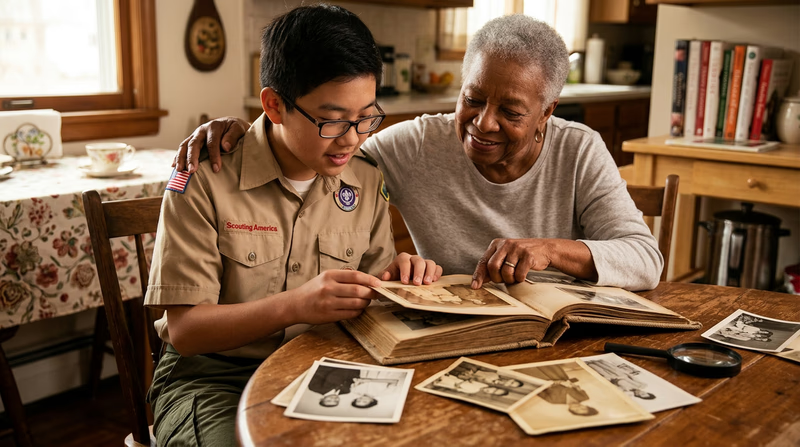
Now that you know what American Heritage is all about, it is time to start with the document that launched a nation.
Req 1 — The Declaration of Independence
Understanding the Declaration
The Declaration of Independence was adopted on July 4, 1776, by the Second Continental Congress. It announced that the thirteen American colonies were breaking away from British rule — and, more importantly, it explained why.
The document was primarily written by Thomas Jefferson, with input from Benjamin Franklin, John Adams, and others. It was not written overnight. Jefferson spent about seventeen days drafting and revising before the committee reviewed it, and Congress debated and edited it further.
The Declaration has three main parts:
- The Preamble — States the purpose: to explain why the colonies are separating from Britain.
- The Statement of Rights — Lays out the philosophy of natural rights and government by consent. This is the section you will focus on for this requirement.
- The List of Grievances — Details the specific complaints against King George III.
The Key Passage — Line by Line
The section you need to rewrite begins with “We hold these truths to be self-evident” and ends with “to provide new Guards for their future security.” Here is a breakdown of its big ideas to help you understand what Jefferson was saying.
Big Ideas in the Passage
- Self-evident truths: Some things are so obviously true that they do not need proof.
- All men are created equal: Every person is born with the same basic worth and dignity.
- Unalienable rights: Rights that cannot be taken away — life, liberty, and the pursuit of happiness.
- Consent of the governed: Government gets its power from the people, not the other way around.
- Right to alter or abolish: If a government stops protecting people’s rights, the people have the right to change it or replace it.
Tips for Rewriting
This requirement asks you to translate 18th-century language into modern, easy-to-understand words. Here are some strategies:
- Break long sentences into short ones. Jefferson’s sentences can be over 100 words long. Chop them up.
- Replace old-fashioned words. “Self-evident” means “obvious.” “Unalienable” means “cannot be taken away.” “Endowed by their Creator” means “given by God” or “born with.”
- Use everyday examples. When Jefferson talks about government power coming from the people, think about elections and voting.
- Keep the meaning, change the words. Your version should say the same thing — just in language that a younger kid could understand.
Why the Declaration Still Matters
The Declaration of Independence is not just a historical curiosity. It is a living document that Americans still turn to when they debate rights, equality, and justice.
- Abraham Lincoln quoted it in the Gettysburg Address to argue that the Civil War was about preserving the ideal that “all men are created equal.”
- Frederick Douglass challenged America to live up to the Declaration’s promises in his famous 1852 speech, “What to the Slave Is the Fourth of July?”
- Martin Luther King Jr. referenced it in his “I Have a Dream” speech, calling the Declaration a “promissory note” that America had not yet fully honored.
- The women’s suffrage movement modeled the Declaration of Sentiments (1848) directly on Jefferson’s language.
The ideas in this passage are not just about 1776. They are about what kind of country America aspires to be — and that conversation is still happening today.
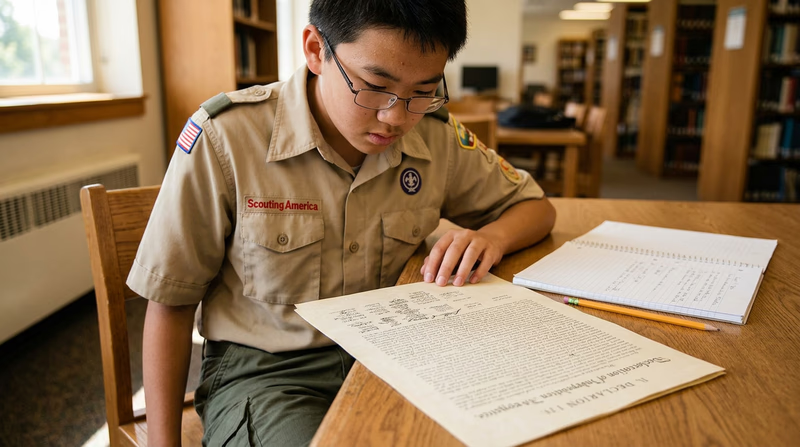
Discussing with Your Counselor
When you meet with your counselor, be ready to:
- Share your rewritten version and explain the choices you made in your translation.
- Discuss why the Declaration matters — not just in 1776, but today.
- Talk about the gap between the Declaration’s ideals and the reality of American history. The founders wrote “all men are created equal” while many of them enslaved people. How has America worked to close that gap over time?
Now that you have explored the Declaration, it is time to meet the people — leaders and citizens — who shaped American heritage.
Req 2 — American Leaders & Change-Makers
Choose TWO of the four options below. Each one explores a different way that people and organizations have shaped America’s heritage. Read through all four options to decide which two interest you most.
Option A: Political Leader & Private Citizen
This option asks you to explore how different kinds of people shape a country. Political leaders pass laws and lead armies — but writers, activists, and religious leaders change the way people think.
Choosing Your Two People
Pick people who genuinely interest you. Here are some starting points, but you are free to choose anyone:
Political leaders — presidents, senators, Supreme Court justices, governors, members of Congress
Private citizens — writers, inventors, religious leaders, artists, scientists, activists, educators
How to Compare
Once you have researched both people, think about these questions:
- What problems did each person face?
- How did each person use their position (leader vs. citizen) to make change?
- Could the private citizen have accomplished the same thing as a political leader — or vice versa?
- Whose contribution has lasted longer? Why?
Option B: An Organization That Changed America
Many of the biggest changes in American history were driven not by a single person but by organized groups of people working together toward a shared goal.
What Counts as an Organization?
Any group that worked to make a positive change in American society qualifies. Here are some categories to consider:
- Civil rights organizations — groups that fought for equal rights
- Conservation organizations — groups that protected land, water, and wildlife
- Service organizations — groups like the Red Cross, Salvation Army, or Habitat for Humanity
- Labor organizations — unions that fought for fair wages and safe working conditions
- Civic organizations — groups that promoted education, voting, or community improvement
Research Framework
When studying your chosen organization, find out:
- When and why was it founded? What problem was it trying to solve?
- What actions did it take? (campaigns, lawsuits, lobbying, direct service)
- What changed because of its work?
- How does it connect to larger themes in American history?
Option C: Interview Two Veterans
Veterans carry firsthand knowledge of American history that you will not find in any book. Their stories connect national events to personal experience.
Finding Veterans to Interview
- Members of your family or your troop
- Local Veterans of Foreign Wars (VFW) or American Legion posts
- Community organizations or houses of worship
- Veterans’ service organizations
Interview Tips
Interview Preparation
Steps to prepare for a great interview- Contact the veteran in advance: Explain who you are, why you want to interview them, and how long it will take.
- Prepare questions ahead of time: Write down 8–10 open-ended questions.
- Bring a notebook and pen: Take notes during the interview (ask permission first if you want to record).
- Listen more than you talk: Let the veteran tell their story in their own way.
- Say thank you: A handwritten thank-you note goes a long way.
Good questions to ask:
- What branch did you serve in, and when?
- What was your role or job?
- What was the most meaningful experience you had during your service?
- What do you believe your service accomplished?
- What do you wish more people understood about military service?
Option D: Interview Three Community Members
This option helps you discover that American heritage is not just one story — it is millions of stories. Different people experience America differently depending on their age, background, and life experiences.
Choosing Your Three People
Pick people of different ages and occupations — that is the key. The more diverse your interviewees, the richer your results.
Examples:
- A teenager and a senior citizen
- A teacher and a business owner
- A recent immigrant and someone whose family has been here for generations
What to Ask
The requirement gives you three main questions, but you can add your own:
- What does America mean to you?
- What do you think is special about this country?
- What American traditions do you feel are important to preserve?
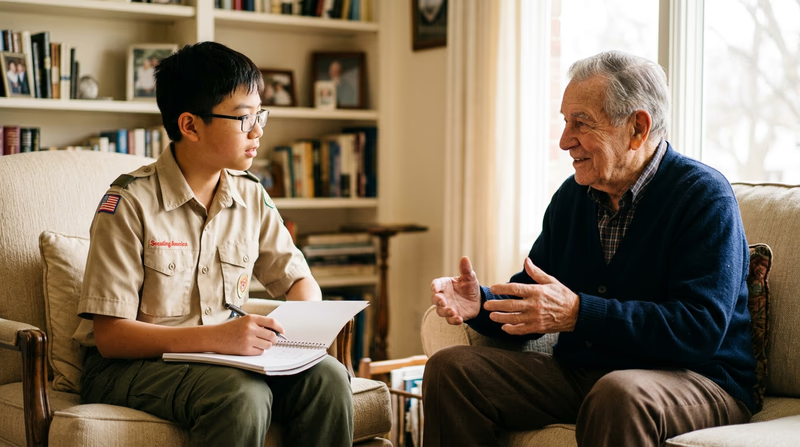
You have explored how leaders, citizens, organizations, and veterans have shaped America. Now let’s look at how the past connects to the present.
Req 3a — America in the News
Connecting Today to Yesterday
The news can feel disconnected from history class, but almost every major issue in America today has roots in the past. Immigration policy connects to waves of migration going back centuries. Debates about government power echo arguments the founders had in 1787. Even technology issues — like online privacy — connect to the Fourth Amendment’s protection against unreasonable searches.
This requirement asks you to be a detective. Pick something happening right now and trace its historical DNA.
How to Choose a Topic
Your topic should be:
- Currently in the news — something being reported on right now
- Related to the United States — it can be domestic or international, but it must connect to America
- Interesting to you — you will do better work if you care about the topic
Where to Find Good News Sources
Not all news sources are equally reliable. Look for sources that are well-established and fact-checked:
PBS NewsHour — Student Reporting Labs News stories and media literacy resources designed for students. A great starting point for finding current events. Link: PBS NewsHour — Student Reporting Labs — https://studentreportinglabs.com/Other reliable sources include the Associated Press (AP News), NPR, BBC News, and your local newspaper. Many libraries provide free access to news databases too.
Tracing the Historical Connection
Once you have chosen a topic, use this framework to connect it to American history:
Step 1: Describe What Is Happening
Write a short summary (3–5 sentences) of your news topic. Cover the basics: Who is involved? What is happening? Where? When did it start?
Step 2: Identify the Historical Roots
Ask yourself:
- Has this kind of issue come up before in American history?
- What laws, events, or movements from the past are connected?
- What values from America’s founding documents (Declaration, Constitution, Bill of Rights) are at play?
Step 3: Explain the Connection
This is the most important part. Draw a clear line between the past and the present. For example:
- A story about voting rights → the 15th, 19th, and 26th Amendments, the Voting Rights Act of 1965
- A story about immigration → Ellis Island, the Immigration Act of 1924, the Immigration and Nationality Act of 1965
- A story about free speech → the First Amendment, landmark Supreme Court cases
Talking to Your Counselor
When you discuss your topic, be prepared to:
- Clearly describe the current event
- Name specific historical events, laws, or values that connect to it
- Explain how the past influenced what is happening today
- Share your own opinion about whether America has made progress on this issue
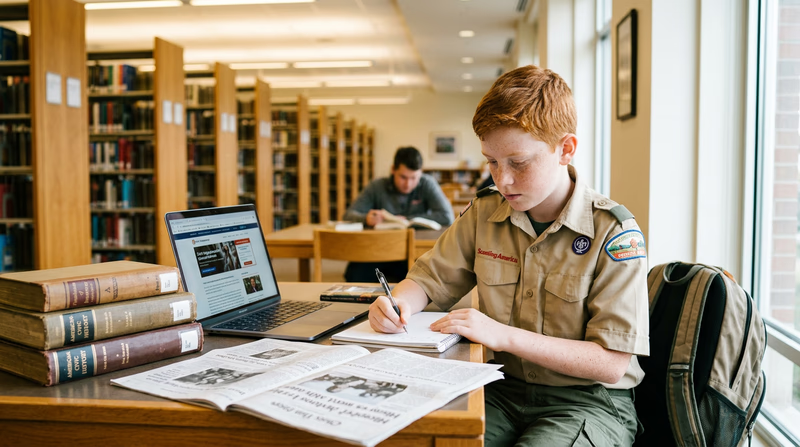
Next up: the symbols that represent America — and the stories behind them.
Req 3b — National Symbols
America’s National Symbols
Every nation has symbols that represent its identity. The United States has five official symbols you need to know for this requirement. For each one, you will need to know three things: when and how it was adopted, how it has changed over time, and how it still influences Americans today.
The Flag
Adoption
The Continental Congress passed the Flag Resolution on June 14, 1777, establishing that the flag would have thirteen alternating red and white stripes and thirteen white stars on a blue field — one stripe and one star for each original colony. The resolution did not specify the arrangement of the stars, which is why early flags varied in design.
Changes
The flag has been redesigned 27 times. The most significant changes came as new states joined the Union. In 1818, Congress passed a law fixing the number of stripes at thirteen (to honor the original colonies) and adding a new star for each new state. The current 50-star flag was designed in 1958 by Robert Heft, a 17-year-old high school student from Ohio, as a class project.
Influence Today
The flag is present at nearly every public event, school, and government building in the country. The U.S. Flag Code provides guidelines for how the flag should be displayed and respected. Flag Day is celebrated on June 14, and the Pledge of Allegiance is recited in schools and at public gatherings across the nation.
The Pledge of Allegiance
Adoption
The original Pledge was written in 1892 by Francis Bellamy, a Baptist minister and magazine editor. It was first published in The Youth’s Companion magazine as part of a national campaign to celebrate the 400th anniversary of Columbus’s arrival in the Americas. Congress officially recognized the Pledge in 1942.
Changes
The Pledge has been modified four times. The most notable change came in 1954, when Congress added the words “under God” during the Cold War era to distinguish the United States from officially atheist communist nations. The original 1892 version read: “I pledge allegiance to my Flag and the Republic for which it stands, one nation, indivisible, with liberty and justice for all.”
Influence Today
The Pledge is recited daily in many American schools and at the opening of legislative sessions, public meetings, and Scouting events. It remains a visible expression of national unity, though debates about the “under God” phrase continue.
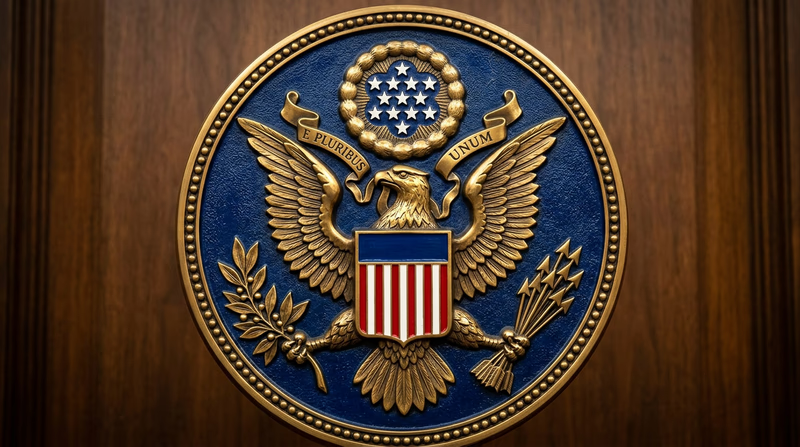
The Great Seal of the United States
Adoption
Congress appointed a committee to design the Great Seal on July 4, 1776 — the same day the Declaration of Independence was adopted. It took six years and three committees before the final design was approved on June 20, 1782. Charles Thomson, the Secretary of Congress, combined the best elements from all three committees’ proposals into the final version.
The Design
- Front (obverse): A bald eagle holding an olive branch (peace) in one talon and thirteen arrows (defense) in the other. A ribbon in its beak reads E Pluribus Unum (“Out of Many, One”). A shield with thirteen red and white stripes covers the eagle’s chest.
- Back (reverse): An unfinished pyramid with thirteen steps, topped by the Eye of Providence. Two Latin phrases appear: Annuit Coeptis (“He has favored our undertakings”) and Novus Ordo Seclorum (“A New Order of the Ages”).
Influence Today
The Great Seal appears on every dollar bill, on U.S. passports, and on official government documents. The bald eagle from the seal became America’s national bird and is one of the most recognized symbols of the United States worldwide.
The Motto
Adoption
The United States has two well-known mottos. E Pluribus Unum (“Out of Many, One”) has appeared on the Great Seal since 1782 and on coins since 1795. However, the official national motto is “In God We Trust,” which was adopted by Congress in 1956.
Changes
“In God We Trust” first appeared on U.S. coins during the Civil War in 1864, when the nation was deeply divided and many Americans sought to acknowledge faith on their currency. It became the official national motto by law in 1956, and has appeared on all U.S. paper currency since 1957.
Influence Today
You will find the motto on every piece of U.S. currency and in many government buildings, including above the Speaker’s rostrum in the U.S. House of Representatives. Both mottos reflect core American values — unity across diversity and trust in a higher purpose.
The National Anthem
Adoption
“The Star-Spangled Banner” was written by Francis Scott Key on September 14, 1814, after he watched the British bombardment of Fort McHenry during the War of 1812. Key was aboard a British ship negotiating a prisoner release and watched the battle through the night. When dawn broke and the American flag was still flying over the fort, he was inspired to write the poem that became the anthem. Congress officially designated it as the national anthem in 1931.
Changes
The original poem, “Defence of Fort M’Henry,” had four stanzas. Only the first is commonly sung today. The melody comes from a popular British song called “To Anacreon in Heaven.” Over the years, performance traditions have evolved — from military bands to solo vocalists at sporting events.
Influence Today
The national anthem is performed at the start of sporting events, government ceremonies, and public gatherings across the country. Standing for the anthem is considered a sign of respect, and the song remains a powerful symbol of national resilience.
America's Founding Documents — National Archives Explore the Declaration of Independence, the Constitution, and the Bill of Rights — plus detailed historical context. Link: America's Founding Documents — National Archives — https://www.archives.gov/founding-docsPreparing for Your Counselor
For each of the five symbols, make sure you can describe:
- When and how it was adopted
- What has changed since its adoption
- How it influences Americans today
Now it is time to turn the lens inward — and explore your own family’s American story.
Req 3c — Your Family's Story
Your Family Is Part of American History
Every family in America has a story — and that story is woven into the larger fabric of the nation. Whether your ancestors arrived on the Mayflower, were brought to America against their will, crossed the border for a better life last year, or have lived on this land for thousands of years, your family’s experiences connect to the big events and movements of American history.
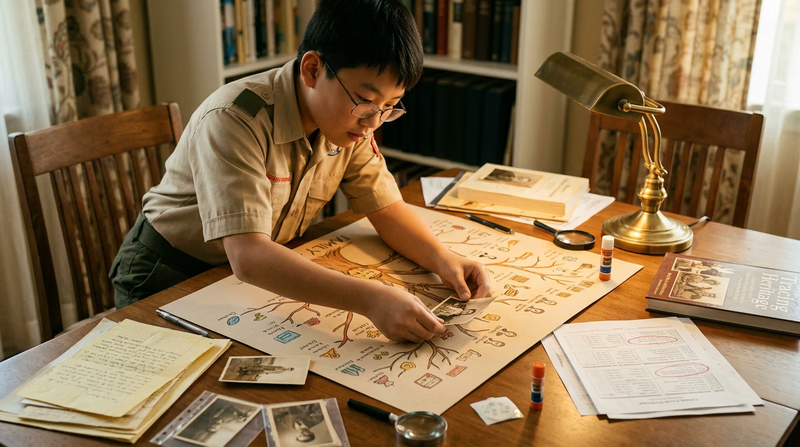
This requirement asks you to become a family historian. You will talk to relatives, dig through records, and discover how the forces of American history shaped your family’s path.
Where to Start
Talk to Your Family
The best source of family history is the people who lived it. Start with the oldest relatives you can reach — grandparents, great-aunts, great-uncles — and work your way through the generations.
Family Interview Questions
Questions to ask your relatives- Where did our family originally come from?
- When and why did our family come to America (if applicable)?
- Where have family members lived in the United States?
- Were any family members involved in wars, migrations, or major historical events?
- What jobs or trades did family members have?
- Are there any family stories or traditions that have been passed down?
- Do you have old photos, letters, or documents I could look at?
Search Online Records
After talking to relatives, you can dig deeper with free online tools:
FamilySearch Free genealogy research platform run by The Church of Jesus Christ of Latter-day Saints. Billions of historical records including census data, immigration records, and birth/death certificates. Link: FamilySearch — https://www.familysearch.org/ Ellis Island Passenger Search Search records of immigrants who arrived in New York through Ellis Island between 1892 and 1957. Link: Ellis Island Passenger Search — https://heritage.statueofliberty.org/Check Public Libraries
Many libraries have local history collections, old newspapers on microfilm, and access to genealogy databases. A librarian can help you find records specific to your area and family.
Connecting Family to History
Once you have gathered information, look for connections between your family’s experiences and major events in American history. Here are some examples:
| American Event | How It Might Have Affected Your Family |
|---|---|
| Revolutionary War (1775–1783) | Ancestors may have fought for independence or remained loyal to Britain |
| Westward Expansion (1800s) | Family may have migrated west for land, gold, or opportunity |
| Civil War (1861–1865) | Ancestors may have fought, been enslaved, or been freed |
| Immigration waves (1880s–1920s) | Family may have arrived at Ellis Island from Europe |
| Great Depression (1929–1939) | Family may have lost jobs, farms, or homes |
| World War II (1941–1945) | Family members may have served, worked in factories, or been interned |
| Civil Rights Movement (1950s–1960s) | Family may have participated in or been affected by the fight for equality |
| Post-1965 immigration | Family may have arrived from Asia, Latin America, Africa, or the Middle East |
What If You Cannot Find Much?
Not every family has detailed records. Adoption, displacement, slavery, and other circumstances can make tracing a family’s history difficult or impossible. If this is your situation, here are some approaches:
- Focus on what you know. Even one or two generations of family stories are valuable.
- Research the community where your family lived. Local history can fill in gaps.
- Explore broader patterns. If you know your family’s cultural background, research the experiences of that group in American history.
- Talk to your counselor. They can help you shape your research to fit your situation.
Sharing with Your Counselor
When you present your research, be ready to:
- Describe your family’s background and how they came to be where they are
- Connect at least one or two family experiences to specific American historical events
- If your family immigrated, explain the reasons why
- Share any interesting stories, photos, or documents you discovered
Time to step outside the history books and explore the history that is right in your own neighborhood.
Req 4 — Local History & Landmarks
Choose TWO of the five options below. Each one helps you explore history right where you live. No matter where you are in America, there is history within walking — or at least driving — distance.
Option A: The National Register of Historic Places
What Is the National Register?
The National Register of Historic Places is the official list of properties in the United States that are worthy of preservation because of their historical, architectural, or cultural significance. It is maintained by the National Park Service and includes more than 95,000 listings — buildings, sites, structures, objects, and districts.
Being listed on the National Register does not prevent a property owner from doing what they want with their property. It is an honorary designation that recognizes the property’s importance and may make it eligible for preservation grants or tax benefits.
How Does a Property Get Listed?
A property becomes eligible for the National Register if it meets at least one of four criteria:
- Association with significant events in American history
- Association with significant people in American history
- Distinctive design or construction — architectural significance
- Potential to yield important information — archaeological significance
The property must also generally be at least 50 years old, though exceptions exist for properties of exceptional importance.
National Register of Historic Places — Search by Location Search the National Register database to find listed properties near you. You can search by state, county, or city. Link: National Register of Historic Places — Search by Location — https://www.nps.gov/subjects/nationalregister/database-research.htmMaking Your Map
Your map should show your local area with historical points of interest marked. It does not need to be a work of art — a clear, hand-drawn map with labels works great.
Option B: A Local Historical Event
Every community has been shaped by events — some famous, some forgotten. This option asks you to find one and bring it to life.
Finding a Local Event
- Search local library archives — librarians are experts at local history
- Visit your county historical society — they often maintain collections of documents, photographs, and artifacts
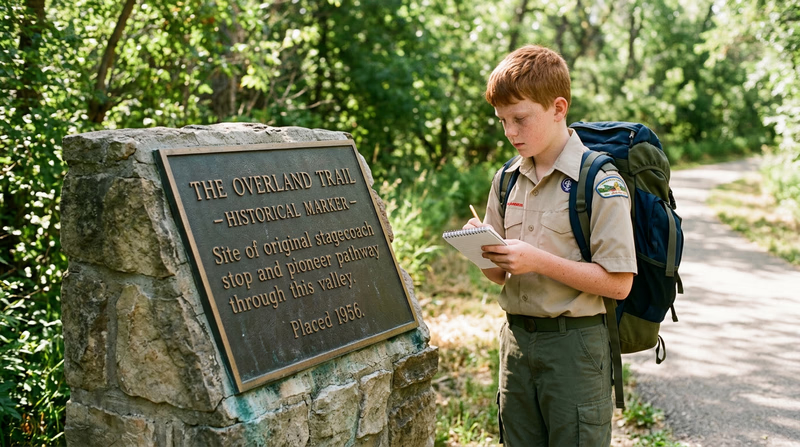
- Look for historical markers — those roadside plaques often mark the sites of significant events
- Check local newspapers — many libraries have digitized archives of old newspapers
What to Research
Once you have chosen an event:
- What happened? Describe the event in detail.
- When and where? Be specific about the location.
- Why did it matter? How did this event change your community?
- Then vs. now: What did the area look like when the event occurred? What does it look like today? If possible, visit the site and note the differences.
Option C: Your Town’s Origins
Every town has an origin story. Some were founded as trading posts, military forts, or railroad stops. Others grew around factories, farms, churches, or schools. Understanding why your town exists helps you understand the community you live in.
Research Questions
- When was your town or neighborhood established?
- Who founded it, and why?
- What ethnic, national, or racial groups settled there?
- What industries or activities drove the local economy?
- How has the area changed in the past 50 years — population, demographics, land use, economy?
- Why do you think those changes happened?
Option D: A History Program
This option gets you involved — not just reading about history, but actively participating in bringing it to life.
What Counts as a “Program”?
- A reenactment or living history event
- A community theater production about a historical event or figure
- A school or library history presentation
- A memorial ceremony (Veterans Day, Memorial Day, Independence Day)
- A historical preservation volunteer project
- A museum-sponsored event or workshop
The key word in the requirement is active — you need to participate, not just attend as a spectator.
What to Report
After your participation, tell your counselor:
- What was the program about?
- What part did you play?
- What did you learn about the historical event or person?
- What was the most meaningful or surprising thing about the experience?
Option E: A Historic Trail or Walk
Historic trails and walks let you literally walk in the footsteps of history. These can range from formal National Historic Trails to local walking tours through historic districts.
Finding a Historic Trail or Walk
National Trails System — National Park Service Explore the national system of trails including National Historic Trails, National Scenic Trails, and National Recreation Trails. Link: National Trails System — National Park Service — https://www.nps.gov/subjects/nationaltrailssystem/index.htmYou can also check:
- Your city or county’s parks and recreation department
- Local tourism websites
- Historical society walking tour guides
- State heritage trail programs
During Your Visit
Pay attention to:
- The historical significance of the trail — what events happened here?
- Physical features — markers, monuments, preserved buildings, landscapes
- How the trail is maintained and interpreted for visitors
National Register Connection
After your visit, think about whether the trail could qualify for the National Register. Remember the four criteria: association with significant events, association with significant people, distinctive design, or potential to yield important information. Make your case to your counselor using specific observations from your visit.
You have explored the history in your own backyard. Now let’s look at how movies, books, and music capture the American experience.
Req 5 — Heritage Through Media
Choose ONE of the three options below. Each one uses a different type of media — film, books, or music — as a lens for understanding American heritage. Pick the one that fits your interests.
Option A: Historical Films
Movies bring history to life in vivid ways — but they also take creative liberties. Your job is to watch with a critical eye and separate the facts from the fiction.
Choosing Your Films
Get your counselor’s and parent’s or guardian’s approval before watching. Good historical films are set in a specific period of American history and portray real events or realistic situations from that time.
Consider films set during:
- The American Revolution or founding era
- The Civil War or Reconstruction
- Westward expansion
- World War I or World War II
- The Civil Rights Movement
- The space race
- Other significant periods
Evaluating Accuracy
For each film, consider:
Historical events:
- Did the major events in the film actually happen?
- Are the dates, locations, and outcomes accurate?
- Did the filmmakers compress time or combine events for dramatic effect?
- What important events were left out?
Character portrayal:
- Are the characters based on real people? If so, are they portrayed accurately?
- Do the characters behave in ways that are realistic for their time period?
- Are certain groups of people stereotyped or left out entirely?
- Does the film show multiple perspectives, or only one side?
Option B: A Biography
A biography takes you deep into one person’s life — their struggles, decisions, and impact. This is your chance to understand a historical figure as a real human being, not just a name in a textbook.
Choosing Your Biography
Get your counselor’s approval on your choice. Look for biographies of people who made a significant contribution — positive or negative — to America’s heritage. This could be a president, an activist, a scientist, an artist, a military leader, or any person whose life intersected with American history in a meaningful way.
Library of Congress — Read.gov Free access to classic American books, including biographies, through the Library of Congress. Link: Library of Congress — Read.gov — https://read.gov/Thinking Critically
The requirement specifically asks you to identify things you admire and things you do not admire. This is important — no historical figure is entirely good or entirely bad. Great leaders made mistakes. Flawed people sometimes did extraordinary things.
Questions to guide your reading:
- What challenges did this person face?
- What decisions did they make that you respect? What decisions do you question?
- How did this person’s actions affect other people — both positively and negatively?
- On balance, do you think this person made America better or worse? Why?
Option C: Songs from American History
Music captures the mood of a moment in a way that speeches and documents cannot. Songs from different periods of American history tell you how people felt — their hopes, fears, anger, and joy.
Finding Historical Songs
Look for songs from at least three different periods. Here are some eras to explore:
| Era | Themes | Examples of Song Types |
|---|---|---|
| Revolutionary War (1770s–1780s) | Liberty, defiance, patriotism | Ballads, marching songs |
| Civil War (1860s) | Sacrifice, loss, unity, division | Camp songs, hymns, folk ballads |
| Westward Expansion (1800s) | Adventure, hardship, new beginnings | Folk songs, cowboy songs |
| World War I & II (1910s–1940s) | Patriotism, longing, sacrifice | Popular songs, big band, swing |
| Civil Rights era (1950s–1960s) | Justice, hope, resistance | Gospel, folk, protest songs |
| Vietnam War era (1960s–1970s) | Protest, questioning authority | Rock, folk, protest songs |
Analyzing the Songs
For each of your five songs, be ready to tell your counselor:
- What period of American history is it from?
- What is the song about? Summarize the lyrics.
- How does it reflect the mood of its era? What were people feeling — and how does the music and lyrics capture that?
- Why did you choose this song? What makes it a good window into that time?

You have explored American heritage through media. One more requirement to go — your future in heritage.
Req 6 — Heritage Careers
Careers in American Heritage
If you have enjoyed working on this merit badge, you might be surprised to learn how many careers involve preserving, interpreting, and sharing American heritage. These jobs exist in government, museums, universities, nonprofits, and the private sector — and they combine a love of history with real-world skills.
Career Areas
Museum Work
Museums are where history comes to life for the public. Museum careers include:
- Curator — Selects, researches, and cares for collections of artifacts. Curators design exhibits and decide which stories to tell.
- Museum Educator — Creates programs for students, families, and visitors. Leads tours, workshops, and hands-on activities.
- Collections Manager — Catalogs, stores, and preserves artifacts. Makes sure items are safe and accessible for future generations.
- Exhibit Designer — Designs the physical layout of exhibits, combining visual storytelling with historical accuracy.
Education: Most museum positions require a bachelor’s degree in history, art history, museum studies, or a related field. Senior roles often require a master’s degree.
Historic Preservation
Preservationists protect historic buildings, landscapes, and sites from demolition or neglect. Careers include:
- Preservation Specialist — Evaluates properties for historical significance and develops plans to restore or protect them.
- Architectural Historian — Studies the history and design of buildings to determine their significance.
- Heritage Planner — Works with local governments to integrate historic preservation into community planning.
Education: A bachelor’s degree in history, architecture, or planning, plus specialized training in preservation. Many professionals earn a master’s degree in historic preservation.
Archives & Libraries
Archivists and librarians are the keepers of primary sources — the original documents, photographs, maps, and recordings that make historical research possible.
- Archivist — Organizes and preserves documents and records. Makes them accessible to researchers and the public.
- Digital Archivist — Specializes in digitizing and preserving materials in electronic formats.
- Reference Librarian — Helps people find historical information and navigate research databases.
Education: A bachelor’s degree is required; a master’s degree in library science (MLS) or archival studies is standard for most positions.
Archaeology
Archaeologists study human history by excavating and analyzing physical evidence — artifacts, structures, and landscapes. In the United States, archaeologists work on everything from pre-colonial Indigenous sites to 20th-century industrial sites.
- Field Archaeologist — Conducts excavations, surveys, and site assessments.
- Cultural Resource Manager — Ensures that construction and development projects comply with historic preservation laws.
Education: A bachelor’s degree in archaeology or anthropology for entry-level work. Most professional positions require a master’s degree or higher.
National Park Service & Government
The National Park Service (NPS) manages more than 400 sites across the country, including battlefields, historic homes, monuments, and cultural landscapes.
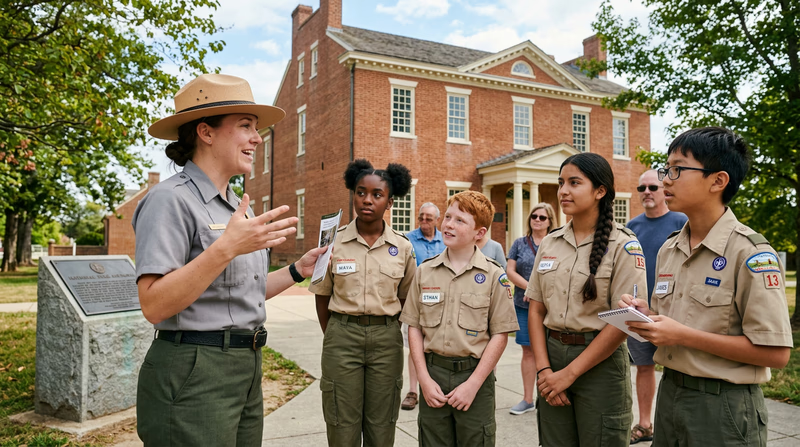
- Park Ranger (Interpretation) — Educates visitors about the history and significance of park sites through talks, tours, and programs.
- Historian — Conducts research and writes reports for government agencies on historical topics.
- Cultural Landscape Architect — Preserves and manages historically significant outdoor spaces.
Education & Research
Teachers, professors, and researchers keep the study of American heritage alive by training the next generation and advancing knowledge.
- History Teacher — Teaches American history at the middle school, high school, or college level.
- Documentary Filmmaker — Creates films that tell historical stories for public audiences.
- Public Historian — Works outside of traditional academia to make history accessible to the general public through writing, consulting, and community projects.
Education: Teaching requires a bachelor’s degree and teaching certification. University positions typically require a Ph.D.
Preparing for a Heritage Career
No matter which career interests you, here are steps you can take right now:
Getting Started
Steps you can take now to explore heritage careers- Volunteer at a local museum, historical society, or library.
- Visit National Park Service sites and talk to rangers about their work.
- Take history, art history, and social studies courses in school.
- Participate in your community’s historic preservation efforts.
- Start a personal history project — document your family, neighborhood, or school.
- Look into summer programs, internships, and camps focused on history or archaeology.
Congratulations — you have worked through all six requirements. Let’s wrap up with some ways to go even further.
Extended Learning
A. Congratulations!
You have earned the American Heritage merit badge — and along the way, you have explored the ideas, people, symbols, and stories that make the United States what it is. But earning the badge is just the beginning. The more you learn about American heritage, the more connections you will see between the past and the world around you. Here are some ways to keep going.
B. Oral History: Capturing Stories Before They Disappear
One of the most powerful things you can do for American heritage is record the stories of the people around you. Oral history is the practice of interviewing people and preserving their accounts of events they experienced firsthand. These recordings become primary sources — the raw material of history.
You already practiced interviewing skills in Requirement 2. Now consider taking it further. Veterans, community elders, immigrant families, and longtime residents all carry stories that will be lost if no one captures them. The Library of Congress runs the Veterans History Project, which collects and preserves firsthand accounts from American veterans. You can contribute by conducting recorded interviews and submitting them to the project.
To do oral history well, prepare thoughtful questions but let the person guide the conversation. Use a quality recording device — even a smartphone works if you find a quiet space. Always get written permission from the person you interview. Transcribe the interview afterward so the words are searchable and accessible. Store copies in multiple places to protect against data loss.
Oral history does something textbooks cannot: it captures the emotion, the pauses, the laughter, and the weight of lived experience. A transcript of a D-Day veteran describing the landing at Omaha Beach conveys something that no historian’s summary can match. By recording these stories now, you are preserving pieces of American heritage that would otherwise vanish.
Veterans History Project — Library of Congress Learn how to contribute oral history interviews with veterans to the Library of Congress collection. Link: Veterans History Project — Library of Congress — https://www.loc.gov/vets/C. Historical Thinking: Reading the Past Like a Detective
History is not just a list of facts — it is an ongoing investigation. Historians do not simply accept what they read. They ask questions, examine evidence, consider perspective, and look for what is missing. This way of thinking is called historical thinking, and it is a skill you can develop and use for the rest of your life.
There are several key habits of historical thinking. Sourcing means asking who created a document, when, and why — before you even read it. A newspaper editorial from 1863 tells you as much about the writer’s perspective as it does about the events described. Contextualization means placing events in their time and place. Judging people from 200 years ago by today’s standards misses the point — the goal is to understand why people acted the way they did, given the world they lived in.
Corroboration is the practice of checking multiple sources against each other. If one account says a battle was a decisive victory and another says it was inconclusive, you need to dig deeper. Close reading means paying attention to word choice, tone, and what is not said. A political speech that talks about “freedom” without defining it might mean very different things to different audiences.
You can practice these skills with any historical document — old newspapers, letters, photographs, maps, or government records. The Stanford History Education Group offers free resources for building historical thinking skills, including lessons built around primary sources.
Stanford History Education Group — Reading Like a Historian Free history lessons built around primary source documents, designed to build critical historical thinking skills. Link: Stanford History Education Group — Reading Like a Historian — https://sheg.stanford.edu/history-lessonsD. Preservation in Action: How Communities Save Their Heritage
Historic preservation is not just for professionals — communities across the country are finding creative ways to protect the places and traditions that tell their stories. Understanding how preservation works helps you participate in and advocate for it.
The preservation movement in America gained national momentum with the National Historic Preservation Act of 1966, which created the National Register of Historic Places and established State Historic Preservation Offices (SHPOs) in every state. But preservation happens at the local level too. Many cities have historic district commissions that review changes to buildings in designated areas. Neighborhoods organize to document and protect their architectural heritage. Volunteers restore old buildings, maintain cemeteries, and create walking tours.
Adaptive reuse is one of the most exciting trends in preservation. Instead of tearing down old buildings, communities find new purposes for them. A 19th-century factory becomes a community arts center. A one-room schoolhouse becomes a local history museum. A decommissioned fire station becomes a restaurant. These projects save historic structures while giving them new life and economic value.
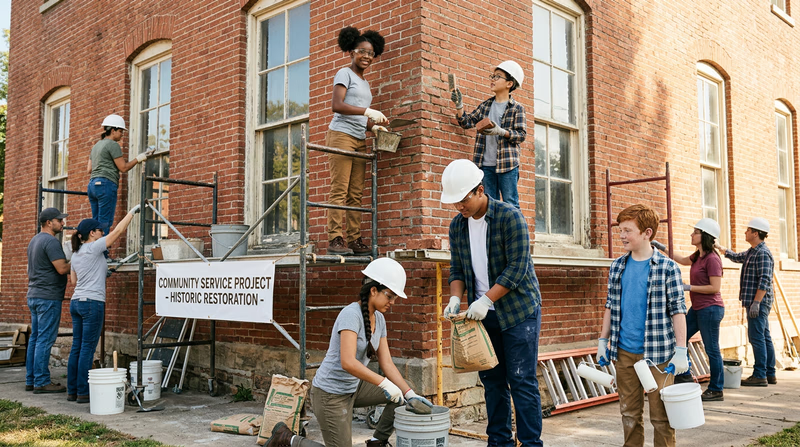
You can get involved in preservation right now. Many communities have historic preservation volunteer days where you can help with restoration projects. Your State Historic Preservation Office can point you to local organizations. If you discover a building or site that you think deserves recognition, you can even research whether it qualifies for the National Register and work with your SHPO to prepare a nomination.
National Trust for Historic Preservation The leading organization for historic preservation in the United States. Explore their programs, campaigns, and ways to get involved. Link: National Trust for Historic Preservation — https://savingplaces.org/E. Real-World Experiences
Visit a National Park Service Site
The National Park Service manages more than 400 sites across the country, including battlefields, historic homes, monuments, and cultural landscapes. Many offer free admission, ranger-led programs, and Junior Ranger activities. Find one near you and experience history firsthand.
Attend a Living History Event
Living history events and reenactments bring the past to life. Participants dress in period clothing, demonstrate historical skills, and recreate scenes from history. These events happen year-round at battlefields, historic sites, and community festivals across the country.
Volunteer at a Local Museum or Historical Society
Museums and historical societies rely on volunteers to help with everything from cataloging collections to leading tours. Volunteering gives you hands-on experience with heritage preservation and looks great on college applications.
Explore a Historic District
Many towns and cities have designated historic districts with distinctive architecture and rich stories. Take a self-guided or docent-led walking tour and pay attention to the architectural styles, historical markers, and the way the neighborhood has evolved over time.
Participate in a Cemetery Documentation Project
Historic cemeteries contain a wealth of information about a community’s past. Volunteer organizations document headstones, research the people buried there, and work to preserve these important sites. The “Billion Graves” and “Find A Grave” projects let you contribute photographs and records from anywhere.
F. Organizations
National Trust for Historic Preservation
The leading nonprofit organization dedicated to saving historic places across America. The National Trust runs programs, advocates for preservation policies, and maintains a list of America’s Most Endangered Historic Places. They also operate historic sites open to the public.
National Trust for Historic Preservation Explore programs, campaigns, and ways to get involved in historic preservation. Link: National Trust for Historic Preservation — https://savingplaces.org/American Historical Association
The oldest and largest organization of professional historians in the United States, founded in 1884. The AHA promotes historical research, teaching, and public engagement with history. Their website includes resources for students interested in studying history.
American Historical Association Resources for students, educators, and anyone interested in the study of American and world history. Link: American Historical Association — https://www.historians.org/National Council on Public History
An organization focused on making history accessible and useful to the public. Public historians work in museums, government agencies, businesses, and communities — anywhere history intersects with everyday life.
National Council on Public History Learn about public history careers, programs, and how history is applied outside of the classroom. Link: National Council on Public History — https://ncph.org/Smithsonian Institution
The world’s largest museum, education, and research complex, with 21 museums and galleries (most of them free), the National Zoo, and numerous research centers. The Smithsonian’s collections tell the story of America and the world.
Smithsonian Institution Explore the Smithsonian's museums, collections, and educational resources — most of which are free and open to the public. Link: Smithsonian Institution — https://www.si.edu/National Park Service
The NPS preserves and interprets America’s natural and cultural heritage across more than 400 sites. Beyond visiting parks, the NPS offers volunteer programs, youth internships, and educational resources for all ages.
National Park Service Plan visits, explore educational resources, and find volunteer and internship opportunities at America's national parks and historic sites. Link: National Park Service — https://www.nps.gov/