Req 1 — The Declaration of Independence
Understanding the Declaration
The Declaration of Independence was adopted on July 4, 1776, by the Second Continental Congress. It announced that the thirteen American colonies were breaking away from British rule — and, more importantly, it explained why.
The document was primarily written by Thomas Jefferson, with input from Benjamin Franklin, John Adams, and others. It was not written overnight. Jefferson spent about seventeen days drafting and revising before the committee reviewed it, and Congress debated and edited it further.
The Declaration has three main parts:
- The Preamble — States the purpose: to explain why the colonies are separating from Britain.
- The Statement of Rights — Lays out the philosophy of natural rights and government by consent. This is the section you will focus on for this requirement.
- The List of Grievances — Details the specific complaints against King George III.
The Key Passage — Line by Line
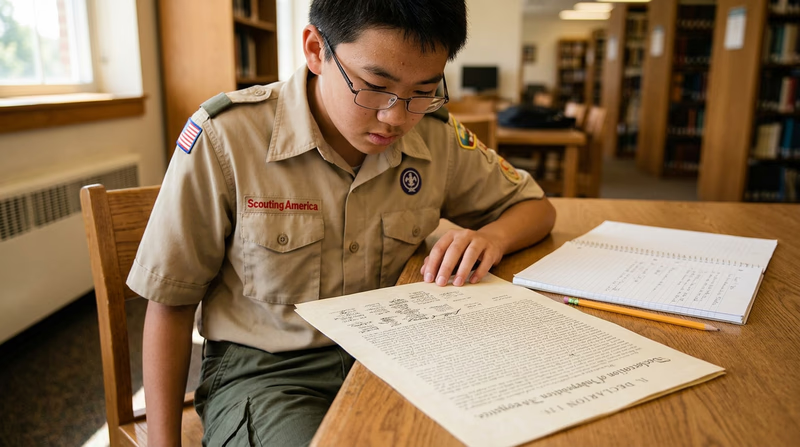
The section you need to rewrite begins with “We hold these truths to be self-evident” and ends with “to provide new Guards for their future security.” Here is a breakdown of its big ideas to help you understand what Jefferson was saying.
Big Ideas in the Passage
- Self-evident truths: Some things are so obviously true that they do not need proof.
- All men are created equal: Every person is born with the same basic worth and dignity.
- Unalienable rights: Rights that cannot be taken away — life, liberty, and the pursuit of happiness.
- Consent of the governed: Government gets its power from the people, not the other way around.
- Right to alter or abolish: If a government stops protecting people’s rights, the people have the right to change it or replace it.
Tips for Rewriting
This requirement asks you to translate 18th-century language into modern, easy-to-understand words. Here are some strategies:
- Break long sentences into short ones. Jefferson’s sentences can be over 100 words long. Chop them up.
- Replace old-fashioned words. “Self-evident” means “obvious.” “Unalienable” means “cannot be taken away.” “Endowed by their Creator” means “given by God” or “born with.”
- Use everyday examples. When Jefferson talks about government power coming from the people, think about elections and voting.
- Keep the meaning, change the words. Your version should say the same thing — just in language that a younger kid could understand.
Why the Declaration Still Matters
The Declaration of Independence is not just a historical curiosity. It is a living document that Americans still turn to when they debate rights, equality, and justice.
- Abraham Lincoln quoted it in the Gettysburg Address to argue that the Civil War was about preserving the ideal that “all men are created equal.”
- Frederick Douglass challenged America to live up to the Declaration’s promises in his famous 1852 speech, “What to the Slave Is the Fourth of July?”
- Martin Luther King Jr. referenced it in his “I Have a Dream” speech, calling the Declaration a “promissory note” that America had not yet fully honored.
- The women’s suffrage movement modeled the Declaration of Sentiments (1848) directly on Jefferson’s language.
The ideas in this passage are not just about 1776. They are about what kind of country America aspires to be — and that conversation is still happening today.
Discussing with Your Counselor
When you meet with your counselor, be ready to:
- Share your rewritten version and explain the choices you made in your translation.
- Discuss why the Declaration matters — not just in 1776, but today.
- Talk about the gap between the Declaration’s ideals and the reality of American history. The founders wrote “all men are created equal” while many of them enslaved people. How has America worked to close that gap over time?
Now that you have explored the Declaration, it is time to meet the people — leaders and citizens — who shaped American heritage.