Req 3b — National Symbols
America’s National Symbols
Every nation has symbols that represent its identity. The United States has five official symbols you need to know for this requirement. For each one, you will need to know three things: when and how it was adopted, how it has changed over time, and how it still influences Americans today.
The Flag
Adoption
The Continental Congress passed the Flag Resolution on June 14, 1777, establishing that the flag would have thirteen alternating red and white stripes and thirteen white stars on a blue field — one stripe and one star for each original colony. The resolution did not specify the arrangement of the stars, which is why early flags varied in design.
Changes
The flag has been redesigned 27 times. The most significant changes came as new states joined the Union. In 1818, Congress passed a law fixing the number of stripes at thirteen (to honor the original colonies) and adding a new star for each new state. The current 50-star flag was designed in 1958 by Robert Heft, a 17-year-old high school student from Ohio, as a class project.
Influence Today
The flag is present at nearly every public event, school, and government building in the country. The U.S. Flag Code provides guidelines for how the flag should be displayed and respected. Flag Day is celebrated on June 14, and the Pledge of Allegiance is recited in schools and at public gatherings across the nation.
The Pledge of Allegiance
Adoption
The original Pledge was written in 1892 by Francis Bellamy, a Baptist minister and magazine editor. It was first published in The Youth’s Companion magazine as part of a national campaign to celebrate the 400th anniversary of Columbus’s arrival in the Americas. Congress officially recognized the Pledge in 1942.
Changes
The Pledge has been modified four times. The most notable change came in 1954, when Congress added the words “under God” during the Cold War era to distinguish the United States from officially atheist communist nations. The original 1892 version read: “I pledge allegiance to my Flag and the Republic for which it stands, one nation, indivisible, with liberty and justice for all.”
Influence Today
The Pledge is recited daily in many American schools and at the opening of legislative sessions, public meetings, and Scouting events. It remains a visible expression of national unity, though debates about the “under God” phrase continue.
The Great Seal of the United States
Adoption
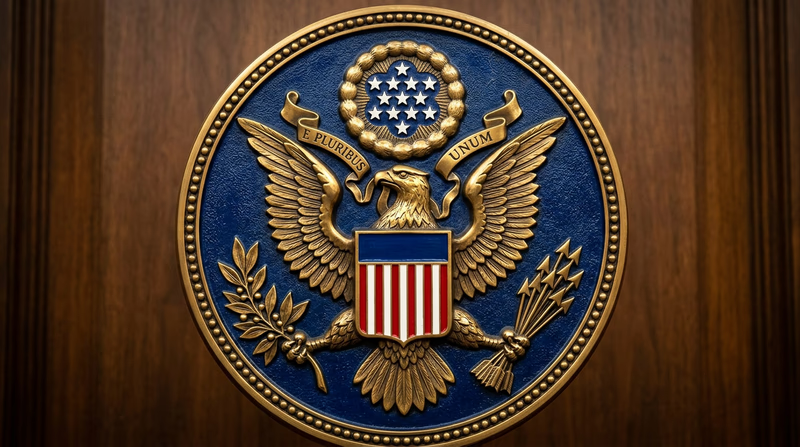
Congress appointed a committee to design the Great Seal on July 4, 1776 — the same day the Declaration of Independence was adopted. It took six years and three committees before the final design was approved on June 20, 1782. Charles Thomson, the Secretary of Congress, combined the best elements from all three committees’ proposals into the final version.
The Design
- Front (obverse): A bald eagle holding an olive branch (peace) in one talon and thirteen arrows (defense) in the other. A ribbon in its beak reads E Pluribus Unum (“Out of Many, One”). A shield with thirteen red and white stripes covers the eagle’s chest.
- Back (reverse): An unfinished pyramid with thirteen steps, topped by the Eye of Providence. Two Latin phrases appear: Annuit Coeptis (“He has favored our undertakings”) and Novus Ordo Seclorum (“A New Order of the Ages”).
Influence Today
The Great Seal appears on every dollar bill, on U.S. passports, and on official government documents. The bald eagle from the seal became America’s national bird and is one of the most recognized symbols of the United States worldwide.
The Motto
Adoption
The United States has two well-known mottos. E Pluribus Unum (“Out of Many, One”) has appeared on the Great Seal since 1782 and on coins since 1795. However, the official national motto is “In God We Trust,” which was adopted by Congress in 1956.
Changes
“In God We Trust” first appeared on U.S. coins during the Civil War in 1864, when the nation was deeply divided and many Americans sought to acknowledge faith on their currency. It became the official national motto by law in 1956, and has appeared on all U.S. paper currency since 1957.
Influence Today
You will find the motto on every piece of U.S. currency and in many government buildings, including above the Speaker’s rostrum in the U.S. House of Representatives. Both mottos reflect core American values — unity across diversity and trust in a higher purpose.
The National Anthem
Adoption
“The Star-Spangled Banner” was written by Francis Scott Key on September 14, 1814, after he watched the British bombardment of Fort McHenry during the War of 1812. Key was aboard a British ship negotiating a prisoner release and watched the battle through the night. When dawn broke and the American flag was still flying over the fort, he was inspired to write the poem that became the anthem. Congress officially designated it as the national anthem in 1931.
Changes
The original poem, “Defence of Fort M’Henry,” had four stanzas. Only the first is commonly sung today. The melody comes from a popular British song called “To Anacreon in Heaven.” Over the years, performance traditions have evolved — from military bands to solo vocalists at sporting events.
Influence Today
The national anthem is performed at the start of sporting events, government ceremonies, and public gatherings across the country. Standing for the anthem is considered a sign of respect, and the song remains a powerful symbol of national resilience.
America's Founding Documents — National Archives Explore the Declaration of Independence, the Constitution, and the Bill of Rights — plus detailed historical context.Preparing for Your Counselor
For each of the five symbols, make sure you can describe:
- When and how it was adopted
- What has changed since its adoption
- How it influences Americans today
Now it is time to turn the lens inward — and explore your own family’s American story.