Req 4 — Local History & Landmarks
Choose TWO of the five options below. Each one helps you explore history right where you live. No matter where you are in America, there is history within walking — or at least driving — distance.
Option A: The National Register of Historic Places
What Is the National Register?
The National Register of Historic Places is the official list of properties in the United States that are worthy of preservation because of their historical, architectural, or cultural significance. It is maintained by the National Park Service and includes more than 95,000 listings — buildings, sites, structures, objects, and districts.
Being listed on the National Register does not prevent a property owner from doing what they want with their property. It is an honorary designation that recognizes the property’s importance and may make it eligible for preservation grants or tax benefits.
How Does a Property Get Listed?
A property becomes eligible for the National Register if it meets at least one of four criteria:
- Association with significant events in American history
- Association with significant people in American history
- Distinctive design or construction — architectural significance
- Potential to yield important information — archaeological significance
The property must also generally be at least 50 years old, though exceptions exist for properties of exceptional importance.
National Register of Historic Places — Search by Location Search the National Register database to find listed properties near you. You can search by state, county, or city.Making Your Map
Your map should show your local area with historical points of interest marked. It does not need to be a work of art — a clear, hand-drawn map with labels works great.
Option B: A Local Historical Event
Every community has been shaped by events — some famous, some forgotten. This option asks you to find one and bring it to life.
Finding a Local Event
- Search local library archives — librarians are experts at local history
- Visit your county historical society — they often maintain collections of documents, photographs, and artifacts
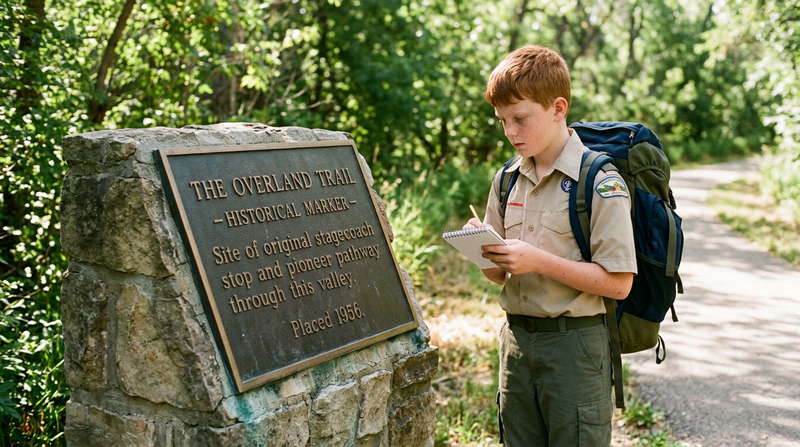
- Look for historical markers — those roadside plaques often mark the sites of significant events
- Check local newspapers — many libraries have digitized archives of old newspapers
What to Research
Once you have chosen an event:
- What happened? Describe the event in detail.
- When and where? Be specific about the location.
- Why did it matter? How did this event change your community?
- Then vs. now: What did the area look like when the event occurred? What does it look like today? If possible, visit the site and note the differences.
Option C: Your Town’s Origins
Every town has an origin story. Some were founded as trading posts, military forts, or railroad stops. Others grew around factories, farms, churches, or schools. Understanding why your town exists helps you understand the community you live in.
Research Questions
- When was your town or neighborhood established?
- Who founded it, and why?
- What ethnic, national, or racial groups settled there?
- What industries or activities drove the local economy?
- How has the area changed in the past 50 years — population, demographics, land use, economy?
- Why do you think those changes happened?
Option D: A History Program
This option gets you involved — not just reading about history, but actively participating in bringing it to life.
What Counts as a “Program”?
- A reenactment or living history event
- A community theater production about a historical event or figure
- A school or library history presentation
- A memorial ceremony (Veterans Day, Memorial Day, Independence Day)
- A historical preservation volunteer project
- A museum-sponsored event or workshop
The key word in the requirement is active — you need to participate, not just attend as a spectator.
What to Report
After your participation, tell your counselor:
- What was the program about?
- What part did you play?
- What did you learn about the historical event or person?
- What was the most meaningful or surprising thing about the experience?
Option E: A Historic Trail or Walk
Historic trails and walks let you literally walk in the footsteps of history. These can range from formal National Historic Trails to local walking tours through historic districts.
Finding a Historic Trail or Walk
National Trails System — National Park Service Explore the national system of trails including National Historic Trails, National Scenic Trails, and National Recreation Trails.You can also check:
- Your city or county’s parks and recreation department
- Local tourism websites
- Historical society walking tour guides
- State heritage trail programs
During Your Visit
Pay attention to:
- The historical significance of the trail — what events happened here?
- Physical features — markers, monuments, preserved buildings, landscapes
- How the trail is maintained and interpreted for visitors
National Register Connection
After your visit, think about whether the trail could qualify for the National Register. Remember the four criteria: association with significant events, association with significant people, distinctive design, or potential to yield important information. Make your case to your counselor using specific observations from your visit.
You have explored the history in your own backyard. Now let’s look at how movies, books, and music capture the American experience.