Extended Learning
A. Introduction
You have completed all nine requirements of the American Labor merit badge — congratulations! You now understand worker concerns, union mechanics, bargaining models, labor history, globalization, and the complex web of stakeholders that shape the world of work. But the story of American labor is still being written, and there is so much more to explore.
B. Deep Dive: How a Union Contract Gets Made
You learned the basics of collective bargaining in Requirement 3, but the actual process of negotiating a union contract is a fascinating, months-long endeavor. Understanding it in detail gives you a much richer picture of how labor relations work in practice.
It starts long before anyone sits down at the table. Months before the current contract expires, the union surveys its members: What matters most to you? What needs to change? What are you willing to fight for? Meanwhile, management analyzes the company’s finances, studies industry trends, and develops its own priorities.
Each side assembles a bargaining team. The union team typically includes elected officers, shop stewards from different departments, and sometimes a professional negotiator from the national union. Management’s team often includes human resources executives, financial analysts, and labor lawyers.
The first sessions involve each side presenting its proposals. Union proposals might include higher wages, better health insurance, more paid leave, or improved safety measures. Management might propose changes to work rules, scheduling flexibility, or modifications to overtime policies. Initial proposals are usually ambitious — each side asks for more than it expects to get.
Then the real negotiation begins. Both sides trade counter-proposals, discuss data and financials, and work through each issue one by one. Sticking points are set aside and revisited later. Side conversations happen in hallways and over coffee. Deadlines create pressure — if the current contract expires without a new one, a strike or lockout becomes possible.
When an agreement is reached on all issues, the union presents the tentative agreement to its membership for a ratification vote. If a majority of members approve, the new contract takes effect. If they reject it, the bargaining team goes back to the table.
A typical contract covers wages, benefits, hours, overtime rules, seniority systems, grievance procedures, safety standards, and dozens of other specific workplace rules. Contracts usually last two to five years, and then the entire process starts again.
C. Deep Dive: Labor and the Law
American labor law is built on a handful of landmark federal laws that you should know about if you want to go deeper:
The National Labor Relations Act (1935) — Also called the Wagner Act, this is the foundation of modern labor law. It guarantees most private-sector workers the right to organize, form unions, and bargain collectively. It also created the National Labor Relations Board (NLRB) to enforce these rights and investigate unfair labor practices.
The Fair Labor Standards Act (1938) — This law established the federal minimum wage, required overtime pay for hours worked beyond 40 per week, and banned most child labor. It has been amended many times since 1938, but its core protections remain.
The Taft-Hartley Act (1947) — Passed over President Truman’s veto, this law restricted some union activities. It banned closed shops (where you must be a union member before being hired), allowed states to pass right-to-work laws, and gave the president the power to intervene in strikes that threaten national safety. Unions criticized it as anti-labor; business groups praised it as restoring balance.
The Civil Rights Act (1964) — Title VII of this landmark law prohibits employment discrimination based on race, color, religion, sex, or national origin. It created the Equal Employment Opportunity Commission (EEOC) to enforce these protections. Later amendments added protections based on age, disability, and other characteristics.
The Occupational Safety and Health Act (1970) — This law created OSHA and established the principle that every worker has the right to a workplace free from recognized hazards. OSHA sets and enforces safety standards and investigates workplace accidents.
Understanding these laws gives you a framework for analyzing almost any labor issue you encounter. When you read a news article about a labor dispute, ask yourself: which of these laws is relevant, and how does it shape what each side can and cannot do?
D. Deep Dive: The Changing Face of Worker Organizing
The traditional image of a labor union — factory workers on a picket line — is just one piece of a much larger picture. Worker organizing in the 21st century looks very different from what it looked like even 20 years ago.
Tech and retail organizing — In recent years, workers at major technology and retail companies have launched high-profile organizing campaigns. Warehouse workers, baristas, and software testers have all voted to form unions at companies that were previously entirely nonunion. These campaigns have brought labor issues back into the national spotlight and attracted a new generation of workers to the labor movement.
Gig worker coalitions — Rideshare drivers, food delivery couriers, and freelance workers face unique challenges because they are often classified as independent contractors rather than employees. This classification means they typically do not have the right to form a union under current labor law. In response, gig workers have formed coalitions and advocacy groups to push for better pay, transparency in how they are compensated, and basic protections.
Worker centers — In communities where traditional union organizing is difficult — particularly among immigrant workers, domestic workers, and low-wage service workers — worker centers have emerged as an alternative. These nonprofit organizations provide services, education, and advocacy for workers who may not have access to union representation.
Social media and public pressure — Today’s worker organizers use social media to share stories, build solidarity, and put public pressure on employers. A single viral post about working conditions can generate more attention than months of traditional organizing. This has changed the power dynamics of labor-management relations in ways that are still unfolding.
The core principle remains the same as it was in the 1800s: workers are stronger together than alone. But the tools, the tactics, and the industries involved are evolving rapidly.
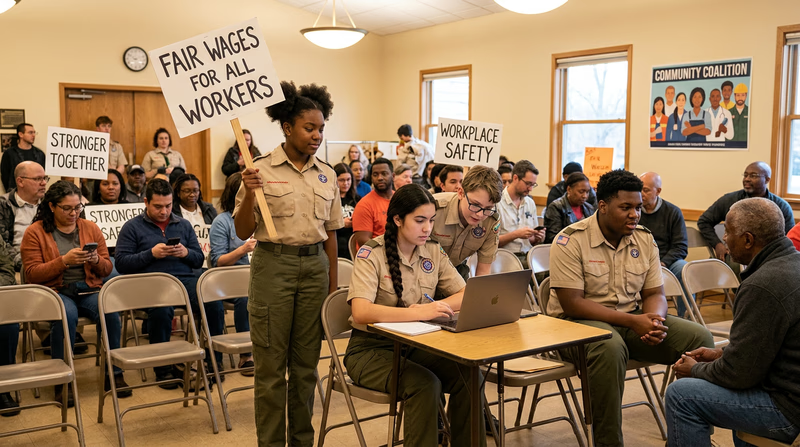
E. Real-World Experiences
Visit a Labor History Museum
Attend a City Council or County Board Meeting
Interview a Worker from a Different Generation
Explore a Historic Labor Site
Participate in a Mock Negotiation
F. Organizations
The largest federation of unions in the United States, representing over 60 national and international unions and more than 12 million workers.
The federal agency responsible for occupational safety, wage and hour standards, unemployment insurance, and other worker protections.
An independent federal agency that enforces the National Labor Relations Act, protecting workers’ rights to organize and bargain collectively.
A professional association for people who study and work in labor and employment relations, with resources for students.
A nonprofit think tank that focuses on the economic conditions of low- and middle-income workers, providing research and data on wages, benefits, and working conditions.
The federal agency that sets and enforces workplace safety standards, providing education and resources for both employers and workers.