Req 3 — What Labor Unions Do
The Language of Labor
Requirement 3 is the vocabulary-building requirement. It asks you to understand and explain a long list of labor concepts. Do not just memorize definitions — your counselor will want you to explain these ideas in a conversation, using your own words and showing that you understand how they connect to each other.
Let’s break down each concept so you can walk into that discussion with confidence.
What Is a Labor Union?
A labor union is an organization of workers who come together to protect their shared interests. Instead of each worker negotiating alone with a large employer, the union negotiates on behalf of all its members. This gives workers much more bargaining power than any individual would have.
Unions do many things:
- Negotiate contracts that set wages, hours, benefits, and working conditions
- Represent members in disputes with management
- Provide training and apprenticeship programs
- Advocate for laws that protect workers
- Offer services like legal assistance, scholarships, and health insurance plans
Key Concepts You Need to Know
Labor and Management
These two terms describe the two sides of the employment relationship:
- Labor refers to the workers — the people who perform the work. In a unionized workplace, “labor” usually means the union and its members.
- Management refers to the employer — the people who own or run the business and make decisions about hiring, firing, scheduling, and company direction.
The relationship between labor and management is at the heart of everything in this merit badge.
Collective Bargaining
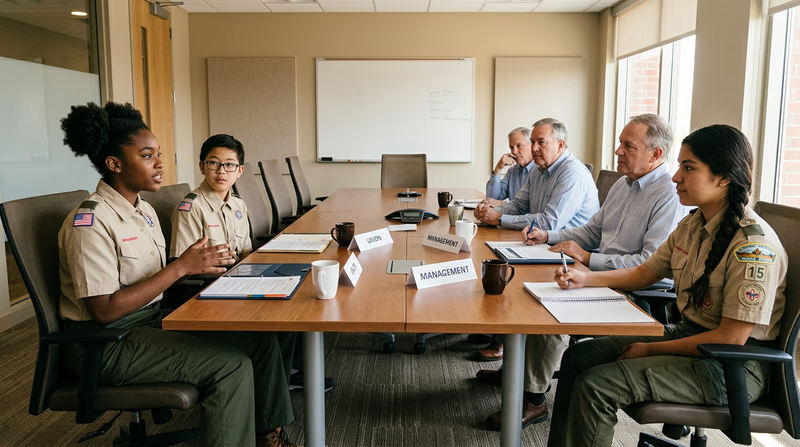
Collective bargaining is the process where union representatives and management sit down together to negotiate the terms of a contract. This contract — called a collective bargaining agreement (CBA) — spells out wages, hours, benefits, workplace rules, and procedures for resolving disputes.
The word “collective” is key. Workers bargain as a group, not as individuals. This levels the playing field because a single worker has very little leverage compared to a large company, but a united workforce has significant influence.
Negotiation
Negotiation is the back-and-forth discussion where both sides try to reach an agreement. Good negotiation involves compromise — each side gives up something to get something else. Union negotiators might push for higher wages, while management might push for more flexible scheduling. The goal is to find terms that both sides can accept.
Union Shops vs. Open Shops
These terms describe whether workers at a particular workplace are required to join the union:
- Union shop — Workers must join the union (or at least pay dues) within a certain period after being hired. The idea is that since all workers benefit from the union’s negotiations, all workers should contribute.
- Open shop — Workers can choose whether or not to join the union. They are not required to pay dues, even though they still benefit from the contract the union negotiated.
This is one of the most debated topics in labor law. Some states have “right-to-work” laws that prohibit union shops, meaning no worker can be required to join a union or pay dues as a condition of employment.
Grievance Procedures
A grievance is a formal complaint by a worker (or the union) that the employer has violated the contract. Grievance procedures are the step-by-step process for resolving these complaints. A typical grievance procedure works like this:
- The worker raises the issue with their immediate supervisor, often with a union steward present.
- If unresolved, the grievance moves to a higher level of management and union leadership.
- If still unresolved, it may go to a formal hearing.
- The final step is usually arbitration (see below).
Having a clear, written process protects both workers and management from unfair treatment.
Mediation and Arbitration
When labor and management cannot agree, outside help may be needed:
- Mediation — A neutral third party (the mediator) helps both sides talk through their disagreements and find common ground. The mediator does not make a decision — they guide the conversation. Either side can accept or reject the mediator’s suggestions.
- Arbitration — A neutral third party (the arbitrator) hears both sides and then makes a decision that is usually binding — meaning both sides must follow it. Arbitration is like a private court specifically for labor disputes.
Think of it this way: a mediator is a coach helping you work it out, while an arbitrator is a referee making the call.

Work Stoppages, Strikes, and Lockouts
When negotiations break down completely, more dramatic actions may happen:
- Work stoppage — A general term for any interruption of work, whether caused by workers or management.
- Strike — Workers stop working to pressure management into meeting their demands. Strikes are labor’s most powerful tool, but they come at a cost — workers do not get paid during a strike, and the company loses production.
- Lockout — Management prevents workers from entering the workplace to pressure the union into accepting management’s terms. A lockout is essentially a strike in reverse — initiated by the employer instead of the workers.
Both strikes and lockouts are last-resort measures. They hurt both sides and are typically used only after all other negotiation efforts have failed.
National Labor Relations Board — Rights We Protect The NLRB explains the rights of workers to organize, bargain collectively, and take action — including strikes — under federal law.Putting It All Together
These concepts are not isolated — they connect like links in a chain. Workers form unions to give labor a stronger voice when dealing with management. They use collective bargaining and negotiation to reach agreements. When disputes arise, grievance procedures, mediation, and arbitration provide structured ways to resolve them. The rules about union shops and open shops determine who participates. And when all else fails, strikes and lockouts are the ultimate expressions of disagreement.
When you talk with your counselor, try to explain how these pieces fit together — not just what each word means, but how the system works as a whole.