Req 5 — Labor History Projects
Choose ONE of these four options. Each one gives you a different way to explore the history of American labor. Read through all four before deciding which one fits your interests and skills best.
The Story of American Labor
Before you pick your project, it helps to understand the broad sweep of labor history. The American labor movement is one of the most important social movements in the country’s history. It transformed working conditions, created the middle class, and established rights that most workers take for granted today.
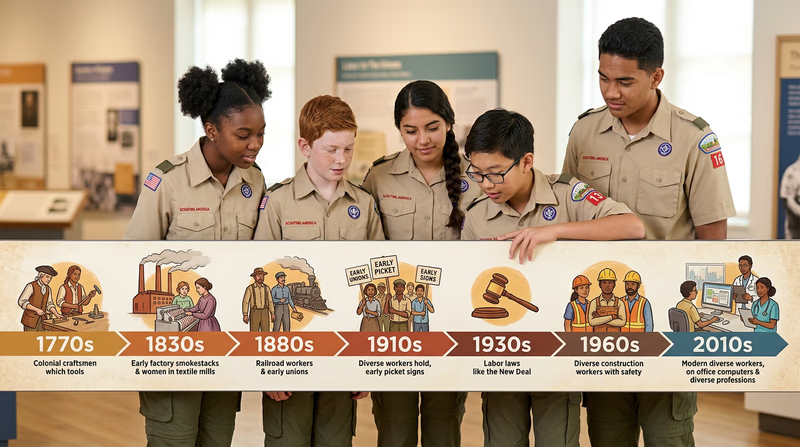
Here are some of the major eras and events you should know about:
Colonial Era to the Early Republic (1770s–1830s)
- Skilled craftsmen (shoemakers, carpenters, printers) formed the first worker organizations in America.
- In 1786, Philadelphia printers organized one of the first recorded strikes in the U.S. to demand a minimum wage.
- Early courts often ruled that unions were illegal “conspiracies.”
The Industrial Revolution (1840s–1890s)
- Factories changed the nature of work. Millions of people — including children — worked long hours in dangerous conditions.
- The Knights of Labor (founded 1869) was one of the first large-scale labor organizations, welcoming workers of all trades, races, and genders.
- The American Federation of Labor (AFL), founded in 1886 by Samuel Gompers, focused on skilled workers and practical goals: better wages, shorter hours, and safer conditions.
- The Haymarket Affair (1886) in Chicago became a turning point in the labor movement, leading to the international observance of May Day as a workers’ holiday.
The Progressive Era and World War I (1900s–1920s)
- The Triangle Shirtwaist Factory fire of 1911 killed 146 workers in New York City. The tragedy led to sweeping workplace safety reforms and fire codes.
- Child labor laws gained momentum. By the 1920s, many states had banned or restricted child labor.
- The Clayton Act (1914) protected unions from being treated as illegal monopolies.
The New Deal and Labor’s Golden Age (1930s–1960s)
- The National Labor Relations Act of 1935 (Wagner Act) guaranteed workers the right to organize and bargain collectively.
- The Fair Labor Standards Act of 1938 established the federal minimum wage, overtime pay, and banned most child labor.
- Union membership peaked in the 1950s, with about one-third of all American workers belonging to a union.
- The Congress of Industrial Organizations (CIO) organized entire industries, including steelworkers, autoworkers, and meatpackers.
- The AFL and CIO merged in 1955 to form the AFL-CIO.
The Civil Rights Era and Beyond (1960s–Present)
- César Chávez and Dolores Huerta organized farmworkers in California, leading to the creation of the United Farm Workers (UFW) and new protections for agricultural laborers.
- The Occupational Safety and Health Act (1970) created OSHA and established the right to a safe workplace.
- Union membership has declined since the 1980s, falling from about 30% of workers to roughly 10% today.
- Public sector unions (teachers, firefighters, government workers) have become a larger share of the union movement.
- New debates about gig workers, minimum wage, and worker organizing continue to shape the movement.
Option A: Build a Timeline
If you choose the timeline option, here is how to make it strong:
Timeline Tips
Making your timeline stand out
- Cover the full span: Start in the 1770s and continue to the present day.
- Include at least 15–20 events for a thorough timeline.
- Mix different types of events: laws, strikes, organizations, and key people.
- Add brief descriptions (1–2 sentences) for each event, not just dates and names.
- Consider using color coding to distinguish categories (legislation, strikes, organizations, key figures).
You can create your timeline on paper (a poster or long roll of paper works well), digitally (using a tool like Google Slides, Canva, or a timeline generator), or even as a web page.
Option B: Prepare an Exhibit or Presentation
This option asks you to highlight three major achievements of the labor movement. Some strong choices include:
- The 40-hour workweek and overtime pay
- The end of widespread child labor
- Workplace safety laws (OSHA)
- The right to organize and bargain collectively
- The minimum wage
- Protections against discrimination in employment
For each achievement, explain:
- What the problem was before the achievement
- How workers and unions fought for the change
- How the achievement affects workers today
Option C: Watch a Labor Movie
Several films explore organized labor in the United States. Here are some well-known examples to discuss with your counselor for approval:
- Norma Rae (1979) — A textile worker organizes her co-workers to join a union in the face of management opposition.
- Newsies (1992) — Based on the real 1899 New York City newsboys’ strike against Joseph Pulitzer’s newspaper empire.
- Matewan (1987) — A dramatization of the 1920 Battle of Matewan, a violent confrontation between coal miners and company agents in West Virginia.
- Silkwood (1983) — Based on the true story of Karen Silkwood, a nuclear plant worker and union activist who raised concerns about safety violations.
After watching, be ready to discuss:
- What labor issues were shown in the film?
- How did the workers organize, and what challenges did they face?
- How did management respond?
- What did you learn about the labor movement from the story?
Option D: Read a Labor Biography
Many individuals have shaped the American labor movement. Here are some notable figures to consider:
- Samuel Gompers — Founder of the American Federation of Labor
- César Chávez — Co-founder of the United Farm Workers
- Dolores Huerta — Co-founder of the United Farm Workers and lifelong labor and civil rights activist
- Eugene V. Debs — Railroad union leader and advocate for industrial unionism
- Mother Jones (Mary Harris Jones) — Organizer who fought against child labor and for miners’ rights
- A. Philip Randolph — Founder of the Brotherhood of Sleeping Car Porters, the first major African American labor union
- Frances Perkins — U.S. Secretary of Labor under FDR and a driving force behind the New Deal labor laws
Ask your counselor to approve your book choice before you start reading. When you discuss the biography, focus on the person’s specific contributions and how their work changed things for workers.
Library of Congress — Rise of Industrial America Primary source materials from the Library of Congress covering the rise of industrial America and the early labor movement. AFL-CIO — Labor History Timeline A comprehensive timeline of key events in American labor history from the AFL-CIO.History Informs the Present
Whichever option you choose, the goal is the same: to understand how the struggles and achievements of past workers created the rights and protections that exist today. The labor movement is not just history — it is a living, ongoing conversation about the future of work.