Extended Learning
A. Introduction
Congratulations — you have earned the Animal Science merit badge! You have surveyed seven categories of livestock, studied diseases and digestive systems, planned an animal management operation, explored genetics and breeding, and dived deep into a specialty option. But the world of animal science is vast, and there is so much more to discover.
B. Deep Dive: Understanding Animal Welfare
Animal welfare is one of the most important — and most debated — topics in modern animal science. It goes beyond simply keeping animals alive and healthy. Welfare means ensuring that animals can live in conditions that meet their physical and behavioral needs.
Scientists use the Five Freedoms framework to evaluate animal welfare:
- Freedom from hunger and thirst — Access to fresh water and a diet that maintains health and vigor.
- Freedom from discomfort — An appropriate environment with shelter and a comfortable resting area.
- Freedom from pain, injury, or disease — Prevention or rapid diagnosis and treatment.
- Freedom to express normal behavior — Sufficient space, proper facilities, and the company of the animal’s own kind.
- Freedom from fear and distress — Conditions and treatment that avoid mental suffering.
These principles guide everything from how barns are designed to how animals are transported and handled. In the United States, organizations like the American Veterinary Medical Association (AVMA) and industry groups develop welfare guidelines, and third-party auditors verify that farms and processing plants meet those standards.
Understanding animal welfare is not just about being kind — it is also good business. Research consistently shows that animals raised in low-stress, welfare-friendly environments are healthier, grow faster, and produce higher-quality products. Consumers increasingly demand transparency about how their food is produced, and companies that can demonstrate high welfare standards often command premium prices.
The field is evolving rapidly. New technologies like environmental sensors, behavior-monitoring cameras, and precision farming tools are giving producers better ways to measure and improve welfare on their operations. If you are interested in this intersection of ethics, science, and technology, animal welfare is a rewarding area to explore further.
American Veterinary Medical Association — Animal Welfare The AVMA's comprehensive resources on animal welfare science, policy, and best practices.C. Deep Dive: Sustainable Agriculture and Livestock
Sustainability means meeting today’s food production needs without compromising the ability of future generations to meet theirs. In animal agriculture, sustainability involves balancing three factors: environmental stewardship, economic viability, and social responsibility.
Environmental challenges in livestock production include greenhouse gas emissions (cattle are significant sources of methane), water usage, land use for feed crops and grazing, and manure management. The good news is that animal scientists are developing innovative solutions to all of these challenges.
Regenerative grazing is one of the most promising approaches. Instead of keeping cattle on the same pasture year-round (which leads to overgrazing), ranchers move herds frequently across a rotation of pastures. This mimics the movement patterns of wild bison herds and can actually improve soil health, increase carbon sequestration in the soil, and boost biodiversity. Well-managed grazing lands can store more carbon than some forests.
Feed additives are another frontier. Researchers have discovered that adding small amounts of certain seaweed species to cattle feed can reduce methane emissions by up to 80%. Other additives improve feed efficiency, meaning animals produce the same amount of meat or milk while eating less feed — reducing the environmental footprint per unit of food produced.
Precision livestock farming uses sensors, data analytics, and automation to optimize every aspect of production — from the exact amount of feed each animal receives to early detection of health problems. By reducing waste and improving efficiency, precision farming helps producers do more with less.
Water recycling, manure-to-energy systems, and integrated crop-livestock systems (where manure fertilizes the crops that feed the animals) are all part of the sustainability toolkit. The future of animal agriculture depends on young scientists and producers who can think creatively about these challenges.
Noble Research Institute — Regenerative Ranching Research and educational resources on regenerative agriculture practices, including rotational grazing and soil health.D. Deep Dive: The Science of Animal Behavior
Animal behavior science (ethology) is a fascinating field that helps us understand why animals do what they do — and how to use that knowledge to manage them more effectively and humanely.
Flight zone and point of balance are two concepts every livestock handler should understand. The flight zone is the area around an animal where it feels comfortable. If you step inside the flight zone, the animal moves away from you. The point of balance is an imaginary line at the animal’s shoulder — step behind it, and the animal moves forward; step in front of it, and the animal stops or backs up. Understanding these concepts allows you to move cattle, sheep, and hogs calmly and efficiently without yelling, prodding, or chasing.
Temple Grandin, a professor of animal science at Colorado State University, revolutionized livestock handling by applying her understanding of animal behavior to the design of handling facilities. Her curved chute systems — based on the natural tendency of cattle to circle back to where they came from — are now used in half of all beef processing plants in North America. Her work demonstrated that low-stress handling is not only more humane but also more efficient and produces better meat quality (stressed animals release hormones that toughen the meat).
Social behavior varies dramatically between species. Cattle are herd animals that become stressed when isolated. Pigs are highly social and intelligent — they can learn their names, solve puzzles, and form complex social hierarchies. Chickens establish a pecking order that determines access to food, water, and roosting space. Horses are herd animals with strong social bonds and a well-defined dominance hierarchy.
Understanding these behaviors helps producers design better housing, handling systems, and management practices. It also opens up career paths in animal behavior consulting, welfare auditing, and research. If you enjoyed working with animals during this badge, consider reading Temple Grandin’s books or watching her TED talks — they are accessible, fascinating, and will change the way you look at livestock.
E. Real-World Experiences
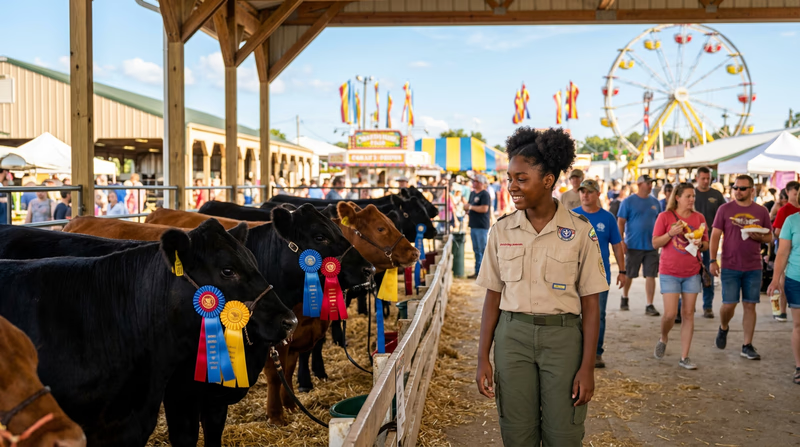
State and County Fairs
4-H Livestock Projects
FFA Career Development Events (CDEs)
University Animal Science Open Houses
Working Ranch Experiences
F. Organizations
National FFA Organization The premier youth organization for agricultural education, leadership, and career development. FFA chapters are active in high schools across all 50 states. 4-H Youth Development The nation's largest youth development organization, with strong livestock and animal science programs available through your local county extension office. American Society of Animal Science (ASAS) The professional society for animal scientists, offering resources on careers, research, and the latest advances in the field. American Veterinary Medical Association (AVMA) The national association for veterinarians, with career resources, animal health information, and guidance for students interested in veterinary medicine. Cooperative Extension System Every state has a cooperative extension service connected to its land-grant university. Extension agents provide free, research-based information on livestock production, pasture management, and more.