Req 5a — Breeding Improvements
Breeding is the engine that drives livestock improvement. Every generation is an opportunity to make a herd or flock a little better — more productive, healthier, or better adapted to its environment. But improvements do not happen by accident. They require a plan.
The Goal of Selective Breeding
Selective breeding means choosing specific animals to be parents based on their traits. The basic idea is simple: if you want more milk, breed your best milking cows. If you want faster-growing pigs, breed the ones that reach market weight quickest. Over many generations, these choices add up to dramatic improvements.
But real-world breeding is more complex than just picking the “best” animal. Producers must balance multiple traits at once — a cow that gives the most milk may also have the weakest feet, and a fast-growing hog may have lower meat quality. Successful breeders think about the whole animal, not just one trait.
How Producers Make Breeding Decisions
1. Performance Testing
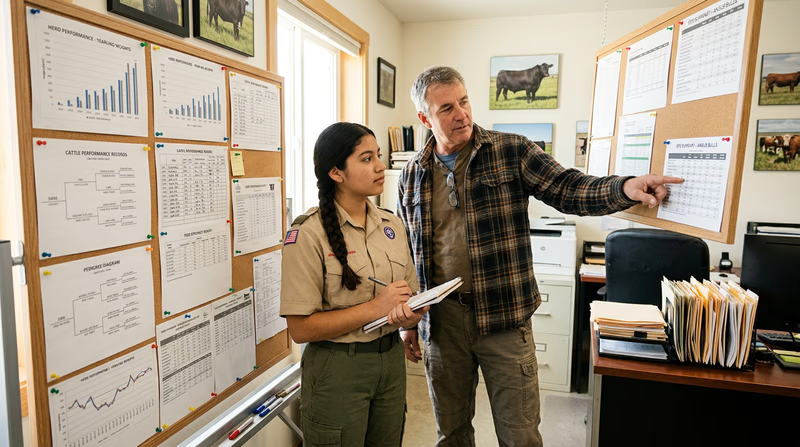
Performance testing means measuring traits in a standardized way so animals can be compared fairly. Examples include:
- Weaning weight — How heavy is a calf at weaning? This reflects the mother’s milking ability and the calf’s growth potential.
- Average daily gain (ADG) — How fast does an animal gain weight on a standardized diet?
- Feed conversion ratio — How efficiently does an animal turn feed into body weight?
- Milk production records — How many pounds of milk (and butterfat) does a dairy cow produce per lactation?
2. Expected Progeny Differences (EPDs)
EPDs are numerical predictions of how an animal’s offspring will perform compared to the breed average. They are calculated using performance data from the animal, its parents, its siblings, and its existing offspring.
For example, a bull with a birth weight EPD of -2.0 is expected to sire calves that are, on average, 2 pounds lighter at birth than calves sired by a bull with an EPD of 0. Lighter birth weights mean easier calving — a trait many producers value.
3. Pedigree Analysis
A pedigree is an animal’s family tree. It shows the parents, grandparents, and often several more generations. Breeders study pedigrees to identify animals that carry desirable genetics — or to avoid inbreeding by making sure the sire and dam are not too closely related.
4. Visual Appraisal
Even with all the data in the world, experienced breeders still evaluate animals visually. They look at:
- Structural soundness — Is the animal built to move well and stay sound for years?
- Muscling — Does the animal carry muscle in the right places?
- Capacity — Does the animal have the body depth and volume to eat and produce at a high level?
- Udder quality (dairy) — Is the udder well-attached, with good teat placement?
5. Breeding Programs in Action
A breeding program is a long-term plan that combines all of these tools. A producer might:
- Define breeding goals (e.g., improve calving ease and marbling in a beef herd).
- Select bulls with strong EPDs for those traits.
- Use artificial insemination (AI) to breed cows to the chosen bulls.
- Performance-test the resulting calves.
- Keep the best females as replacements; sell the rest.
- Repeat, adjusting selections each year based on new data.
This cycle of selection, mating, evaluation, and re-selection is how herds and flocks improve over time.
Now let’s look more closely at the two fundamental breeding strategies: pure breeding and cross breeding.