Req 5b — Pure & Cross Breeding
These are two fundamental breeding strategies, and every livestock producer uses one or both depending on their goals. Understanding the difference — and the advantages of each — is essential to animal science.
Pure Breeding
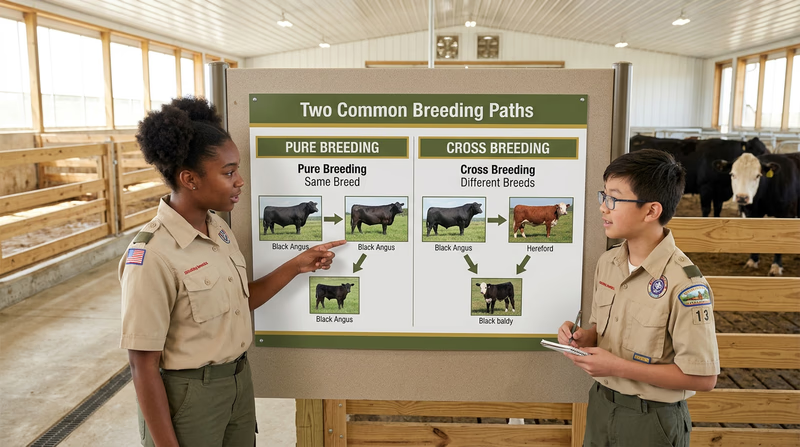
Pure breeding (also called straightbreeding) means mating animals of the same breed together. Both the sire (father) and dam (mother) are registered members of the same breed. The offspring are purebred and can be registered with the breed association.
How it works:
An Angus bull is bred to an Angus cow. The resulting calf is a purebred Angus. If that calf is a heifer, she can later be bred to another Angus bull, continuing the purebred line.
Advantages of pure breeding:
- Predictability — Purebred animals tend to produce offspring with consistent, known traits. If you breed two Holsteins together, you know the calf will look and produce like a Holstein.
- Breed improvement — Purebred breeders can focus on improving specific traits within the breed over time.
- Registration and value — Purebred, registered animals are often worth more because buyers know the genetics they are getting.
- Maintaining breed identity — Pure breeding preserves the unique characteristics that define each breed.
Disadvantages:
- Inbreeding risk — If the breed population is small or breeders are not careful, closely related animals may be mated, which can lead to reduced fertility, weaker immune systems, and other problems.
- Limited genetic diversity — Staying within one breed limits the range of traits available to select from.
Cross Breeding
Cross breeding means mating animals of two or more different breeds. The offspring are called crossbreds. This is one of the most powerful tools available to livestock producers.
How it works:
An Angus bull is bred to a Hereford cow. The resulting calf is an Angus-Hereford cross (sometimes called a “black baldy” because of its black body and white face). This calf is not purebred and typically cannot be registered with either parent breed’s association.
Advantages of cross breeding:
- Hybrid vigor (heterosis) — This is the biggest advantage. Crossbred animals often outperform both parent breeds in traits like growth rate, fertility, disease resistance, and overall hardiness. It is the same principle that makes hybrid corn outperform its parent lines.
- Combining breed strengths — You can pair a breed known for maternal ability with one known for growth and carcass quality, getting the best of both.
- Wider genetic diversity — Crossing breeds brings in new genes, reducing the risk of inbreeding problems.
Disadvantages:
- Less predictable — Crossbred offspring can vary more in appearance and performance than purebreds.
- Cannot register — Crossbred animals generally cannot be registered with purebred associations, which may limit their sale value as breeding stock.
- Requires planning — Effective crossbreeding programs require careful selection of complementary breeds.
Common Crossbreeding Systems
Producers use several crossbreeding systems depending on their goals:
- Two-breed cross — The simplest system. Breed A sire × Breed B dam. The F1 (first-generation) offspring get the maximum hybrid vigor.
- Three-breed rotation — Uses three breeds in a rotating pattern across generations to maintain hybrid vigor over time.
- Terminal cross — All crossbred offspring are sold for harvest (none kept for breeding). This maximizes hybrid vigor in every generation but requires maintaining purebred herds to produce replacement females.
- Composite breeds — A stabilized combination of multiple breeds that is then bred as its own population. The Beefmaster (Hereford × Shorthorn × Brahman) is an example.
Next, let’s explore the cutting-edge technology that modern animal scientists use to take breeding — and production — to the next level.