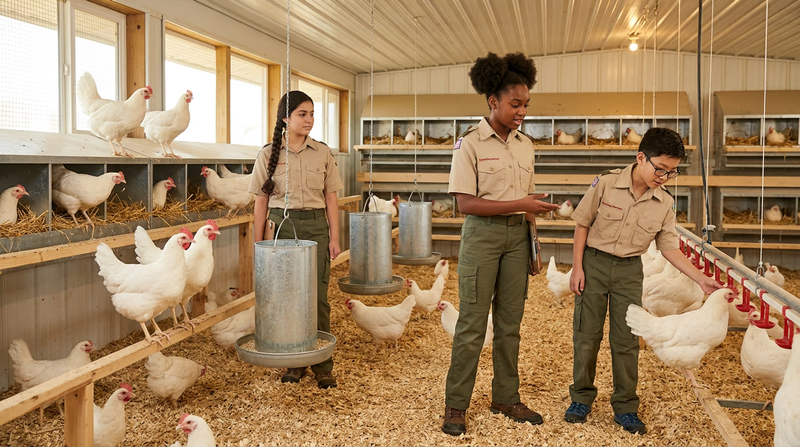
Req 6 — Avian Option
This option covers poultry housing design, overcrowding dangers, egg grading, chicken meat classes, hands-on flock experience, and poultry terminology. Complete all five sub-requirements (a–e) below.
Requirement 6a — Poultry House Design
Layer House Features
If you sketch a layer house (for egg-producing hens), include:
- Nest boxes — One nest for every 4–5 hens, placed off the ground in a quiet area. Nests should be dark and private to encourage laying.
- Roosts (perches) — Elevated bars where hens sleep at night. Allow 8–10 inches of roost space per bird. Roosts should be higher than nest boxes so hens do not sleep in the nests.
- Feeders — Trough or tube feeders that provide constant access to feed. Allow 3–4 inches of feeder space per bird.
- Waterers — Nipple drinkers or bell waterers. Clean water must always be available. One waterer per 25–30 birds.
- Ventilation — Fans, ridge vents, and adjustable sidewall curtains or inlets to control airflow.
Broiler House Features
A broiler house (for meat birds) is simpler:
- No nest boxes or roosts — Broilers are raised on the floor and harvested before they reach laying age.
- Litter — The floor is covered with wood shavings, rice hulls, or other absorbent bedding.
- Feeders and waterers — Automatic pan feeders and nipple drinkers suspended from the ceiling.
- Ventilation — Large exhaust fans on one end with air inlets on the other (tunnel ventilation) to maintain air quality and temperature.
Environmental Controls
Insulation — Walls and ceilings are insulated to maintain stable temperatures. Poultry are sensitive to temperature extremes — the ideal range for layers is 60–75°F (15–24°C).
Ventilation — Critical for removing moisture, ammonia, and heat. Poor ventilation leads to respiratory disease, wet litter, and reduced performance. In modern houses, fans and inlets are controlled by computers that adjust airflow based on temperature and humidity sensors.
Temperature controls — Heaters (propane brooders) warm the house for young chicks. Evaporative cooling pads or tunnel ventilation cool the house in summer. Heat stress can kill birds rapidly.
Automatic lights — Lighting programs control when lights turn on and off to regulate egg production.
Why Light Matters for Egg Production
Hens need 14–16 hours of light per day to maintain peak egg production. As days get shorter in fall and winter, egg production naturally drops. Commercial layer houses use artificial lighting programs to keep the day length consistent year-round.
- Increasing light stimulates the pituitary gland, which releases hormones that trigger egg development.
- Decreasing light slows or stops production.
- Pullets (young hens) are raised on shorter light schedules, then given increasing light when they reach laying age to stimulate the onset of production.
Requirement 6b — Overcrowding Dangers
Overcrowding is one of the most harmful conditions in poultry production. When too many birds are kept in too little space, problems multiply:
- Disease transmission — Birds in close contact spread infections faster. Respiratory diseases, coccidiosis, and viral infections move through crowded flocks at alarming rates.
- Stress and aggression — Crowded birds become stressed, which weakens their immune systems. Stress also leads to feather pecking and cannibalism — birds literally attack each other.
- Poor air quality — More birds produce more moisture, ammonia, and carbon dioxide. Without enough space and ventilation, air quality deteriorates rapidly, damaging the birds’ respiratory systems.
- Reduced production — Stressed, uncomfortable birds eat less, grow slower, and lay fewer eggs. Feed conversion efficiency drops.
- Wet litter — More birds means more manure in the same space. Litter becomes wet, promoting bacterial growth and increasing the risk of footpad dermatitis (painful sores on the feet).
- Heat stress — Crowded birds generate more body heat. In warm weather, this can cause mass mortality. Poultry cannot sweat — they cool themselves by panting, which is much less efficient.
Requirement 6c — Egg Grading and Meat Classes
Egg Grading
The USDA grades eggs based on interior and exterior quality:
- Grade AA — The highest quality. The shell is clean, unbroken, and practically normal. When cracked open, the white is thick and firm, and the yolk stands up tall and round. The air cell (the space at the large end of the egg) is small (1/8 inch or less).
- Grade A — Very similar to AA. The white is reasonably firm, and the air cell is slightly larger (3/16 inch or less). This is the grade most commonly sold in grocery stores.
- Grade B — Lower quality. The white may be thin and watery, the yolk may be flattened, and the shell may have minor staining or abnormal shape. Grade B eggs are typically used in liquid egg products, baking mixes, and other processed foods.
Egg sizing is separate from grading. Sizes (Jumbo, Extra Large, Large, Medium, Small, Peewee) are based on the minimum weight per dozen eggs, not the size of individual eggs.
Classes of Chicken Meat
Chicken meat is classified by the age and sex of the bird at harvest:
- Cornish game hen (poussin) — A very young chicken (usually under 5 weeks), weighing about 2 pounds. Despite the name, it can be either sex.
- Broiler/Fryer — A young chicken (usually 6–8 weeks), weighing 2.5–4.5 pounds. This is the most common type of chicken sold in the United States.
- Roaster — A young chicken (usually 8–12 weeks), weighing 5–7 pounds. Larger and more mature than a broiler, with more fat for roasting.
- Capon — A castrated male chicken, usually 4–8 months old, weighing 6–10 pounds. Capons have tender, well-marbled meat and are considered a specialty product.
- Hen/Stewing hen — A mature female chicken (over 10 months), typically a retired layer. The meat is tougher and requires slow cooking (stewing, braising) but has excellent flavor.
Requirement 6d — Raise or Visit
Option 1: Manage an egg-producing flock for five months. Keep records of feed purchased, eggs sold, medication, vaccination, and mortality.
Option 2: Raise five chickens from hatching. Keep records of feed intake, weight gains, medication, vaccination, and mortality.
Option 3: Visit a commercial avian production facility. Describe what you saw and explain what you learned. If you cannot visit, view a video or research online (with parent/guardian permission).
Record-Keeping for Flock Management
Track these items regularly
- Daily egg count (for layers) or weekly weights (for meat birds)
- Feed purchased — type, amount, and cost
- Eggs sold — number, price, and revenue
- Medications and vaccinations — dates, types, and dosages
- Deaths — date, number, and suspected cause
- General observations — bird behavior, egg quality, weather conditions
Requirement 6e — Poultry Terminology
- Chick — A newly hatched chicken of either sex.
- Pullet — A young female chicken that has not yet begun laying eggs (typically under 20 weeks old).
- Hen — A mature female chicken that is laying eggs or has laid eggs.
- Cockerel — A young male chicken, typically under one year old.
- Cock (rooster) — A mature male chicken, one year or older.
- Capon — A male chicken that has been castrated. Capons grow larger, have more tender meat, and are calmer than intact males.