Req 6 — Beef Cattle Option
This option covers beef production systems, facility design, meat cuts and grading, and industry terminology. Complete all four sub-requirements (a–d) below.
Requirement 6a — Visit or Research a Beef Operation
There are three main beef production systems, and each plays a different role in getting beef from pasture to plate:
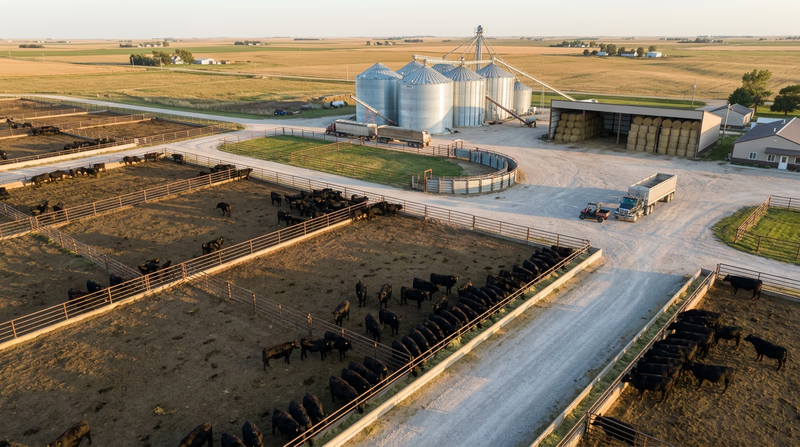
1. Feeding market cattle for harvest — These are feedlot operations where cattle are brought to a target weight on a high-energy grain diet. Feedlots typically handle hundreds or thousands of cattle at a time. The goal is efficient weight gain and consistent meat quality.
2. Cow/calf operations — These ranches maintain a breeding herd of cows that produce calves each year. Calves are raised on pasture with their mothers until weaning (around 6–8 months), then sold to feeders or backgrounders. This is the foundation of the beef industry.
3. Purebred operations — These producers raise registered, purebred cattle and sell breeding stock (bulls and replacement females) to commercial producers. Purebred breeders focus intensely on genetics and performance records.
Questions to Ask During Your Visit
Or research these topics if visiting online
- What breed or breeds of cattle are raised here?
- How are the cattle fed — pasture, hay, grain, or a combination?
- How are cattle weighed and how often?
- How are cattle shipped — by truck, by trailer, to where?
- What handling facilities are used (chutes, corrals, scales)?
- What is the biggest challenge in running this operation?
Requirement 6b — Feedlot or Corral Design
You have two sketch options here. Choose the one that best fits the type of operation you researched in 6a.
Feedlot Layout (for 30+ fattening steers)
A good feedlot sketch should include:
- Pens with enough space per animal (250–400 sq ft per head for finishing cattle)
- Feed bunks along the fence line for easy access — cattle eat from one side, feed trucks fill from the other
- Water tanks or automatic waterers shared between pens
- Hay and grain storage — a hay barn and grain bins or a commodity shed near the feed mixing area
- Feed mixing area where rations are prepared
- Loading chute for receiving and shipping cattle — should be curved (cattle move better through curves) and connected to a working alley
- Hospital pen for isolating sick animals
- Drainage — pens should slope slightly so water runs off, keeping conditions dry
Corral Plan (for 50+ cows and calves)
A working corral should include:
- Holding pen large enough for the entire group
- Crowding pen (also called a “tub”) — a funnel-shaped pen that directs cattle into a single-file alley
- Working alley — a narrow chute where cattle move in single file
- Squeeze chute or headgate — where individual animals are restrained for veterinary work, tagging, or treatment
- Cutting gates — gates at key points that allow you to sort animals into different pens
- Loading chute — a ramp leading to a truck or trailer, with solid sides so cattle do not balk
Requirement 6c — Beef Cuts and USDA Grading
Wholesale (Primal) Cuts
A beef carcass is divided into eight primal cuts:
- Chuck (shoulder) — roasts, stews, ground beef
- Rib — ribeye steak, prime rib
- Loin (short loin and sirloin) — T-bone, porterhouse, filet mignon, sirloin steak
- Round (rear leg) — round steak, roasts, ground beef
- Brisket (chest) — brisket for smoking or braising
- Plate (belly area) — short ribs, skirt steak
- Flank — flank steak, London broil
- Shank (lower legs) — osso buco, soup bones
USDA Dual Grading System
The USDA uses two separate grading systems for beef:
Quality Grades — Based on marbling (intramuscular fat) and maturity (age of the animal). More marbling generally means more tender, juicy, flavorful beef. From highest to lowest:
- Prime — Abundant marbling. Found in high-end restaurants. About 3–5% of all graded beef.
- Choice — Moderate marbling. The most common grade in grocery stores.
- Select — Slight marbling. Leaner and less tender, but more affordable.
- Below these are Standard, Commercial, Utility, Cutter, and Canner — rarely sold at retail.
Yield Grades — Based on the amount of usable lean meat on the carcass. Graded from 1 to 5, with 1 being the leanest (highest percentage of boneless, closely trimmed retail cuts) and 5 having the most external fat. Yield grade is determined by measuring backfat thickness, ribeye area, kidney/pelvic/heart fat, and carcass weight.
Requirement 6d — Beef Cattle Terminology
Here are the key beef cattle terms you need to know:
- Bull — An intact (uncastrated) male bovine used for breeding.
- Steer — A male bovine that has been castrated. Steers are the primary source of commercial beef because they are calmer and produce more consistently marbled meat than bulls.
- Bullock — A young bull, typically under 2 years old, that has not been castrated. In some regions, this term refers specifically to a young bull being raised for beef.
- Cow — A mature female bovine that has had at least one calf.
- Heifer — A young female bovine that has not yet had a calf.
- Freemartin — A female calf born twin to a male calf. Freemartins are almost always infertile (about 90% of the time) due to hormonal exposure during development in the womb. They are typically raised for beef rather than kept for breeding.
- Heiferette — A heifer that was bred but lost her calf early or failed to conceive. She is then fed out for harvest rather than kept in the breeding herd.
- Calf — A young bovine of either sex, from birth until weaning (typically 6–8 months).