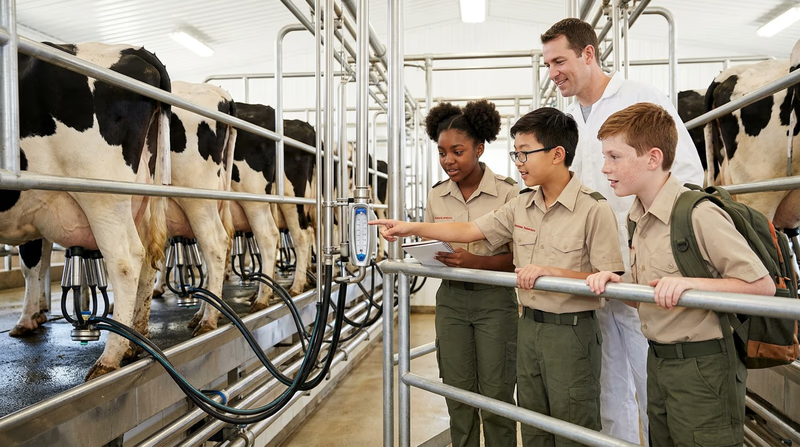
Req 6 — Dairy Option
This option covers milk production biology, milk components, Grade A standards, dairy equipment, terminology, and visiting a dairy operation. Complete all six sub-requirements (a–f) below.
Requirement 6a — How Cows Convert Feed to Milk
Milk production is an incredible biological process. A dairy cow’s body takes raw materials — grass, hay, grain, and water — and transforms them into a nutrient-rich liquid that contains protein, fat, sugar, vitamins, and minerals.
Here is how it works:
- Digestion — The cow eats forage and grain. In her rumen (remember the four-compartment stomach from Requirement 3?), billions of microorganisms ferment the fiber and break down nutrients.
- Nutrient absorption — Digested nutrients pass through the intestinal wall and enter the bloodstream.
- Mammary gland synthesis — Blood flows through the udder, where specialized cells in the mammary gland extract nutrients and synthesize milk components. It takes approximately 400–500 pounds of blood flowing through the udder to produce just one pound of milk.
- Milk letdown — When the cow is stimulated (by a calf suckling or by a milking machine), the hormone oxytocin triggers milk release from the udder.
Dairy vs. Beef Feeding
Dairy cows need far more energy and protein than beef cows because milk production is extremely demanding:
- Dairy cows eat a carefully balanced total mixed ration (TMR) that combines forages (corn silage, alfalfa hay) with grains (corn, soybean meal) and supplements (minerals, vitamins). A high-producing dairy cow may eat 100+ pounds of feed per day.
- Beef cows eat primarily forage-based diets — pasture grass and hay. Their nutritional needs are lower because they are not producing milk at the same volume. Grain is typically only added during the finishing period in a feedlot.
Requirement 6b — Milk Components Chart
Here are the approximate components of whole cow’s milk and goat’s milk:
Cow’s Milk (per 100g):
| Component | Amount |
|---|---|
| Water | 87.0% |
| Lactose (milk sugar) | 4.9% |
| Fat | 3.7% |
| Protein (casein + whey) | 3.4% |
| Minerals (ash) | 0.7% |
| Vitamins | Trace |
Goat’s Milk (per 100g):
| Component | Amount |
|---|---|
| Water | 87.0% |
| Lactose | 4.4% |
| Fat | 4.1% |
| Protein | 3.6% |
| Minerals (ash) | 0.8% |
| Vitamins | Trace |
Requirement 6c — Grade A Milk and Pasteurization
Grade A Milk Standards
Grade A milk is produced under strict sanitation standards enforced by the U.S. Food and Drug Administration (FDA) through the Pasteurized Milk Ordinance (PMO). Requirements include:
- Somatic cell count (SCC) must be below 750,000 cells per mL — high SCC indicates udder infection (mastitis)
- Bacteria count must be below 100,000 colony-forming units per mL before pasteurization
- Temperature — milk must be cooled to 45°F (7°C) or below within 2 hours of milking
- Facility standards — milking parlors must meet cleanliness requirements for walls, floors, ventilation, and lighting
- Equipment — all surfaces that contact milk must be smooth, non-absorbent, and easily cleaned
- Regular inspections — farms are inspected at least twice per year
Pasteurization
Pasteurization is the process of heating milk to kill harmful bacteria. It was developed by French scientist Louis Pasteur in the 1860s.
How it works:
- HTST (High Temperature, Short Time) — milk is heated to 161°F (72°C) for 15 seconds, then rapidly cooled. This is the most common method.
- UHT (Ultra-High Temperature) — milk is heated to 280°F (138°C) for 2 seconds, giving it a much longer shelf life.
Why it matters: Raw milk can contain dangerous bacteria like Salmonella, E. coli, and Listeria. Pasteurization eliminates these pathogens while preserving the taste and nutritional value of milk.
Requirement 6d — Milking Equipment and Sanitation
Milking Equipment
Modern dairy farms use several types of milking systems:
- Pipeline milking systems — Milk travels from the cow through a pipeline directly to a bulk tank. Most common in tie-stall barns.
- Milking parlors — Cows walk into a specialized room designed for efficient milking. Common types include parallel, herringbone, and rotary parlors.
- Robotic milking systems — Fully automated systems where cows enter voluntarily and are milked without a human operator (covered in Requirement 5c).
Key equipment in any system includes:
- Milking unit — Four teat cups attached to a claw that applies gentle vacuum to extract milk
- Pulsator — Alternates vacuum and rest to mimic a calf’s suckling pattern
- Bulk tank — A refrigerated stainless steel tank that cools and stores milk until pickup
- CIP (Clean-In-Place) system — Automated cleaning that flushes the milking system with hot water, detergent, and sanitizer after every milking
Sanitation Standards
- All equipment surfaces must be cleaned and sanitized before and after each milking
- Udders must be cleaned and dried before attaching the milking unit (pre-dipping with disinfectant)
- Teats are dipped in a disinfectant solution after milking (post-dipping) to prevent bacteria from entering the open teat canal
- Bulk tanks must maintain milk at 45°F or below
- Milking areas must be kept clean, well-ventilated, and free of pests
Requirement 6e — Dairy Terminology
Cattle terms:
- Bull — An intact male bovine used for breeding.
- Cow — A mature female bovine that has had at least one calf.
- Steer — A castrated male bovine, typically raised for beef.
- Heifer — A young female bovine that has not yet had a calf.
- Springer — A heifer or cow that is close to calving (about to “spring” into milk production). On dairy farms, springers are monitored closely as they approach their due date.
Goat terms:
- Buck — An intact male goat used for breeding. Also called a “billy.”
- Doe — A female goat. Also called a “nanny.”
- Kid — A young goat of either sex.
Requirement 6f — Visit a Dairy Operation
Questions to Ask During Your Visit
Or research these topics if visiting online
- How many cows are milked and how often?
- What breed of cattle or goats is used?
- What do the animals eat, and how is the ration prepared?
- What milking system is used (parlor, pipeline, robotic)?
- How is milk cooled, stored, and picked up?
- What sanitation procedures are followed?
- What is the biggest challenge in dairy farming today?