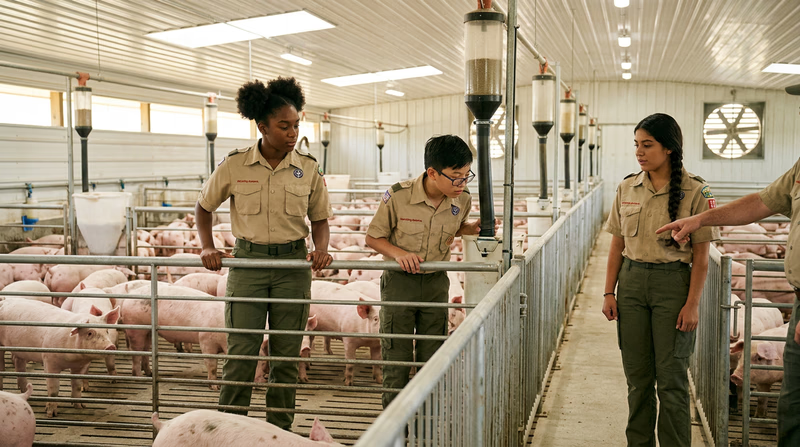
Req 6 — Hog Option
This option covers pork cuts and USDA grading, feeding programs, hands-on experience, and swine terminology. Complete all four sub-requirements (a–d) below.
Requirement 6a — Pork Cuts and USDA Grading
Primal (Wholesale) Cuts of Pork
Your sketch should show a side view of a hog with the primal cuts marked:
- Shoulder (Boston Butt) — Pulled pork, shoulder roasts, blade steaks. A heavily worked muscle that benefits from slow cooking.
- Picnic shoulder — Roasts, smoked picnic ham, ground pork.
- Loin — The largest and leanest primal. Includes pork chops (rib, center-cut, sirloin), tenderloin, and back ribs. The loin runs along the top of the back.
- Belly — Bacon and spare ribs. Pork belly has become a popular restaurant item on its own.
- Ham (leg) — Fresh ham roasts, cured ham, ham steaks. The ham is the entire rear leg.
- Side/Spareribs — St. Louis–style ribs are cut from this area.
- Jowl — The cheek, often cured like bacon. Used in Southern cooking.
- Feet (trotters) — Used in specialty dishes and for making gelatin.
USDA Pork Grading
Unlike beef, pork grading is less commonly used at retail. The USDA grades for pork are:
- U.S. No. 1 — Highest quality. The most muscular carcass with the least backfat. The loin eye is large, and the carcass has a high percentage of lean cuts.
- U.S. No. 2 — Slightly less muscling and slightly more backfat than No. 1.
- U.S. No. 3 — Average muscling and moderate backfat.
- U.S. No. 4 — Below-average muscling and excessive backfat.
- Utility — Lowest grade. Very thin, poorly muscled carcasses or those with defects.
Basis for grading: Pork grades are based primarily on two measurements:
- Backfat thickness — Measured at the last rib. Less backfat means a leaner, higher-graded carcass.
- Muscling — Evaluated by the size of the loin eye (the cross-section of the longissimus muscle at the last rib). Larger loin eyes indicate more lean meat.
Requirement 6b — Feeding Programs
Hog feeding is divided into distinct phases, each with different nutritional goals. Here is the lifecycle from breeding through market:
Phase 1: Gestation (Breeding to Farrowing — about 114 days)
A bred gilt (first-time mother) or sow needs a diet that supports fetal development without making her too fat:
- Feed: A corn-soybean meal diet with added vitamins and minerals
- Amount: 4–6 pounds per day (restricted feeding to prevent excess weight gain)
- Key nutrients: Adequate protein (12–14%), calcium, and phosphorus for developing piglets
- Goal: Maintain body condition score of 3 (on a 1–5 scale)
Phase 2: Lactation (Farrowing to Weaning — about 21 days)
Once the sow gives birth (farrows), her nutritional needs skyrocket. She is now producing milk for 8–14 piglets:
- Feed: A high-energy, high-protein diet (16–18% protein)
- Amount: Increase gradually to full feed — a lactating sow may eat 12–16 pounds per day
- Key nutrients: Extra energy (often from added fat), lysine (an essential amino acid for milk production), calcium, and phosphorus
- Water: A lactating sow can drink 6–8 gallons of water per day
- Goal: Maximize milk production and minimize weight loss in the sow
Phase 3: Nursery (Weaning to ~50 lbs — about 5–6 weeks)
Newly weaned piglets transition from milk to solid feed. This is a stressful period:
- Feed: Highly palatable, easily digestible starter diets with dried whey, soybean meal, and added flavoring
- Protein: 20–22% (high to support rapid growth)
- Feeding: Free-choice (available at all times)
- Goal: Minimize weaning stress and get piglets eating solid feed as quickly as possible
Phase 4: Growing (50 lbs to ~130 lbs)
Piglets are now called “growers” and are building frame and muscle:
- Feed: Corn-soybean meal diet with 16–18% protein
- Feeding: Free-choice
- Goal: Maximize lean growth
Phase 5: Finishing (130 lbs to market weight, ~280 lbs)
The final phase focuses on reaching market weight efficiently:
- Feed: Corn-soybean meal diet with 13–15% protein (lower than growing phase)
- Feeding: Free-choice
- Goal: Efficient weight gain while maintaining lean meat quality
- Duration: About 8–10 weeks
Requirement 6c — Raise or Visit
Option 1: Raise a feeder pig from weaning to market weight. Keep records of feed intake, weight gains, medication, vaccination, and mortality.
Option 2: Visit a farm where hogs are produced, or visit a packing plant handling hogs. Describe what you saw and explain what you learned. If you cannot visit, view a video or research online (with parent/guardian permission).
Farm Visit Questions
Topics to explore during your visit
- What breed or crossbreed of hogs is raised?
- How are the hogs housed (indoor confinement, hoop barns, pasture)?
- What do they eat, and how is feed delivered?
- What biosecurity measures are in place?
- How are piglets managed from birth through weaning?
- What is the current market price for finished hogs?
Requirement 6d — Hog Terminology
- Gilt — A young female pig that has not yet had a litter of piglets. Once she farrows (gives birth) for the first time, she becomes a sow.
- Sow — A mature female pig that has had at least one litter.
- Barrow — A male pig that has been castrated. Barrows are raised for meat production because they grow more efficiently and produce better-tasting pork than intact males.
- Boar — An intact male pig used for breeding. Boars are also the term used for wild pigs.