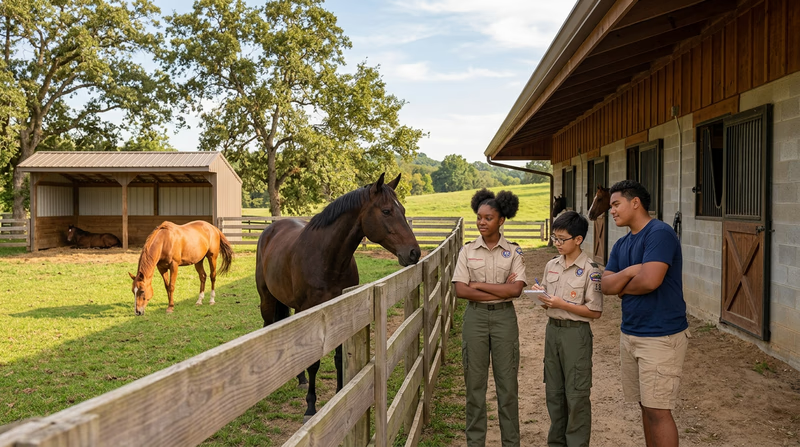
Req 6 — Horse Option
This option covers barn design, equine history, horse terminology and color patterns, visiting a horse farm, and equine nutrition. Complete all five sub-requirements (a–e) below.
Requirement 6a — Horse Barn Design
A well-designed horse barn keeps horses safe, healthy, and comfortable while making daily chores efficient for the caretaker. Your sketch should include:
Barn features:
- Stalls — Each horse needs a stall at least 12 × 12 feet (larger for draft breeds). Stalls should have solid lower walls and open upper walls or bars for ventilation and social interaction.
- Aisle — A center aisle at least 10–12 feet wide for leading horses and moving equipment.
- Feed room — A secure, rodent-proof room for storing grain and supplements.
- Hay storage — Can be a loft above or a separate structure (storing hay in a separate building reduces fire risk).
- Tack room — For storing saddles, bridles, grooming supplies, and other equipment.
- Wash rack — An area with drainage and cross-ties for bathing and grooming horses.
- Ventilation — Ridge vents, windows, or fans to keep air flowing. Good airflow prevents respiratory disease.
- Water — Automatic waterers or buckets in each stall, plus a water source in the aisle.
Exercise yard (paddock):
- Fencing — Board fencing, pipe fencing, or coated wire. Never use barbed wire for horses — they can be badly injured by it.
- Size — At least a half-acre per horse for turnout.
- Footing — Good drainage to prevent muddy conditions.
- Shade — Trees or a run-in shed for weather protection.
- Gate — Wide enough for a horse and handler to pass through safely (at least 4 feet).
Requirement 6b — History and Uses of Horses
A Brief History
Horses evolved in North America over 55 million years, starting as small, multi-toed forest animals the size of a dog. They crossed land bridges to Asia and Europe, where they were eventually domesticated around 4,000–3,500 BCE on the steppes of Central Asia.
Ironically, horses went extinct in North America around 10,000 years ago and were not seen on the continent again until Spanish explorers brought them back in the 1500s. Native peoples quickly adopted the horse, and it transformed life across the Great Plains.
Benefits to people through history:
- Transportation — Before cars, horses were the primary means of travel and freight hauling.
- Agriculture — Draft horses powered plows, harvesters, and wagons for centuries.
- Warfare — Cavalry units shaped the outcome of battles from ancient times through World War I.
- Communication — The Pony Express carried mail 1,800 miles across the American West in just 10 days.
- Recreation — Today, horses are used for riding, racing, showing, rodeo, polo, and therapeutic programs.
When discussing the breeds you chose in Requirement 1, focus on how each breed’s physical traits match its special use. A Thoroughbred’s long legs and lean build make it ideal for racing. A Quarter Horse’s muscular hindquarters give it explosive speed for cattle work.
Requirement 6c — Horse Terminology
Gender and age terms:
- Mare — A mature female horse (4 years or older).
- Stallion — An intact male horse used for breeding.
- Gelding — A castrated male horse. Geldings are generally calmer and easier to handle than stallions.
- Foal — A young horse of either sex, from birth to one year.
- Colt — A young male horse, typically under 4 years.
- Filly — A young female horse, typically under 4 years.
Type and use terms:
- Mustang — A free-roaming horse of the American West, descended from Spanish horses brought by explorers. Mustangs are managed by the Bureau of Land Management.
- Quarter Horse — A breed developed in America for short-distance racing and cattle work, named for its speed over a quarter mile.
- Draft horse — A large, heavy horse bred for pulling loads. Breeds include Clydesdale, Percheron, Belgian, and Shire.
- Pacer — A harness racing horse that moves both legs on the same side of its body simultaneously (lateral gait).
- Trotter — A harness racing horse that moves its legs in diagonal pairs (diagonal gait).
Color and pattern terms:
- Pinto — A horse with large patches of white and another color (brown, black, etc.). A color pattern, not a breed.
- Calico — A term sometimes used for a pinto-patterned horse with three or more colors, similar to a calico cat.
- Palomino — A golden-yellow body color with a white or light cream mane and tail.
- Roan — A base color mixed evenly with white hairs throughout the body. A red roan has a chestnut base; a blue roan has a black base.
- Overo — A pinto pattern where white patches are irregular and typically do not cross the back. Often has a white face.
- Tobiano — A pinto pattern where white patches are regular and rounded, typically crossing the back. Legs are usually white.
Requirement 6d — Visit a Horse Farm
Questions to Ask During Your Visit
Or research these topics online
- What breeds are kept at this farm and for what purpose?
- How are the horses housed and exercised?
- What do they eat, and how often are they fed?
- How is health care managed (farrier, veterinarian, vaccinations)?
- What training methods are used?
- What is the daily routine for caring for the horses?
Requirement 6e — Horse Feeding and Colic
Feeding a Horse Doing Light Work
A horse doing light work (trail riding a few times per week, light schooling) needs:
- Forage first — The foundation of any horse’s diet is hay or pasture. A horse should eat 1.5–2% of its body weight in forage per day. For a 1,000-pound horse, that is 15–20 pounds of hay.
- Grain — Light-work horses may need little or no grain. If grain is fed, 2–4 pounds per day of a commercial feed is typically sufficient.
- Water — A horse drinks 8–12 gallons of water per day.
- Salt and minerals — A salt block or loose salt should be available at all times.
Why Feed Changes with Work Level
A horse’s energy needs increase dramatically with work intensity. A horse in heavy training (racing, eventing, ranch work) may need 2–3 times the calories of a horse at rest. The extra energy comes from increased grain, higher-quality hay, and sometimes added fat (like vegetable oil). Different breeds also have different metabolisms — an easy-keeping Quarter Horse may need less feed than a high-strung Thoroughbred doing the same amount of work.
Colic
Colic is a general term for abdominal pain in horses. It is the number one killer of horses and should always be treated as an emergency.
Common causes:
- Sudden changes in feed type or amount
- Eating too much grain at once
- Dehydration or insufficient water intake
- Sand ingestion from eating off sandy ground
- Parasite damage to the intestines
- Stress from travel, competition, or changes in routine
Symptoms:
- Pawing at the ground
- Looking at or biting at the flanks
- Rolling repeatedly
- Sweating without exercise
- Refusing to eat
- Lying down and getting up repeatedly
- Elevated heart rate