Req 6 — Sheep or Goat Option
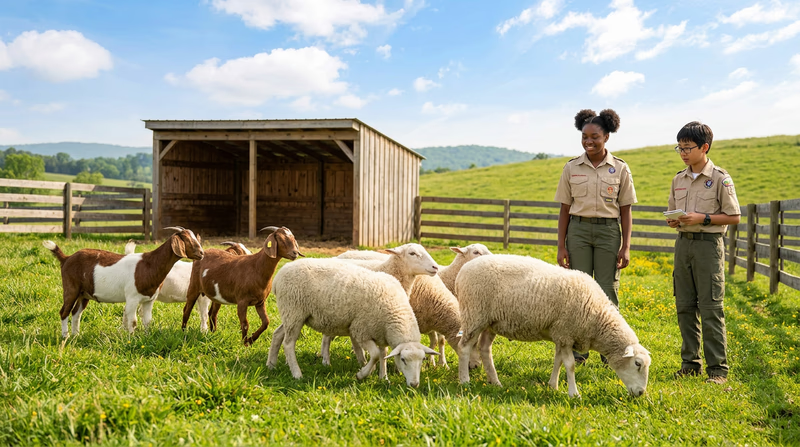
First, choose whether you want to focus on sheep or goats — then complete all five sub-requirements (a–e) below using your chosen animal.
Requirement 6a — Wholesale and Retail Cuts
Your sketch should show a side view of a lamb or goat with the primal (wholesale) cuts marked.
Lamb Primal Cuts
- Shoulder — Shoulder roasts, blade chops, ground lamb
- Rack — Rib chops, rack of lamb (the premium cut, often “Frenched” for presentation)
- Loin — Loin chops, saddle of lamb
- Leg — Leg of lamb (roasted whole or butterflied), leg steaks
- Breast/Foreshank — Riblets, stew meat, ground lamb
- Hind shank — Braised shanks
Goat Primal Cuts
Goat cuts are similar to lamb but goat meat (called chevon or cabrito when from a young kid) tends to be leaner:
- Shoulder — Roasts, stew meat
- Rack — Rib chops
- Loin — Loin chops
- Leg — Roasts, steaks
- Breast — Ribs, stew meat
Requirement 6b — Wool Sorting and Grading
After a sheep is shorn, the entire fleece is removed in one piece and must be sorted and graded before it can be processed into yarn and fabric.
Sorting
Sorting is the process of separating different quality sections of the same fleece. A single fleece contains wool of varying quality depending on where it grew on the sheep’s body:
- Shoulder and sides — The finest, most uniform wool
- Back — Good quality but may be weathered or sun-bleached
- Belly and legs — Coarser, often dirty or matted — this wool is separated out
- Britch (rear end) — The coarsest wool on the sheep
Skilled wool sorters can separate a fleece into 10–15 different grades by hand.
Grading
Wool is graded primarily by fiber diameter (measured in microns — one micron is one-thousandth of a millimeter). Finer wool is more valuable because it makes softer, more comfortable fabrics.
Common grading systems:
- Blood system — An older American system that grades wool as Fine, 1/2 Blood, 3/8 Blood, 1/4 Blood, Low 1/4 Blood, Braid, and Common. These names originally referred to the percentage of Merino blood in the sheep, but today they simply describe fiber diameter ranges.
- Spinning count system — A numerical system (e.g., 64s, 58s, 50s) indicating how many hanks of yarn can be spun from one pound of clean wool. Higher numbers mean finer wool.
- Micron system — The modern, scientific standard. Merino wool can be as fine as 11.5 microns. For comparison, a human hair is about 70 microns.
Other factors that affect wool grade include:
- Staple length — The length of the wool fiber
- Yield — The percentage of clean wool remaining after grease, dirt, and vegetable matter are washed out
- Strength — How resistant the fiber is to breaking
- Color — White wool commands the highest price because it can be dyed any color
Requirement 6c — Milk Products
Both sheep and goat milk are used to make a wide range of products:
From goat’s milk:
- Fluid drinking milk (fresh, pasteurized)
- Chèvre (soft, fresh goat cheese)
- Feta cheese (traditionally made from sheep or goat milk)
- Yogurt
- Butter
- Ice cream
- Soap and skin care products
- Cajeta (caramelized goat milk, popular in Mexican cuisine)
From sheep’s milk:
- Roquefort cheese (France)
- Pecorino Romano (Italy)
- Manchego (Spain)
- Feta (Greece — traditionally sheep’s milk or a sheep/goat blend)
- Ricotta (can be made from sheep’s milk whey)
- Yogurt
Requirement 6d — Raise or Visit
Option 1: Raise a lamb or goat from weaning to market weight. Keep records of feed intake, weight gains, medication, vaccination, and mortality.
Option 2: Visit a farm or ranch where sheep or goats are raised. Describe what you saw and explain what you learned. If you cannot visit, view a video or research online (with parent/guardian permission).
If you are raising an animal, keeping good records is essential:
Record-Keeping Essentials
Track these items weekly or as events occur
- Date and weight at each weigh-in
- Type and amount of feed consumed
- Any medications or treatments given (with dates and dosages)
- Vaccination dates and types
- Health observations (appetite, energy, body condition)
- Any deaths and their causes
If you are visiting a farm, ask about:
Farm Visit Questions
Topics to explore
- What breed is raised and why was it chosen?
- Is the operation focused on meat, milk, fiber, or a combination?
- How are the animals housed and what do they eat?
- How is the flock or herd managed for health and reproduction?
- What are the biggest challenges of raising sheep or goats?
Requirement 6e — Terminology
Sheep terms:
- Wether — A castrated male sheep. Wethers are raised for meat and are often used as show animals in 4-H and FFA.
- Ewe (pronounced “you”) — A female sheep of any age.
- Ram — An intact male sheep used for breeding. Also called a “tup” in some regions.
- Lamb — A young sheep under one year of age, of either sex.
Goat terms:
- Doe — A female goat.
- Nanny — Another common term for a female goat (though “doe” is preferred in the goat industry).
- Kid — A young goat of either sex.
- Buck — An intact male goat used for breeding.
- Billy — Another common term for a male goat (though “buck” is preferred in the industry).