 Getting Started
Introduction & Overview
Have you ever watched a cartoon character sprint off a cliff, hang in midair for a moment, look down, and then plummet? That moment — that pause, that comedic timing — is the magic of animation. Animation is the art of making still images appear to move, and it shows up everywhere: movies, video games, apps, medical simulations, weather maps, and even the emoji reactions on your phone.
The Animation merit badge takes you behind the scenes. You will learn how animators turn drawings and digital models into living, breathing characters. Better yet, you will create your own animations and discover whether this blend of art and technology sparks something in you.
Then and Now
Then — Drawing Life One Frame at a Time
Animation stretches back further than most people realize. In the 1830s, inventors created spinning devices like the zoetrope and the phenakistoscope — simple toys that used slits and spinning discs to trick the eye into seeing motion. By the early 1900s, artists like Winsor McCay were hand-drawing thousands of individual pictures to create short films. His 1914 film Gertie the Dinosaur amazed audiences who had never seen a drawing come alive on screen.
The real revolution came in 1928, when Walt Disney introduced Steamboat Willie — one of the first cartoons with synchronized sound. Disney’s studio went on to pioneer full-length animated films, starting with Snow White and the Seven Dwarfs in 1937. For decades, every frame of animation was drawn and painted by hand on transparent sheets called cels, then photographed one frame at a time.
- Tools: Pencil, paper, ink, paint, transparent cels, cameras
- Speed: A single second of animation required 12 to 24 individual drawings
- Team size: Hundreds of artists for a feature film
Now — Pixels, Processors, and Possibilities
Today, animators still draw — but they also sculpt digital 3D models, program physics simulations, and capture real human movement with motion-capture suits. A single artist with a laptop and free software can create animations that would have taken a full studio just a generation ago.
- Tools: Tablets, 3D software, game engines, AI-assisted tools
- Speed: Software can generate “in-between” frames automatically (a process called tweening)
- Reach: Animation appears in films, games, social media, medical training, architecture, courtroom presentations, and space mission planning
Get Ready! Whether you love drawing, enjoy working with technology, or just want to understand how your favorite shows and games are made, this merit badge has something for you. By the end, you will have created real animations with your own hands — and you will never watch a cartoon the same way again.
Kinds of Animation
Animation is not one single technique — it is an entire family of art forms. Here are the major types you might explore.
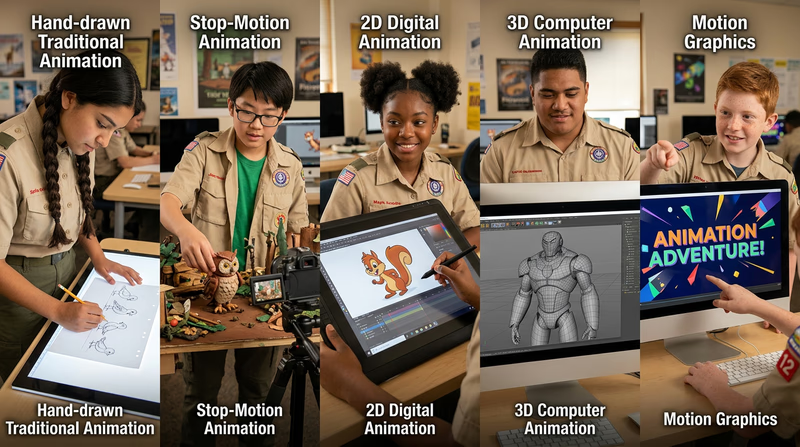
Traditional (Hand-Drawn) Animation
This is the classic approach: an artist draws each frame by hand, one after another. When the frames are played back quickly (usually 12 or 24 per second), the drawings appear to move. Classic Disney films like The Little Mermaid and The Lion King were made this way.
Stop-Motion Animation
Stop-motion animators physically move real objects — clay figures, puppets, paper cutouts, or even everyday items — and photograph each tiny change. When the photos are played in sequence, the objects appear to move on their own. Films like Wallace & Gromit, Coraline, and Kubo and the Two Strings are stop-motion masterpieces.
2D Digital Animation
This is hand-drawn animation’s modern cousin. Artists draw on tablets using software that handles coloring, layering, and playback. The drawings are still flat (two-dimensional), but the process is faster because the computer handles tasks like inking and “in-betweening.”
3D Computer Animation (CGI)
3D animators build digital models, apply textures and lighting, and then move those models through a virtual 3D space. This is the technique behind Toy Story, Frozen, and most modern animated films. It is also how characters move in video games.
Motion Graphics
Motion graphics bring text, shapes, logos, and data to life. Think of a title sequence in a movie, an animated infographic on the news, or the countdown timer on a sports broadcast. Motion graphics focus on graphic design elements rather than characters.
Experimental and Mixed Media
Some animators break all the rules. They paint directly on film strips, animate sand on a light table, combine live action with drawn characters, or use AI to generate moving images. Experimental animation pushes the boundaries of what “animation” even means.
Now that you know the many forms animation can take, let’s dive into the requirements — starting with the big question: what exactly is animation?