Req 1b — History of Animation
The Early Experiments (1800s)
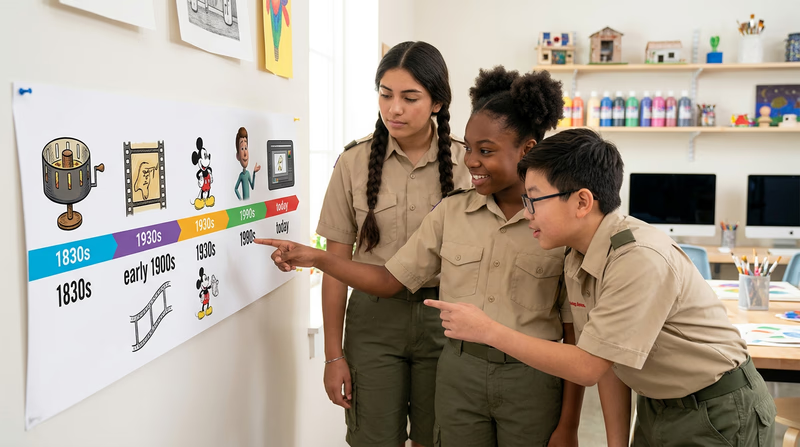
Long before movies existed, inventors were fascinated by the idea of making pictures move. In the early 1800s, a wave of clever devices appeared across Europe:
- Thaumatrope (1825): A simple disc with a different image on each side. Spin it fast, and the two images merge into one. A bird on one side and a cage on the other? Suddenly the bird appears inside the cage.
- Phenakistoscope (1832): A spinning disc with sequential drawings around the edge. View it through slits in front of a mirror, and the drawings appear to move.
- Zoetrope (1834): A spinning drum with images on a strip inside. Peer through the slits, and you see a short animation loop — a horse galloping, a dancer spinning.
These devices proved that the human eye could be tricked into seeing motion from a series of still images. That discovery would change everything.
The Birth of Animated Film (1900s–1920s)
Once motion picture cameras were invented in the 1890s, it was only a matter of time before artists started drawing directly for the screen.
- J. Stuart Blackton created Humorous Phases of Funny Faces (1906), often considered the first animated film. He drew faces on a chalkboard and photographed each change.
- Émile Cohl made Fantasmagorie (1908) in France — a two-minute film of simple stick figures that morph and transform.
- Winsor McCay raised the bar dramatically with Gertie the Dinosaur (1914). McCay drew thousands of frames to create a character with personality — Gertie bowed, drank water, and seemed to interact with McCay himself on stage.
The Golden Age (1930s–1960s)
Walt Disney transformed animation from a novelty into a major art form:
- Steamboat Willie (1928): One of the first cartoons with synchronized sound. Mickey Mouse whistled and the audience was hooked.
- Snow White and the Seven Dwarfs (1937): The first full-length animated feature film. Critics predicted it would fail. It became the highest-grossing film of its time.
- The multiplane camera: Disney’s team invented a camera that shot through layers of painted glass, creating a sense of depth. Backgrounds could scroll at different speeds, making forests and castles feel three-dimensional.
Other studios emerged during this era too. Warner Bros. gave us Bugs Bunny and Daffy Duck. Hanna-Barbera created Tom and Jerry. In Japan, Osamu Tezuka — known as the “God of Manga” — pioneered the style that would become anime, producing Astro Boy in 1963.
The Computer Revolution (1970s–2000s)
Computers began entering animation studios in the 1970s, slowly at first:
- Tron (1982): One of the first films to use extensive computer-generated imagery (CGI), though it was considered a risk at the time.
- Toy Story (1995): Pixar’s first feature film — and the first entirely computer-animated feature in history. The movie proved that 3D CGI could carry an emotional story, not just flashy visuals.
- Shrek (2001): DreamWorks showed that CGI animation was not a one-studio trick. The floodgates opened.
By the 2000s, most major animated films were made with computers. Traditional hand-drawn animation became rare in Hollywood, though it continued to thrive in anime studios in Japan and independent animation worldwide.
Animation Today and Beyond (2010s–Present)
Animation technology continues to evolve rapidly:
- Real-time rendering: Game engines like Unreal Engine now produce animation that looks nearly photorealistic — and can render it instantly, not over hours.
- Motion capture: Actors wear special suits with sensors so their movements can be recorded and applied to digital characters. This technique powered films like Avatar and games like The Last of Us.
- AI-assisted tools: New software can generate in-between frames, suggest movement, or even create rough animations from text descriptions. The technology is still young but advancing fast.
- Accessibility: Free tools like Pencil2D, Krita, and Blender mean anyone with a computer can start animating today.
You have seen how animation evolved from spinning discs to supercomputers. Next, you will learn the rules that make animation feel real.