Req 2 — The 12 Principles
Where the Principles Came From
In 1981, two legendary Disney animators — Frank Thomas and Ollie Johnston — published a book called The Illusion of Life: Disney Animation. In it, they described 12 principles that Disney animators had developed over decades of trial and error. These principles are not just opinions — they are based on how objects actually move in the real world and how the human eye perceives motion.
Professional animators still study and apply these principles today, whether they are drawing by hand or working in 3D software. Understanding them will make your own animations dramatically better.
The 12 Principles
1. Squash and Stretch
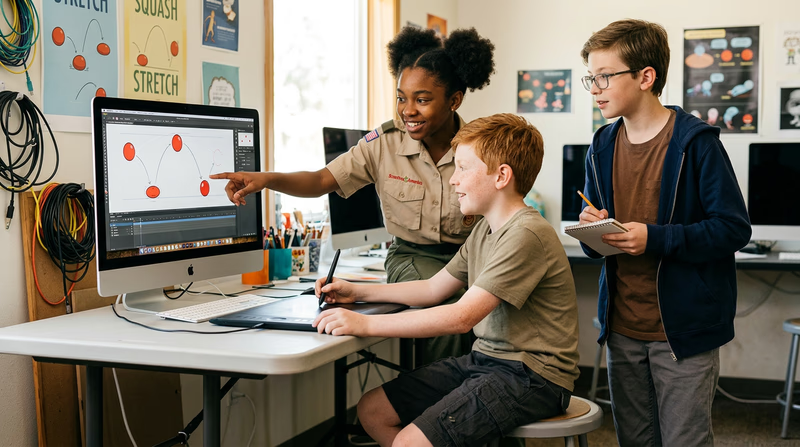
This is the most important principle. When an object moves, it changes shape slightly. A bouncing ball squashes flat when it hits the ground and stretches tall as it flies upward. This makes objects feel like they have weight and flexibility — not like rigid blocks.
Why it matters: Without squash and stretch, a bouncing ball looks like a rigid marble clicking against the ground. With it, the ball feels alive and springy.
2. Anticipation
Before a character does something, they prepare for it. A pitcher winds up before throwing. A character crouches before jumping. A person leans back before running forward. Anticipation tells the audience, “Something is about to happen — pay attention.”
Why it matters: Without anticipation, actions feel sudden and confusing. The audience does not have time to understand what is happening.
3. Staging
Staging is about presenting an idea so the audience immediately understands it. The character’s pose, position on screen, camera angle, and background all work together to direct attention to the most important action. Think of it like directing a play — every element guides the viewer’s eye.
Why it matters: Poor staging buries important actions in visual clutter. Good staging makes the story crystal clear even without dialogue.
4. Straight Ahead Action and Pose to Pose
These are two different ways to create animation:
- Straight ahead: Draw frame 1, then frame 2, then frame 3, and so on. This creates fluid, spontaneous movement but can be hard to control.
- Pose to pose: Draw the key poses first (the beginning, middle, and end of an action), then fill in the frames between them. This gives more control over timing and composition.
Most animators use a combination of both. Key poses provide structure; straight-ahead drawing adds energy.
Why it matters: Choosing the right approach (or mixing them) determines whether an animation feels controlled and polished or wild and energetic.
5. Follow Through and Overlapping Action
When a character stops moving, not everything stops at the same time. Hair keeps swinging. A cape continues to flow. Arms overshoot and swing back. Follow through is the continuation of movement after the main action stops. Overlapping action means different parts of a character move at different rates.
Why it matters: If everything stops at exactly the same frame, the character looks like a robot. Follow through and overlapping action make movement feel natural and organic.
6. Slow In and Slow Out
Objects in the real world do not start and stop instantly — they accelerate and decelerate. A car eases into motion and brakes gradually. A swinging pendulum slows at the top of its arc and speeds through the bottom. In animation, this means adding more frames at the beginning and end of an action (where movement is slower) and fewer frames in the middle (where it is fastest).
Why it matters: Without slow in and slow out, movements feel mechanical and robotic. With it, they feel smooth and natural.
7. Arcs
Almost all natural movement follows a curved path — an arc. When you throw a ball, it traces a parabola. When you turn your head, it follows a slight arc, not a straight line. Animating along arcs instead of straight lines makes movement look natural.
Why it matters: Straight-line movements look stiff and unnatural. Arcs give animation a flowing, lifelike quality.
8. Secondary Action
A secondary action supports the main action without taking attention away from it. If a character is walking (main action), they might also be whistling, swinging their arms, or adjusting their hat (secondary actions). These extra details add richness and personality.
Why it matters: Without secondary actions, characters feel flat and one-dimensional. Secondary actions reveal personality, emotion, and context.
9. Timing
Timing refers to the number of frames used for an action, which controls the speed of movement. Fewer frames mean faster action; more frames mean slower action. Timing is how animators create weight, mood, and emotion. A heavy elephant lands slowly (many frames). A small mouse darts quickly (few frames).
Why it matters: Timing is how the audience feels whether something is heavy or light, fast or slow, funny or serious. Get timing wrong, and the entire scene feels off.
10. Exaggeration
Animation does not have to match reality perfectly. In fact, it usually should not. Exaggeration means pushing movements, expressions, and poses beyond what is physically realistic to make them more exciting and readable. A surprised character’s eyes do not just widen — they bulge. A punch does not just connect — it sends the other character flying.
Why it matters: Perfectly realistic animation can actually look dull on screen. Exaggeration adds energy, humor, and clarity.
11. Solid Drawing
Solid drawing means giving characters a sense of three-dimensional volume and weight, even in 2D animation. An animator with solid drawing skills understands anatomy, perspective, and how forms look from different angles. In 3D animation, this translates to creating believable models and poses.
Why it matters: Characters drawn without solid drawing skills look flat, inconsistent, and “floaty.” Solid drawing grounds them in a believable space.
12. Appeal
Appeal does not mean every character has to be cute or pretty. It means every character should be interesting and engaging to watch. A villain can have appeal. A monster can have appeal. Appeal comes from clear design, readable shapes, strong personality, and a sense that this character is unique and alive.
Why it matters: If the audience does not find a character interesting to look at, they will not care about the story. Appeal is what makes you lean in instead of tune out.
Preparing for Your Discussion
Discussion Prep
Before meeting with your counselor
- Pick your five principles: Choose the ones you find most interesting or can explain best.
- Find examples: For each principle, think of a specific moment in a movie, show, or game where you have seen it used.
- Try it yourself: Sketch a simple example of at least one principle — even a stick-figure bouncing ball with squash and stretch counts.
- Practice explaining: Say your explanations out loud. If you can explain a principle to a friend and they understand it, you are ready.
Now that you understand the principles behind great animation, it is time to put them into practice.