Req 4b — The Future of Animation
Animation Is Already Everywhere
Before you think about the future, consider how animation already touches your daily life. You interact with animation when you:
- Scroll through social media (animated stickers, GIFs, video effects)
- Use GPS navigation (animated turn-by-turn directions)
- Play video games (every character, effect, and menu animation)
- Watch weather forecasts (animated radar, storm path projections)
- Use apps on your phone (loading spinners, transition effects, animated notifications)
Animation is not just entertainment — it is a tool for communication, education, and problem-solving. And that tool is getting more powerful every year.
Where Animation Is Heading
Healthcare and Medicine
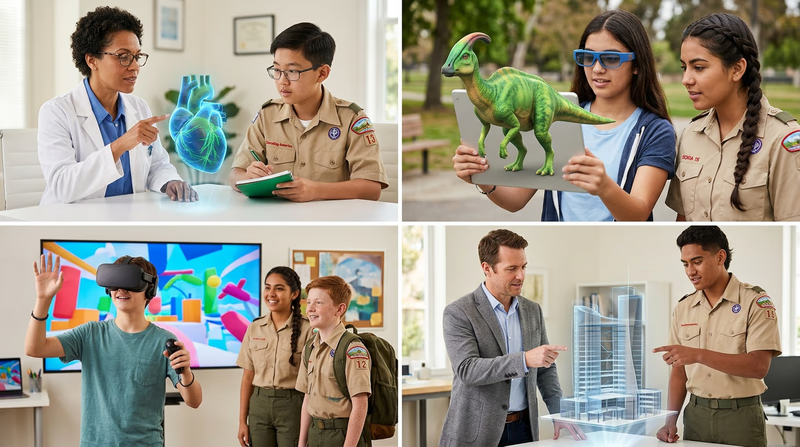
Animated 3D models already help doctors plan surgeries, but the future goes further. Imagine:
- Personalized medical animations created from your own MRI or CT scan data, showing your body in motion so doctors can spot problems before they become serious.
- Animated physical therapy guides that show you exactly how to perform exercises, adjusting in real time to your range of motion using your phone’s camera.
- Surgical training simulators so realistic that medical students can practice complex procedures in virtual reality before ever entering an operating room.
Education
Animation has the power to make difficult subjects click. Future classrooms might use:
- Interactive animated textbooks where you can manipulate a 3D model of a molecule, watch a historical battle unfold on a map, or see how a bridge handles stress.
- AI-generated animated tutors that explain concepts in different ways until you understand, adapting to your learning style in real time.
- Virtual field trips with fully animated historical environments — walk through ancient Rome, explore the ocean floor, or visit the surface of Mars.
Gaming and Entertainment
Video games and animated films will continue pushing boundaries:
- Real-time ray tracing makes lighting, reflections, and shadows in games look nearly photorealistic — and the technology improves every year.
- AI-driven characters could react to your words and actions in unpredictable, human-like ways, making games feel less scripted.
- Volumetric capture records real people as 3D animated models, blending live action and animation in ways we have never seen.
Communication and Social Media
Animation is becoming the language of online communication:
- Animated avatars that mirror your facial expressions in real time during video calls.
- Augmented reality (AR) filters that place animated characters and effects into your real-world surroundings through your phone’s camera.
- Personalized animated content that creates short videos or stories tailored to your interests, assembled by AI in seconds.
Architecture and Engineering
Animated simulations will play an even larger role in building the physical world:
- Digital twins — fully animated, real-time simulations of buildings, bridges, and cities that engineers can stress-test before construction begins.
- Construction previews that let residents see exactly how a new development will look in their neighborhood, complete with animated traffic flow, sunlight patterns, and landscaping through the seasons.
Space Exploration
NASA and other space agencies rely heavily on animation:
- Mission simulations that animate a spacecraft’s entire journey — launch, orbit, landing — so engineers can test every scenario before the real flight.
- Data visualization that turns raw telescope data into animated maps of distant galaxies, asteroid paths, and planetary surfaces.
Preparing for Your Discussion
A Deep Dive Into the Present and Future of Animation An in-depth article exploring current animation trends and where the industry is heading.You have explored where animation is going. Now let’s look at how you could make animation your career.