Req 1 — What Is Archaeology?
Archaeology is the study of past human life and cultures through physical evidence — the things people made, used, and left behind. Archaeologists dig up objects like pottery, tools, bones, and building foundations, but they are not just collecting cool stuff. They are piecing together the story of how people lived, what they believed, and how their world changed over time.
The key word is context. An arrowhead sitting in a display case is interesting. But an arrowhead found next to a fire pit, three feet underground, alongside deer bones and charcoal from a specific century — that tells a real story. Archaeologists care as much about where something was found as what it is.
How Archaeology Relates to Other Fields
Archaeology does not work alone. It overlaps with several other fields, and understanding those connections will help you see the bigger picture.
Anthropology is the broad study of human cultures and societies — past and present. Archaeology is actually a branch of anthropology in the United States. While a cultural anthropologist might live with a community today to study their traditions, an archaeologist studies communities that may have existed thousands of years ago by examining what they left in the ground.
History studies the past through written records — letters, books, government documents, newspapers. Archaeology picks up where history leaves off. For periods and places with no written records (most of human existence), archaeology is the only way to learn about the past. Even when written records exist, archaeology often reveals truths that documents missed or deliberately left out.
Geology is the study of the Earth — its rocks, minerals, and physical processes. Archaeologists rely heavily on geology. The layers of soil (called stratigraphy) at a dig site work like the pages of a book: deeper layers are older. Geologists also help archaeologists understand ancient landscapes, climate changes, and where people might have found raw materials for their tools.
Paleontology studies ancient life through fossils — mostly animals and plants that lived millions of years ago, long before modern humans existed. This is where many people get confused. If it is a dinosaur bone, that is paleontology. If it is a human-made tool found near an ancient campfire, that is archaeology. The simple dividing line: paleontology studies life forms; archaeology studies human-made things and human behavior.
Archaeology vs. Artifact Collecting and Treasure Hunting
This distinction is critical, and your counselor will want you to understand it clearly.
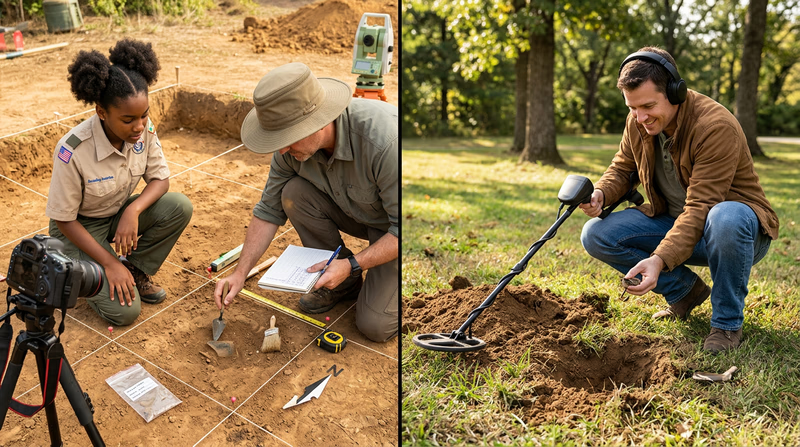
Artifact collectors and treasure hunters remove objects from the ground for personal enjoyment or profit. They might use metal detectors to find coins, dig up arrowheads to display on a shelf, or search for gold in old shipwrecks to sell. The object itself is all that matters to them.
Archaeologists study objects in place — recording exactly where each item was found, what surrounded it, and what layer of soil it came from. When an artifact is ripped out of the ground without this documentation, its story is lost forever. It becomes just a pretty object with no scientific value.
Here is a quick comparison:
| Archaeologist | Artifact Collector / Treasure Hunter | |
|---|---|---|
| Goal | Answer questions about past human life | Find and keep interesting objects |
| Method | Systematic excavation with detailed records | Digging or detecting without documentation |
| Context | Records every detail about where and how objects were found | Often ignores context |
| Legal | Works under permits and follows laws | May violate federal and state laws |
| Result | Knowledge shared with the public | Objects go into private collections |