Req 10 — Fieldwork Experience
This is the hands-on heart of the Archaeology merit badge. You have learned the theory — now you put it into practice by participating in real or simulated archaeological work.
Option A: Assist a Qualified Archaeologist
This option gets you into the field alongside a working professional. You need at least eight hours of participation, which might be spread across several days or completed in one or two long sessions.
Finding an Opportunity
Start looking early — archaeological projects have limited volunteer spots and often fill up months in advance. Here are places to look:
- Your merit badge counselor — They may already have connections to local archaeologists.
- State archaeological societies — Most states have societies that organize volunteer dig days and public archaeology events.
- Universities — College archaeology departments sometimes run summer field schools or community projects that welcome volunteers.
- National and state parks — Many parks have ongoing archaeological programs that accept volunteers.
- Museums — Natural history and anthropology museums often need help with laboratory work, collections management, or public programs.
What to Expect on Site
Tasks you might be assigned include:
- Excavation — Carefully removing soil with trowels and brushes, one layer at a time.
- Screening — Sifting removed soil through mesh screens to catch small artifacts.
- Recording — Taking photos, making drawings, filling out forms, and logging artifact locations.
- Surveying — Walking across a landscape looking for surface artifacts or features.
- Lab work — Washing, sorting, labeling, and cataloging artifacts.
What to Document
Keep a field journal during your experience. After your eight hours, be ready to discuss:
Fieldwork Reflection
Prepare to discuss these with your counselor
- What was the project about? What questions were the archaeologists trying to answer?
- What specific tasks did you do? Describe your hands-on involvement.
- Which steps of archaeological inquiry did you observe? (Site location, survey, excavation, analysis, interpretation, preservation, information sharing)
- What surprised you about the work?
- What did you learn that you could not have learned from a book or classroom?
Option B: Simulated Archaeological Project
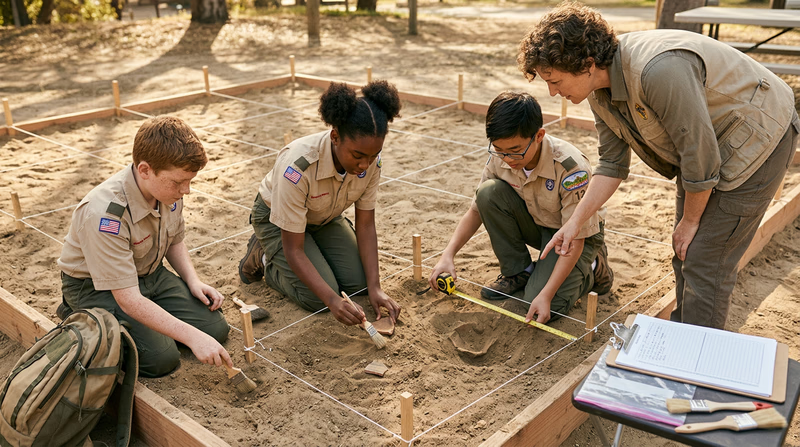
If a live dig is not available, a simulated site provides the same learning experience in a controlled setting. A qualified instructor sets up a mock excavation with planted artifacts and features, and you work through the archaeological process from start to finish.
What the Simulation Should Include
The simulation should mimic a real excavation as closely as possible:
- A prepared site with buried artifacts and features (fire pits, wall foundations, trash deposits) placed in realistic patterns.
- A grid system for mapping artifact locations.
- Recording materials — graph paper, measurement tools, cameras, and artifact bags.
- Multiple artifact types — pottery, stone tools, bones, charcoal, trade goods — chosen to tell a story when analyzed together.
Key Concepts to Demonstrate
During the simulation, focus on these ideas:
Spatial relationships — Where artifacts are found relative to each other matters enormously. A grinding stone found next to a fire pit tells a different story than one found next to a burial. Record the exact position of everything.
Environmental effects — Temperature, moisture, soil acidity, and biological activity all affect how artifacts survive (or don’t). Metal rusts. Wood rots. Pottery breaks but the pieces survive for millennia. Discuss with your counselor how these factors change what you would expect to find at a real site.
Time effects — Later activities can disturb earlier ones. A farmer plowing a field might scatter artifacts from an ancient village across the surface. Tree roots can push objects out of their original positions. Animals burrowing through the soil can mix layers together.
Sharing results — Think about how you would present your findings. Would you write a report? Create a museum display? Give a public talk? Post online? Archaeologists have a responsibility to share their work, and the format depends on the audience.