Req 11 — Sharing Archaeology
Archaeology does not end when artifacts are pulled from the ground. The final step — and one of the most important — is sharing what was learned. This requirement gives you two ways to do that: creating an exhibit for the public or using experimental archaeology to understand the past by doing.
Option A: Prepare an Archaeological Exhibit
Museum exhibits are how most people encounter archaeology. A well-designed exhibit does not just display objects — it tells a story, teaches a concept, and sparks curiosity. Helping prepare one gives you insight into how archaeologists communicate with the public.
What an Exhibit Needs
Exhibit Planning Checklist
Key elements of a good archaeological exhibit
- A clear theme or story. What is the exhibit about? What should visitors learn?
- Selected artifacts or replicas that support the story.
- Labels and panels that explain each object — what it is, where it was found, what it tells us.
- Visual context — maps, photographs, reconstructions, or diagrams that help visitors understand the site.
- A logical flow that guides visitors through the exhibit in a meaningful order.
- Accessibility — text should be readable, displays should be at a reasonable height, and information should be understandable by a general audience.
Your exhibit does not have to be in a major museum. It could be a display case at your school, a table at a Scout event, a poster presentation at a library, or a small exhibit at a local visitor center. What matters is the thought and planning behind it.
Where to Find Opportunities
- Local museums — Many small museums welcome volunteer help with exhibit design, artifact labeling, and display setup.
- Your school — Create a display for a hallway case or classroom.
- Scout events — Set up an exhibit at a camporee, troop meeting, or merit badge fair.
- Libraries and community centers — These often have display spaces available for educational exhibits.
Option B: Experimental Archaeology
Experimental archaeology is one of the most exciting branches of the field. Instead of just studying artifacts, you actually try to make them — or practice the skills that ancient people used — to understand how they were produced and what they reveal about past technology and knowledge.
What Is Experimental Archaeology?
The basic idea is simple: if you want to understand how ancient people made a stone tool, try making one yourself. If you want to know how long it took to build a structure, build a small-scale version. The hands-on experience often reveals things that studying finished artifacts alone cannot.
Project Ideas
Here are examples of experimental archaeology projects appropriate for Scouts (always work under the supervision of a qualified instructor):
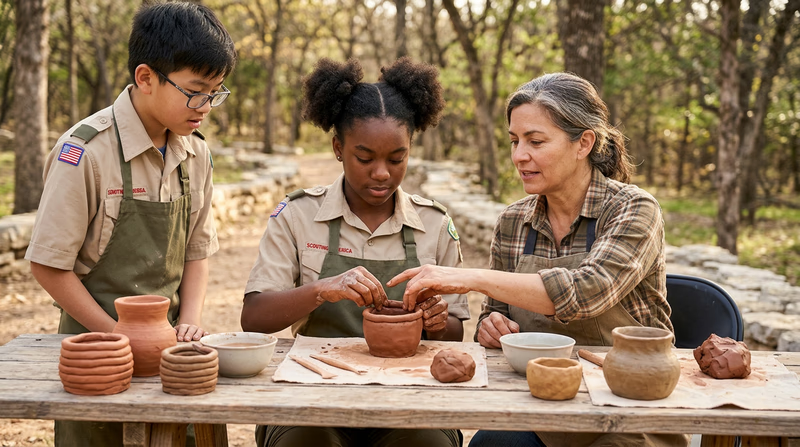
Pottery making — Use traditional methods (coil building or pinch pots with natural clay) to create a vessel without a potter’s wheel. Compare your results to ancient pottery.
Cordage and weaving — Twist plant fibers (like dogbane, milkweed, or yucca) into cord or rope using techniques that predate written history. This skill was essential for everything from fishing nets to baskets.
Fire starting — Use a bow drill, hand drill, or flint-and-steel to create fire the way people did for thousands of years. (This connects to your Scouting skills too.)
Flintknapping — Under careful supervision, learn to shape stone into tools by striking flakes off a core, just as people did for millions of years. This requires protective gear and expert guidance.
Natural dyes — Experiment with plants, minerals, and other natural materials to dye fabric or cordage, recreating ancient coloring techniques.
Cooking with ancient methods — Prepare food using techniques from the past — pit roasting, stone boiling (heating rocks and dropping them into water in a container), or grinding grain with a mano and metate.
Writing Your Report
After your experiment, write a brief report covering:
Experiment Report Outline
Include these sections in your writeup
- What skill or item did you attempt to re-create?
- What historical or archaeological evidence guided your experiment?
- What materials and methods did you use?
- What happened? Describe the process and your results.
- What worked well? What was harder than you expected?
- What did you learn about the past from this hands-on experience?
- How does this experiment change your understanding of the people who used this technology?