Req 3 — Dating the Past
One of the first questions anyone asks about an archaeological discovery is: “How old is it?” Figuring out the age of a site, a structure, or an artifact is one of the most important — and most fascinating — parts of archaeology. Archaeologists use two broad categories of dating methods: relative dating and absolute dating.
Relative Dating — Older or Younger?
Relative dating tells you which things are older or younger than other things, but it does not give you an exact date. Think of it like sorting a stack of family photos by who looks youngest — you can put them in order without knowing the exact year each photo was taken.
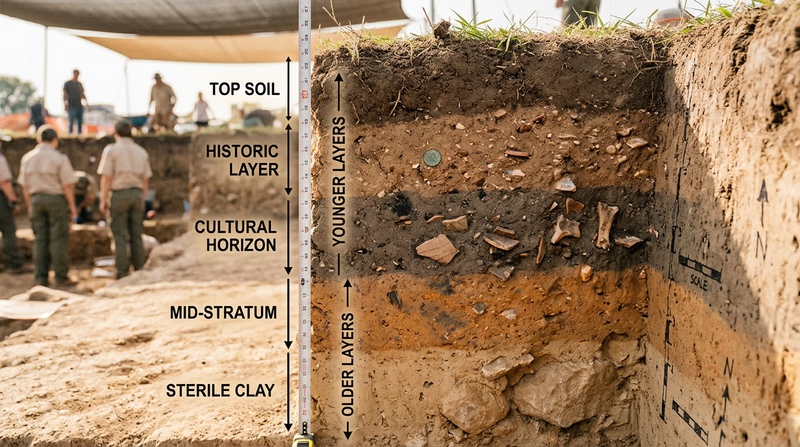
Stratigraphy is the most fundamental relative dating method. It is based on a simple principle: in undisturbed soil, deeper layers are older than layers above them. Imagine stacking pancakes on a plate — the first pancake you put down is on the bottom. When archaeologists dig through layers of soil (called strata), they know that artifacts found in deeper layers are generally older than those found closer to the surface.
Seriation is another relative dating technique. It tracks how the style of an artifact changes over time. For example, if you lined up cell phones from the last 20 years, you could put them in order based on size, shape, and features — even without knowing the exact year each model was released. Archaeologists do the same thing with pottery styles, tool shapes, and other artifacts.
Absolute Dating — How Old Exactly?
Absolute dating gives you an actual age — a number in years (or a range of years). This is much more precise than relative dating, but it usually requires special technology and laboratory analysis.
Radiocarbon dating (Carbon-14 dating) is the most well-known absolute dating method. Here is how it works: all living things absorb a radioactive form of carbon called Carbon-14 (C-14) from the atmosphere while they are alive. When an organism dies, it stops absorbing C-14, and the C-14 it already has slowly decays at a known, steady rate. By measuring how much C-14 remains in an organic sample (wood, bone, charcoal, seeds), scientists can calculate how long ago the organism died.
Radiocarbon dating works on materials up to about 50,000 years old. For anything older, archaeologists need other methods.
Dendrochronology (tree-ring dating) uses the annual growth rings of trees to establish precise dates. In good growing years, trees produce wide rings. In drought years, the rings are narrow. By matching ring patterns from living trees to those in old wood (from ancient buildings, for example), scientists have built continuous tree-ring records stretching back thousands of years. If a piece of wood from an archaeological site matches a known ring pattern, it can be dated to the exact year the tree was cut down.
Other Dating Methods
While stratigraphy, radiocarbon dating, and dendrochronology are the methods you will encounter most often, archaeologists have several other tools in their toolkit:
- Thermoluminescence (TL) — Measures the last time certain minerals (in pottery or burned stone) were heated. Useful for dating ceramics and hearths.
- Potassium-Argon dating — Used on volcanic rocks and extremely old sites. This method helped date some of the earliest human ancestor sites in Africa to millions of years ago.
- Obsidian hydration — Measures the amount of water absorbed by the surface of obsidian (volcanic glass) tools since they were made. The thicker the hydration layer, the older the tool.
Putting It All Together
In practice, archaeologists rarely rely on a single dating method. They combine relative and absolute techniques to cross-check their results. Stratigraphy might tell them that Layer A is older than Layer B. Radiocarbon dating of charcoal from Layer A might confirm it dates to around 3000 BCE. Pottery seriation might further support the timeline. The more lines of evidence that agree, the more confident archaeologists can be about their dates.