Req 7 — Artifacts Tell Stories
This requirement gives you three ways to explore a core idea in archaeology: objects tell stories about the people who made and used them. Choose the option that works best for you, and read the guidance below to get the most out of the experience.
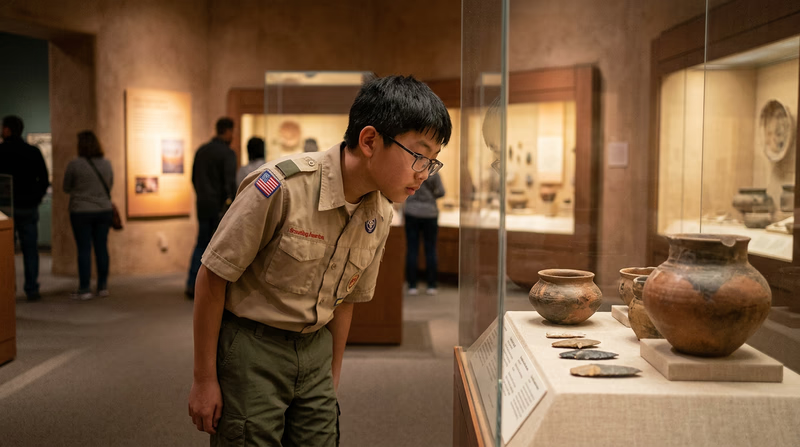
Option A: Visit a Museum
Museums are where archaeology meets the public. A well-designed exhibit does not just display objects behind glass — it uses those objects to tell a story about real people and their lives.
When you visit, pay attention to how the museum presents its artifacts:
Museum Visit Observation Guide
Look for these things during your visit
- How are artifacts arranged? By time period, by theme, by culture, or by material?
- What context does the museum provide? Read the labels and panels — do they explain where the object was found and what it tells us?
- Are there reconstructions or models? These help visitors imagine what the original site or object looked like in its prime.
- How do artifacts support the story? Pick one exhibit and think about how removing the key artifacts would change the narrative.
- What is missing? Are there gaps in the story? Perspectives that aren’t represented?
Option B: Family Artifact / Heirloom
Every family has objects that carry history — a grandmother’s ring, a war medal, an old tool, a recipe book, a piece of furniture. These objects are artifacts in the truest sense. They connect you to your family’s past the same way archaeological artifacts connect us to ancient cultures.
When preparing to present your family artifact, think about these questions:
- What is it? Describe the object — its material, size, condition, and any markings or details.
- Who did it belong to? What do you know about the person who owned or made it?
- How old is it? Can you estimate when it was made or acquired?
- What story does it tell? What does this object reveal about your family’s history, values, or experiences?
- How has it been preserved? Has it been kept in a special place? Passed down through specific people?
- What would an archaeologist think? If someone found this object in 1,000 years with no other information, what could they figure out from the object alone?
Option C: Trash Analysis (Garbology)
This option might sound funny, but it is based on a real branch of archaeology. In the 1970s, archaeologist William Rathje launched the Tucson Garbage Project, systematically studying what people threw away to learn about modern consumption patterns. What he found often contradicted what people said they did. People reported eating healthy food but threw out junk food wrappers. People said they recycled, but recyclable materials filled their trash cans.
Your job for this option is simpler — but the idea is the same. For one week, keep a list of everything your family throws away (you do not need to dig through the trash; just keep a running log as items go into the bin).
Then think about what a future archaeologist would learn from your trash:
Trash Analysis Questions
Discuss these with your counselor
- What materials are most common? (Plastic, paper, food waste, metal, glass?)
- What would survive 1,000 years? (Plastics and metals yes; food and paper mostly no.)
- What could an archaeologist conclude about your family’s diet from the food packaging?
- What technology do you use? (Broken electronics, batteries, charger cables?)
- How many people live in your household? Could an archaeologist figure that out from the trash?
- What would be completely invisible? (Digital purchases, streaming, online communication leaves no physical trace.)