Extended Learning
A. Introduction
Congratulations — you have earned the Archery merit badge! You have learned how to stay safe on the range, how arrows and bows work, how different archery formats are scored, and how to put arrows on target. But this is just the beginning. Archery is a sport you can enjoy and improve at for the rest of your life, from your backyard to a competition stage.
B. Deep Dive: Mental Focus and the Archer’s Mindset
Archery is sometimes called “meditation in motion,” and for good reason. At its core, every shot is a test of mental control. The best archers in the world do not just have strong arms and steady hands — they have trained their minds to stay calm, focused, and present on every single shot.
The challenge of consistency. In most sports, you react to something — a ball coming toward you, a defender closing in. In archery, there is nothing to react to. You create the action. This means every distraction — a gust of wind, the archer next to you, the thought “I need a 10 to win” — comes from inside your own head. Learning to manage those distractions is what separates good archers from great ones.
Shot routine as anchor. The 11 Steps of Shooting are not just a physical checklist — they are a mental framework. By doing the same thing in the same order every time, your conscious mind can relax and trust the process. Many Olympic archers describe their best performances as “automatic” — the body executes the shot while the mind simply observes.
Breathing techniques. Most competitive archers use controlled breathing to manage tension. A common pattern is to take a deep breath as you raise the bow, exhale half as you draw, hold briefly at anchor, and release on the natural respiratory pause. This reduces muscle tremor and steadies your aim.
Handling pressure. When the score matters — whether it is a merit badge round or a tournament — pressure builds. Experienced archers deal with this by focusing only on the current shot, not the score. They call this “one arrow at a time.” If you shot a bad arrow, it is gone. If you need a 9 to win, ignore that thought and focus on your process. The score takes care of itself when the form is right.
C. Deep Dive: Tuning Your Bow for Better Accuracy
Once you have solid form, the next step toward tighter groups is bow tuning — adjusting your equipment so that arrows fly as straight and consistently as possible. Even a perfectly executed shot will miss if the bow is not tuned to match your arrows.
Arrow spine matching. Every arrow shaft has a “spine” rating — a measure of how stiff it is. When the bowstring releases, the arrow actually bends around the riser before straightening out in flight (this is called the archer’s paradox). If the arrow spine does not match your draw weight and draw length, the arrow will wobble excessively and fly inconsistently. Arrow manufacturers publish spine charts that match shaft stiffness to draw weight — use them.
Paper tuning. One of the simplest tuning methods is to shoot an arrow through a sheet of paper stretched in a frame. A perfectly tuned bow produces a clean hole with three short vane tears evenly spaced around it (a “bullet hole”). If the tear is elongated in one direction, it tells you what to adjust — nocking point height, arrow rest position, or arrow spine.
Walk-back tuning. Shoot arrows at a vertical line on a target from increasing distances (10, 15, 20, 25 yards). If the arrows drift consistently left or right as the distance increases, your arrow rest needs a small horizontal adjustment.
Bare-shaft tuning. Shoot two groups — one with fletched arrows and one with unfletched (bare) shafts. If the bare shafts consistently hit to the left or right of the fletched group, the arrows are too stiff or too weak for your setup.
Tuning can seem technical, but even basic adjustments make a noticeable difference. Your local pro shop or club instructor can walk you through the process with your own equipment.
D. Deep Dive: Archery as a Competitive Sport
If you enjoyed shooting for your merit badge, competitive archery offers a path to push yourself further. There are opportunities at every level — from local club tournaments all the way to national championships and the Olympic Games.
USA Archery JOAD (Junior Olympic Archery Development). JOAD is the official youth development program of USA Archery. It is designed for archers under 21 and offers a structured progression of achievement pins and awards based on scored rounds. JOAD clubs meet regularly and provide coaching, equipment, and a supportive team environment. Many of America’s Olympic archers started in JOAD.
Scholastic archery programs. The National Archery in the Schools Program (NASP) introduces archery in school physical education classes and offers local, state, and national tournaments. NASP uses a standardized format — Genesis compound bows and NASP-approved arrows — so all students compete on a level playing field.
USA Archery tournaments. USA Archery runs a full national tournament schedule, including indoor nationals, outdoor nationals, and the U.S. Open. Events are organized by age group and equipment division (recurve, compound, barebow), so you are always competing against archers with similar equipment and experience.
World Archery and the Olympics. At the international level, World Archery governs the sport, and archery has been part of the Olympic Games since 1900 (with some interruptions). Olympic archery uses recurve bows exclusively, while the World Archery Championships include all divisions.
USA Archery — JOAD Program Learn about the Junior Olympic Archery Development program, find a JOAD club near you, and see how to start competing.E. Real-World Experiences
Ready to take your archery off the range? Here are some real-world experiences worth seeking out:
Visit a Local Archery Pro Shop
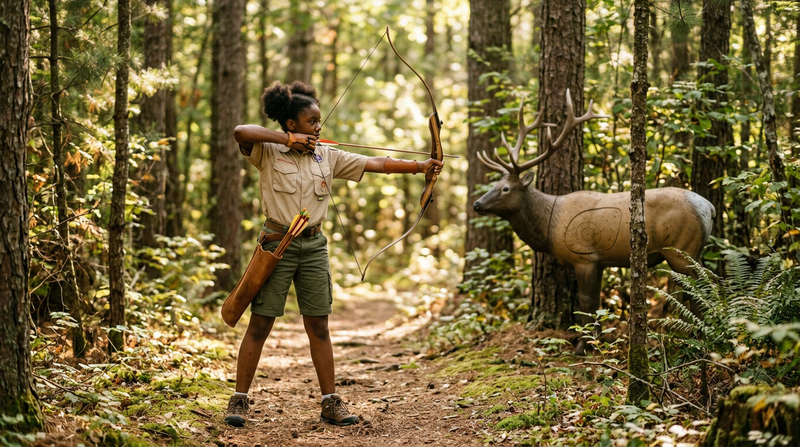
Shoot a 3-D Archery Course
Attend a USA Archery Tournament as a Spectator
Try Archery at a Scout Camp
F. Organizations
These organizations can help you continue your archery journey:
The national governing body for the sport of archery in the United States. Offers clubs, tournaments, coaching certification, and the JOAD youth development program.
The largest field archery organization in the United States. Hosts field, 3-D, and indoor tournaments across the country with divisions for all ages and skill levels.
The trade organization for the archery and bowhunting industry. Their consumer site, Archery 360, offers excellent beginner resources and a tool to find ranges and shops near you.