Req 3 — Accessories & Terminology
Req 3a — Archery Accessories
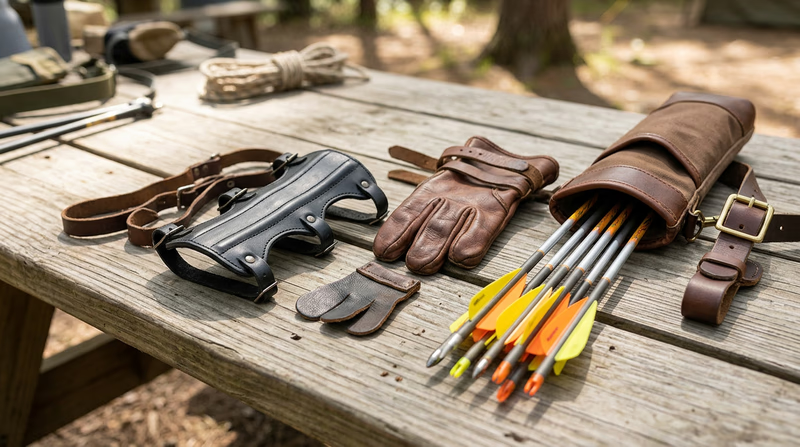
Archery accessories are not optional extras — they protect your body and keep your equipment organized. Here is what each one does and why you need it.
Finger Tab
A finger tab is a small piece of leather or synthetic material that fits over the fingers you use to pull the bowstring (usually the index, middle, and ring fingers). It protects your fingers from the repeated friction of the string and gives you a smoother release.
- Use: Place the tab over your drawing fingers before each shooting session. The smooth surface lets the string slide off your fingers cleanly.
- Why: Without a tab, the bowstring digs into your fingertips. After just a few shots, you will develop painful blisters that make it hard to shoot well.
- Care: Wipe down after use to remove sweat and oils. Leather tabs can be lightly conditioned to stay supple.
- Storage: Store flat in a dry place. Do not crumple or fold.
Arm Guard (Bracer)
An arm guard is a flat piece of leather, plastic, or composite material that straps to the inside of your bow arm (the arm holding the bow). It protects your forearm from being hit by the bowstring when you release an arrow.
- Use: Strap it to the inside of your bow arm before shooting. Make sure it covers the area from wrist to just below the elbow.
- Why: A bowstring slapping bare skin hurts — and it leaves a welt that can take days to heal. Even experienced archers wear arm guards because even good form occasionally produces a string slap.
- Care: Wipe clean after use. Check straps and buckles for wear.
- Storage: Store flat. Do not stack heavy items on top of it.
Shooting Glove
A shooting glove covers the three drawing fingers with individual leather or synthetic finger stalls. It serves the same purpose as a finger tab — protecting your fingers from the bowstring — but some archers prefer the feel of a glove because it stays in place more securely.
- Use: Slide it on your drawing hand before shooting. Each finger stall should fit snugly.
- Why: Like a tab, a glove prevents blisters and gives a consistent release. Some archers prefer gloves for cold-weather shooting because they also provide warmth.
- Care: Air dry after use. Leather gloves can be conditioned occasionally.
- Storage: Store flat with fingers extended, not balled up.
Quiver
A quiver holds your arrows safely and keeps them accessible. Quivers come in several styles:
Hip quiver: Hangs from your belt at your side. Most common for target archery.
Back quiver: Slings over your shoulder with arrows pointing up behind you. Traditional style, popular for field archery and historical reenactment.
Ground quiver: A stand that holds arrows upright next to the shooting line. Common at ranges.
Bow-mounted quiver: Attaches directly to the bow. Used mainly for bowhunting.
Use: Place arrows point-down in the quiver (hip or ground quiver) or point-up (back quiver). Always retrieve arrows from the quiver — never from the ground or your other hand.
Why: Loose arrows are a tripping and stabbing hazard. A quiver keeps them organized, protected, and ready to use.
Care: Check for worn stitching, broken clips, or bent supports. Clean fabric quivers periodically.
Storage: Store upright or hanging. Remove arrows before long-term storage.
Req 3b — Key Archery Terms
Understanding these four terms will help you communicate with instructors, shop staff, and fellow archers.
Draw Length
Your draw length is the distance you pull the bowstring back from the bow’s grip to your anchor point (the consistent spot on your face where you hold the string at full draw). It is measured in inches and is determined by your arm span and body proportions.
Draw length matters because it determines how long your arrows need to be and how the bow is set up for you. An arrow that is too short is dangerous — it can fall off the arrow rest and jam into the bow. An arrow that is too long is less efficient and harder to control.
Draw Weight
Draw weight is the amount of force (measured in pounds) required to pull the bowstring back to full draw. A 20-pound draw weight means you need to exert 20 pounds of pulling force to reach full draw.
For beginners, a draw weight of 15–25 pounds is typical. Competitive target archers may use 30–50 pounds. Bowhunters often use 40–70 pounds or more, depending on the game they pursue and state minimum requirements.
Using a draw weight that is too heavy causes fatigue, poor form, and even injury. It is always better to start light and build up.
Mechanical Release
A mechanical release (or release aid) is a handheld device that clips onto the bowstring and releases it with a trigger mechanism instead of your fingers. Mechanical releases are used almost exclusively with compound bows. They provide an extremely clean, consistent release that eliminates the inconsistency of a finger release.
Release aids come in several styles — wrist-strap triggers, handheld thumb triggers, and back-tension releases that fire when you expand your back muscles.
Barebow
Barebow is a shooting style where the archer uses a recurve bow with no sights, stabilizers, clickers, or other aiming devices attached to the bow. The archer aims using instinct, gap shooting (using the arrow tip as a reference point), or string walking (moving the finger position on the string to adjust aim for different distances).
Barebow is a recognized competition division in both USA Archery and World Archery events. It is considered one of the most challenging and rewarding styles because the archer relies entirely on skill and feel.
USA Archery — Equipment Rules Official equipment rules and division definitions from USA Archery, including barebow and other competition categories.