Req 4 — Formats & Scoring
This requirement covers four topics that every archer needs to understand:
- Ends and rounds — how shooting is organized
- Field, target, and 3-D archery — the three main formats
- World Archery five-color target scoring — the Olympic-style target
- NFAA target scoring — the field and indoor targets used in national competition
Req 4a — Ends and Rounds
These two terms describe how shooting is organized in archery competitions and practice sessions.
What Is an End?
An end is a set of arrows shot before the archer walks to the target to score and retrieve them. In most target archery, an end consists of three or six arrows. After shooting the arrows in an end, the archers stop, score their arrows, pull them from the target, and return to the shooting line.
Think of an end like an “at bat” in baseball — it is one turn at the line.
What Is a Round?
A round is a complete set of ends that makes up a full scoring event. A round defines the total number of arrows, the distance(s), and the target size. Different organizations and competition levels use different rounds.
For example:
- A USA Archery indoor round might consist of 20 ends of three arrows each (60 arrows total) shot at 18 meters.
- An NFAA field round might consist of 14 targets at various distances.
Think of a round like a “game” — it is the full competition from start to finish.
Req 4b — Field, Target, and 3-D Archery
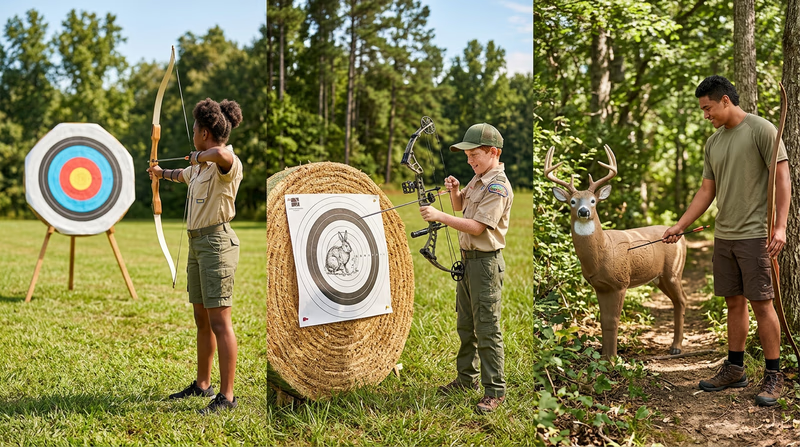
Target Archery
Target archery is the most structured form of the sport. Archers shoot at round, multi-colored paper or cardboard targets from fixed, known distances on a flat, open range. Distances are clearly marked, and conditions are as consistent as possible.
- Setting: Flat, open range (indoor or outdoor)
- Targets: Round, concentric-ring targets (World Archery five-color or NFAA single-color)
- Distances: Fixed and known (e.g., 18m indoors, 30–70m outdoors)
- Key skill: Precision and consistency at a known distance
Field Archery
Field archery takes place on a walking course through varied terrain — typically woods, hills, and open fields. Archers move from target to target, shooting at different distances and angles. Some targets have marked distances; others require the archer to estimate the range.
- Setting: Wooded or hilly course, outdoor only
- Targets: Paper targets on foam or straw bales placed at various positions
- Distances: Varying, sometimes marked, sometimes unmarked
- Key skill: Distance judgment and adapting to terrain
3-D Archery
3-D archery uses life-sized foam animal targets placed along a wooded course, similar to field archery. Distances are almost always unmarked, and the targets are designed to simulate real hunting situations. Scoring rings are marked on the animal’s vital areas.
- Setting: Wooded course, outdoor only
- Targets: Three-dimensional foam animal figures
- Distances: Unmarked (archer must judge the distance)
- Key skill: Distance estimation and shot placement on a realistic target
Req 4c — World Archery Five-Color Target Scoring
The World Archery (WA) target is the one you see at the Olympics and most organized target archery events. It has five colors arranged in concentric rings, with each color divided into two scoring zones (an inner and an outer ring). This creates 10 scoring rings plus an inner “X” ring.
The Colors and Scores (from center outward)
| Color | Rings | Score |
|---|---|---|
| Gold (Yellow) | Inner ring (X/10) | 10 points |
| Gold (Yellow) | Outer ring | 9 points |
| Red | Inner ring | 8 points |
| Red | Outer ring | 7 points |
| Blue | Inner ring | 6 points |
| Blue | Outer ring | 5 points |
| Black | Inner ring | 4 points |
| Black | Outer ring | 3 points |
| White | Inner ring | 2 points |
| White | Outer ring | 1 point |
Scoring Rules
- An arrow that lands on the line between two rings scores the higher value.
- An arrow that hits the target face but is outside the outermost ring scores zero.
- The inner 10-ring (the “X” ring) is used as a tiebreaker — if two archers have the same total score, the one with more X-ring hits wins.
Req 4d — NFAA Target Scoring
The NFAA uses different target designs than World Archery. Here is how each one works.
NFAA Black-and-White Field Target
The NFAA field target has a black circle with a white center spot. It is a simpler design than the WA target, but the scoring is straightforward:
| Zone | Score |
|---|---|
| White center spot (X-ring) | 5 points (also used for tiebreakers) |
| Black outer ring | 5 points |
| Area outside the rings | 0 points |
On the NFAA field target, any arrow in the black or the white center scores 5 points. The X-ring (white center) serves as a tiebreaker only — it does not score higher than the rest of the black ring.
NFAA Blue Indoor Target
The NFAA blue indoor target (also called the “blue face”) has a blue target face with a white center. It uses a five-ring scoring system:
| Zone | Score |
|---|---|
| Inner white ring (X-ring) | 5 points (tiebreaker) |
| Outer white ring | 5 points |
| Blue inner ring | 4 points |
| Blue outer ring | 3 points |
| Outside scoring area | 0 points |
Key Difference from WA Scoring
Unlike the WA target, where scores range from 1 to 10, the NFAA targets use a narrower point range (0–5). This means that on an NFAA target, the margin between a good shot and a great shot is smaller, which puts a premium on consistency.
NFAA — Rules and Bylaws Official NFAA rules including target specifications, scoring procedures, and competition formats. World Archery — Rules The complete World Archery rulebook, including target specifications, scoring, and competition formats used at the Olympics.