Req 5 — Shooting Options Overview
Choose Your Path
Requirement 5 is where you put everything together and get on the shooting line. You will choose one of two options based on the type of bow you want to shoot:
Option A — Recurve Bow or Longbow
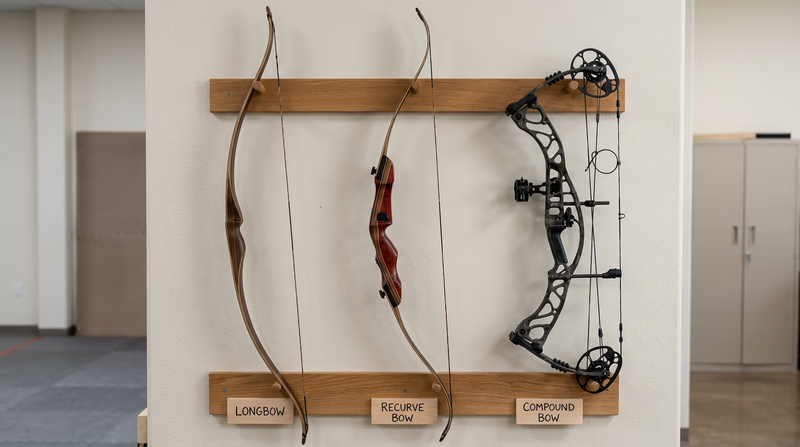
The recurve bow is the most common bow used in Scouting programs and the style you see at the Olympics. It has gracefully curved limbs that sweep away from the archer at the tips. The longbow is the simplest bow design — a straight (or slightly curved) stave with a bowstring. Both are shot with a finger release.
If you choose this option, you will:
- Learn the parts of a recurve or longbow
- Demonstrate proper care and storage
- Learn and demonstrate the 11 Steps of Shooting
- String the bow yourself
- Mark the nocking point on the bowstring
- Shoot a scored round and meet a minimum score
Option B — Compound Bow
The compound bow uses a system of pulleys (cams) and cables that reduce the holding weight at full draw, making it easier to aim steadily. Compound bows are the most popular choice for bowhunting and are also used in competition. They can be shot with either a finger release or a mechanical release.
If you choose this option, you will:
- Learn the parts of a compound bow
- Demonstrate proper care and storage
- Learn and demonstrate the 11 Steps of Shooting
- Understand why compound bow strings must be replaced by a pro shop
- Mark the nocking point on the bowstring
- Shoot a scored round and meet a minimum score
Qualified Supervision Required
Notice that Requirement 5 specifically says you must work under the supervision of a certified instructor. This is not something you can do on your own. The qualified supervisors are:
- A USA Archery Level 1 Instructor (or higher)
- A National Camping School (NCS) Range Activities Director
- A Rangemaster over age 18 who has been trained by one of the above
Your merit badge counselor can help you find a qualified instructor, or your local Scout council can point you to a camp or club with the right staff.
Ready to Choose?
Pick the option that matches the bow you will be shooting and dive in:
Or jump directly to Option B — Compound Bow if that is the path you are taking.