Extended Learning
A. Introduction
You have completed the requirements for the Architecture merit badge — congratulations! You now know how to identify architectural styles, understand sustainable building practices, read construction drawings, and create a scaled floor plan. But the world of architecture runs deep, and there is so much more to discover.
B. Deep Dive: How Buildings Stay Standing
Every building you see — from a garden shed to a 100-story skyscraper — must resist the forces that try to push it over, pull it apart, or crush it flat. Understanding these forces is what separates a structure that stands for centuries from one that collapses.
There are four main types of forces (called “loads”) that act on every building:
- Dead loads are the weight of the building itself — the walls, floors, roof, and all the permanent materials. A concrete floor slab, for example, is extremely heavy and the structure beneath it must be designed to carry that weight continuously.
- Live loads are the weight of everything temporary — people, furniture, equipment, and stored materials. A library floor must support far more live load than a bedroom floor because bookshelves full of books are incredibly heavy.
- Wind loads push against the sides of a building. Tall buildings and buildings in hurricane-prone areas need special bracing systems to resist being pushed sideways. Skyscrapers actually sway slightly in strong winds — engineers design this flexibility on purpose so the building bends instead of breaks.
- Seismic loads are forces created by earthquakes. In earthquake zones, buildings use special foundations, flexible joints, and reinforced frames that allow them to absorb and dissipate the shaking energy rather than cracking apart.
Architects and structural engineers use three primary structural systems to resist these forces. Post-and-beam construction uses vertical columns and horizontal beams — think of a table with four legs. Load-bearing walls distribute weight along entire wall surfaces rather than through individual columns — many brick and stone buildings use this approach. Frame construction uses a skeleton of steel or reinforced concrete that carries all the loads, allowing the exterior walls to be lightweight curtains of glass or thin panels. Most modern skyscrapers use frame construction, which is why they can have walls made almost entirely of glass.
The next time you walk past a construction site, look at the exposed structure before the walls go up. You are seeing the bones of the building — the system that will keep it standing for decades or centuries.
C. Deep Dive: The Architect’s Toolkit — From Pencil to Pixel
The tools architects use have changed dramatically over the centuries, but the goal remains the same: turn an idea in someone’s mind into a building you can walk through.
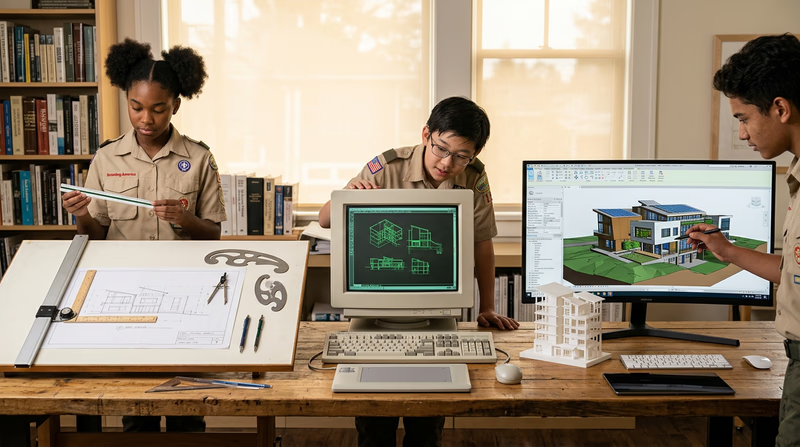
For most of architectural history, every drawing was done by hand. Architects used drafting tables, T-squares, triangles, compasses, and fine-point pencils to produce incredibly detailed construction drawings. A single set of drawings for a large building could take months to complete, and every copy had to be traced by hand or reproduced with a blueprint machine that used ammonia and UV light.
In the 1980s, Computer-Aided Design (CAD) software — most notably AutoCAD — revolutionized the profession. Architects could draw faster, edit without starting over, and share files electronically. But early CAD was essentially a digital drafting board — you were still drawing lines on a flat screen.
The real game-changer came with Building Information Modeling (BIM) software like Autodesk Revit. Instead of drawing a building, architects now model it in three dimensions. Every wall, window, pipe, and wire exists as a digital object with real-world properties — a wall knows its thickness, material, fire rating, and cost. When an architect changes a wall on one floor, BIM software automatically updates every drawing, schedule, and calculation in the entire project.
Today, architects also use 3D printing to create physical scale models in hours instead of weeks, virtual reality (VR) to let clients walk through a building before construction begins, and parametric design software to generate complex curved shapes that would be impossible to draw by hand. Some firms are even experimenting with AI-assisted design tools that can generate floor plan layouts based on a set of requirements.
Despite all this technology, most architects still start with pencil sketches. There is something about the speed and freedom of drawing by hand that helps ideas flow in ways that clicking a mouse cannot replicate.
D. Deep Dive: Architecture You Can Visit
Some buildings are worth a special trip. These architectural landmarks across the United States offer tours, exhibits, or open public access so you can experience great architecture firsthand.
Frank Lloyd Wright’s Fallingwater in Mill Run, Pennsylvania, is one of the most famous houses in the world. Built over a waterfall, it demonstrates Wright’s philosophy of “organic architecture” — designing buildings that harmonize with their natural surroundings. Guided tours let you walk through every room and see how the cantilevered terraces extend over the stream below.
The Guggenheim Museum in New York City, also designed by Frank Lloyd Wright, features a spiraling interior ramp that lets visitors view art while walking a continuous path from top to bottom. The building itself is as much a work of art as anything inside it.
The Gateway Arch in St. Louis, Missouri, designed by Eero Saarinen, is a 630-foot stainless steel catenary curve — the tallest monument in the United States. A tram system carries visitors to the top for views up to 30 miles in every direction.
The Chrysler Building in New York City is a masterpiece of Art Deco architecture. Its stainless steel crown, triangular windows, and eagle-head gargoyles at the corners make it one of the most recognizable skyscrapers in the world. While the upper floors are private offices, the lobby is open to the public and worth a visit for its stunning murals and marble.
E. Real-World Experiences
Tour a LEED-Certified Building
Visit Your City's Architecture Foundation
Attend an Open House Event
Explore a Historic Preservation District
Build with Habitat for Humanity
F. Organizations
The leading professional organization for architects in the United States, offering resources for students, career guidance, and community events.
A museum in Washington, D.C. dedicated to architecture, design, engineering, and construction, with exhibits, programs, and educational resources for all ages.
The organization behind the LEED green building certification system, offering education and resources about sustainable architecture and design.
A nonprofit working to save and revitalize historic places across America, from grand landmarks to everyday buildings that tell the story of their communities.
A free, award-winning mentoring program that introduces high school students to careers in architecture, construction, and engineering through hands-on projects with industry professionals.
An international nonprofit that brings people together to build homes, communities, and hope. Youth volunteer programs let Scouts gain real construction experience.