Architecture Merit Badge — Complete Digital Resource Guide
https://merit-badge.university/merit-badges/architecture/guide/
Introduction & Overview
Look around you right now. Chances are, you are inside a building that someone designed. The walls, the roof, the windows, the way light enters the room — an architect made decisions about all of it. Architecture is the art and science of designing the spaces where people live, work, learn, and play.
The Architecture merit badge invites you to see buildings in a whole new way. You will learn to recognize different styles, understand how structures are built, and discover how architects balance beauty, function, and sustainability. By the end, you might even draw a floor plan of your own.
Then and Now
Then — Building for the Ages
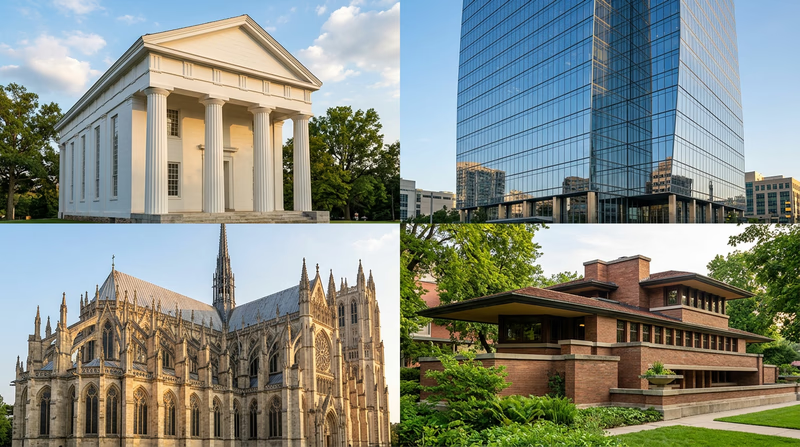
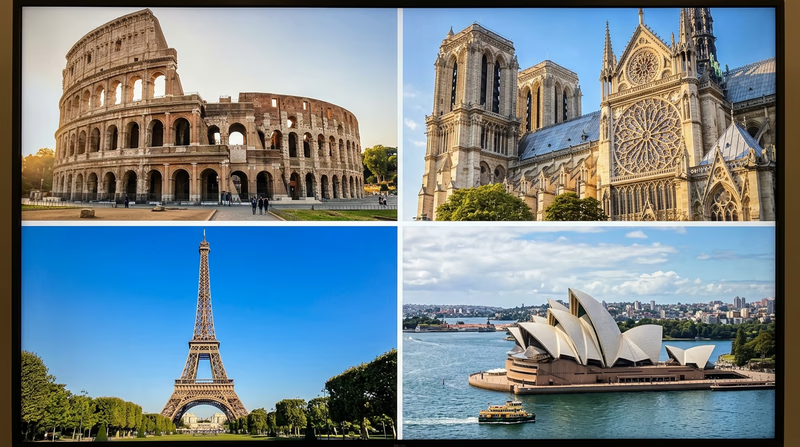
For thousands of years, architecture was one of humanity’s greatest achievements. The ancient Egyptians built the Great Pyramids — structures so precisely engineered that they still stand after 4,500 years. The Greeks created the Parthenon with its graceful columns, setting a standard for beauty that architects still study today. Roman engineers invented concrete and built the Colosseum and aqueducts that carried water across entire regions. In the Middle Ages, Gothic cathedrals like Notre-Dame soared toward the sky with pointed arches and stained glass windows that took generations to complete.
- Purpose: Shelter, worship, governance, defense, and displays of power
- Tools: Hand-drawn plans, stone, wood, brick, and human labor
- Mindset: Build to last centuries — every detail carved by hand
Now — Designing for Tomorrow
Today’s architects use computer-aided design (CAD) software to create buildings that would have been impossible to imagine a century ago. Skyscrapers twist and curve. Rooftops grow gardens. Buildings generate their own electricity from solar panels and collect rainwater for reuse. Some architects are even experimenting with 3D-printed structures and buildings made from recycled materials.
- Purpose: Living, working, learning, healing — and protecting the planet
- Tools: CAD software, Building Information Modeling (BIM), 3D printing, sustainable materials
- Mindset: Design for people, design for the environment, design for the future
Get Ready! Architecture is all around you — in your school, your home, your favorite park. Once you start looking at buildings as designed objects, you will never see your world the same way again. Let’s explore!

Kinds of Architecture
Architecture is a broad field with many specialties. Here are some of the major types you will encounter as you work through this merit badge.
Residential Architecture
This is the architecture of homes — houses, apartments, condominiums, and townhouses. Residential architects design spaces where people eat, sleep, and spend time with family. They think about how rooms connect, where natural light enters, and how a home fits into its neighborhood.
Commercial Architecture
Commercial architecture includes offices, shops, restaurants, hotels, and shopping centers. These buildings must attract visitors, move people efficiently through spaces, and create an atmosphere that supports the business inside.
Institutional Architecture
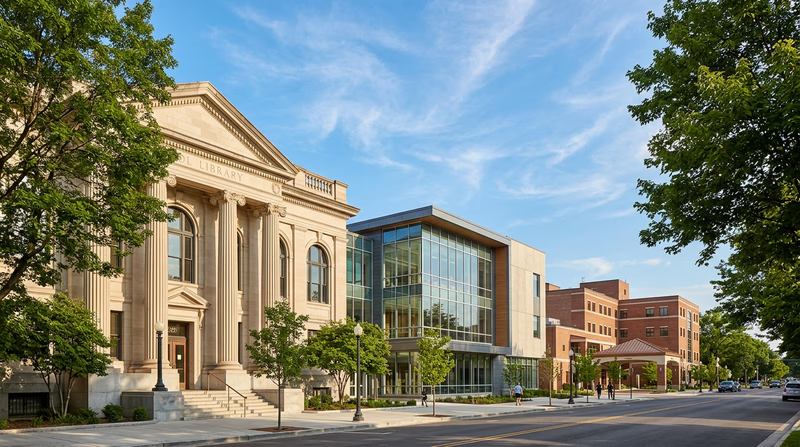
Schools, hospitals, courthouses, libraries, and government buildings fall under institutional architecture. These structures serve the public and often need to last for decades. Think about your own school — the layout of classrooms, hallways, and gathering spaces was all planned by an architect.
Industrial Architecture
Factories, warehouses, power plants, and water treatment facilities are industrial buildings. They prioritize function — moving materials, housing heavy equipment, and keeping workers safe. While they may not look glamorous, industrial buildings are essential to how our world works.
Landscape Architecture
Landscape architects design outdoor spaces: parks, playgrounds, plazas, trails, and gardens. They shape the land itself, choosing where to plant trees, place benches, and route pathways. If you have ever enjoyed a well-designed park, a landscape architect made that experience possible.
Interior Architecture
Interior architects focus on the spaces inside buildings. They decide room layouts, ceiling heights, lighting, and how people move through interior spaces. Interior architecture goes deeper than decorating — it involves structural changes like moving walls, adding windows, or redesigning how a floor is used.
Now that you have a sense of what architecture is and the many forms it takes, it is time to start exploring buildings in your own community.
Req 1a — Community Building Tour
Getting Started on Your Tour
This requirement is your chance to become an architectural detective. You are going to walk through your community — your town, your neighborhood, your downtown — and really look at the buildings around you. Not just glance at them, but study them. What shapes do you see? What materials were used? How old does the building look?
Before you head out, grab a notebook (or your phone for notes), a pencil, and a sketchbook. You will want to record what you find.
Common Architectural Styles in America
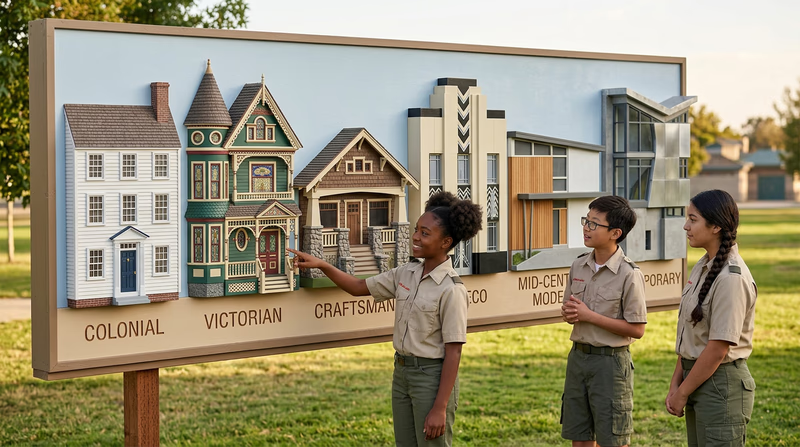
As you walk through your community, try to match buildings to these common architectural styles. You do not need to memorize every detail — just look for the key features that set each style apart.
Colonial (1600s–1700s)
Colonial buildings are symmetrical with a centered front door. They typically have evenly spaced windows, a simple rectangular shape, and a side-gabled roof. Many colonial homes are made of brick or wood clapboard. You will often find this style in the eastern United States.
Victorian (1860s–1900s)
Victorian buildings are hard to miss. They feature ornate decorations, colorful paint, steep roofs, towers or turrets, and wrap-around porches. The Queen Anne style — with its mix of textures, patterns, and asymmetric shapes — is one of the most recognizable Victorian styles.
Craftsman / Bungalow (1900s–1930s)
Craftsman homes are cozy and low to the ground. Look for wide front porches with thick, tapered columns, exposed rafters under the eaves, and natural materials like stone and wood. This style celebrates handcraftsmanship over factory-produced details.
Art Deco (1920s–1930s)
Art Deco buildings are bold and geometric. They feature sharp lines, zigzag patterns, sunburst motifs, and metallic accents. You will often find Art Deco in older downtown areas — think movie theaters, banks, and office buildings from the Jazz Age.
Mid-Century Modern (1940s–1960s)
Mid-Century Modern buildings embrace simplicity and connection to nature. Look for flat or low-sloped roofs, large glass windows, open floor plans, and clean lines. Many schools and public buildings from this era use this style.
Contemporary / Modern
Contemporary architecture uses the latest materials and technology. Glass curtain walls, unusual shapes, cantilevered sections, and green roofs are common features. If a building looks like nothing else around it, it may be contemporary.
What to Look For on Your Tour
When you stand in front of a building, ask yourself these questions:
Building Observation Checklist
Questions to answer for each building you study- What shape is the building? Rectangular, L-shaped, circular, irregular?
- What materials do you see? Brick, wood, stone, glass, steel, concrete?
- How is the roof shaped? Flat, gabled, hipped, domed?
- What do the windows look like? Large or small? Arched or rectangular? Grouped or evenly spaced?
- Are there decorative elements? Columns, carvings, trim, patterns?
- What period does the building seem to come from?
- What is the building used for? Does the design match its purpose?
Making Your Sketch
For the sketch portion, pick the building you admire most. It does not have to be the biggest or oldest — choose one that catches your eye.
Your sketch does not need to be museum-quality. Focus on capturing the building’s overall shape, proportions, and key features. Here are some tips:
Architectural Styles Visual Guide — ThoughtCo An illustrated guide to major architectural styles throughout history, with photos and key features to help you identify buildings in your community. Link: Architectural Styles Visual Guide — ThoughtCo — https://www.thoughtco.com/architecture-4133010
Beyond the Basics
As you explore, pay attention to how buildings relate to each other. Are there clusters of similar styles? That often means a neighborhood was built during the same time period. Do you see a very old building surrounded by newer ones? That building may have historical significance that saved it from demolition.
Now that you have explored your community’s buildings, it is time to zoom out and look at architecture on a grander scale.
Req 1b — Historical Achievement
What Makes an Architectural Achievement “Major”?
A historical architectural achievement is not just a pretty building — it is a structure or innovation that changed how people live, build, or think. The best examples pushed the boundaries of engineering, introduced new materials or techniques, or inspired generations of architects who came after.
When choosing your achievement, look for something that meets at least one of these criteria:
- It solved a problem no one had solved before
- It introduced a new building technique or material
- It changed how cities or communities were designed
- It still influences architecture today
Notable Achievements to Consider
You get to choose any historical architectural achievement that interests you. Here are several examples to spark your thinking — but do not feel limited to this list.
The Roman Colosseum (80 AD)
The Colosseum in Rome could seat 50,000 spectators and had a system of ramps, corridors, and numbered entrances that moved crowds efficiently — a design concept still used in every modern sports stadium. The Romans also pioneered the use of concrete, arches, and vaults to create massive enclosed spaces.
Gothic Cathedrals (1100s–1500s)
Gothic cathedrals like Chartres and Notre-Dame introduced flying buttresses — external supports that allowed walls to be thinner and filled with enormous stained glass windows. This innovation let architects build taller, lighter structures flooded with natural light. The engineering principles behind flying buttresses are still studied today.
The Crystal Palace (1851)
Built in London for the Great Exhibition, the Crystal Palace was one of the first large structures made almost entirely of glass and cast iron — prefabricated in sections and assembled on site. It proved that buildings could be constructed from factory-made parts, paving the way for modern construction methods.
The Eiffel Tower (1889)
When Gustave Eiffel built his 1,000-foot iron tower for the Paris World’s Fair, many people called it ugly and demanded it be torn down. Instead, it became the most recognizable structure in the world and demonstrated that iron (and later steel) could be used to build to extraordinary heights — opening the door to the skyscraper age.
The Empire State Building (1931)
Built in just 410 days during the Great Depression, the Empire State Building stood as the world’s tallest building for nearly 40 years. Its steel-frame construction and efficient design process set the standard for skyscraper construction and proved that extremely tall buildings were practical and economical.
Fallingwater (1935)
Designed by Frank Lloyd Wright, Fallingwater is a house built over a waterfall in Pennsylvania. Its cantilevered concrete terraces extend over the stream below, blending the building into the natural landscape. Fallingwater popularized the idea that architecture should work with nature, not against it.
The Sydney Opera House (1973)
Jørn Utzon’s design features a series of interlocking shell-shaped roof structures that were so complex, engineers spent years figuring out how to actually build them. The solution — prefabricated concrete ribs — advanced construction technology and proved that daring designs could become reality.
How to Research Your Achievement
Once you have picked your achievement, dig into the details. Here is a framework to guide your research:
Research Framework
Key questions to answer about your chosen achievement- When and where was it built? What was happening in the world at that time?
- Who designed it? What was the architect or engineer trying to accomplish?
- What materials and techniques were used? Were any of them new at the time?
- What problems did the builders face, and how did they solve them?
- How did this achievement influence later buildings or construction methods?
- Can you find examples of modern buildings that were inspired by this achievement?
Talking to Your Counselor
When you share what you learned, focus on the impact — not just the facts. Your counselor wants to hear you explain why this achievement matters. How did it change architecture? How does it still affect the buildings we see today?
Try organizing your presentation around three main points:
- What made it groundbreaking at the time it was built
- What influence it had on architecture that came after
- Why it still matters today
With your community tour complete and your historical research done, it is time to look at how architecture is evolving to protect the environment.
Req 2 — Sustainable Architecture
This requirement connects the Scout values you already practice outdoors — Leave No Trace and the Outdoor Code — to the world of building design. Just as Scouts aim to leave the campsite better than they found it, architects are designing buildings that leave the planet better off too.
Req 2a: Sustainable Architecture and Green Buildings
Sustainable architecture means designing buildings that meet today’s needs without harming the environment or using up resources that future generations will need. A sustainable building uses less energy, wastes less water, produces less pollution, and creates healthier spaces for the people inside.
The term “green building” describes a structure designed with sustainability in mind from the ground up. Green buildings are evaluated and certified by programs like LEED (Leadership in Energy and Environmental Design), which scores buildings on categories like energy efficiency, water conservation, and indoor air quality.
Common Green Building Features
Here are features you will frequently find in green buildings. You need to identify three for your counselor — understanding more will give you a strong foundation for the discussion.
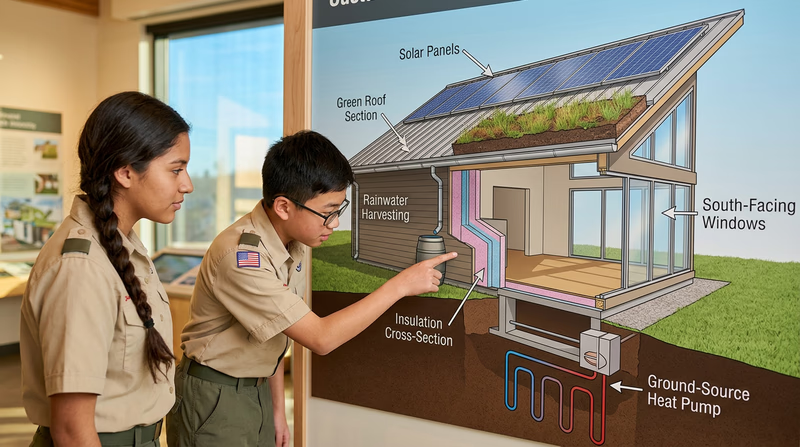
Solar panels and renewable energy systems. Many green buildings generate their own electricity using solar panels on the roof or walls. Some also use small wind turbines or geothermal systems that draw heat from underground.
High-performance insulation and windows. Green buildings use advanced insulation and double- or triple-pane windows to keep heat in during winter and out during summer. This dramatically reduces energy needed for heating and cooling.
Green roofs and living walls. A green roof is covered with plants and soil instead of traditional shingles or metal. Green roofs absorb rainwater, provide insulation, reduce urban heat, and create habitat for birds and insects. Living walls bring the same benefits to vertical surfaces.
Rainwater harvesting and water-efficient fixtures. Green buildings often collect rainwater for landscape irrigation or toilet flushing. Low-flow faucets, toilets, and showerheads reduce daily water use by 30–50% compared to standard fixtures.
Natural lighting and ventilation. Architects position windows, skylights, and open floor plans to maximize daylight and airflow. This reduces the need for electric lighting and mechanical air conditioning.
Recycled and locally sourced materials. Using materials that were recycled or sourced nearby reduces the energy spent on manufacturing and transportation.
Req 2b: Renewable vs. Recycled Building Materials
These two terms sound similar but mean very different things.
Renewable Building Materials
A renewable material comes from a source that can be regrown or replenished naturally within a human lifetime. The key word is replenishable — if you use it, nature can make more.
| Material | Source | Common Uses |
|---|---|---|
| Wood / Timber | Trees (sustainably harvested forests) | Framing, flooring, siding, furniture |
| Bamboo | Bamboo grass (grows up to 3 feet per day) | Flooring, scaffolding, wall panels |
| Cork | Cork oak bark (harvested without cutting the tree) | Flooring, insulation, wall tiles |
| Straw bales | Agricultural byproduct (regrown annually) | Insulation, wall construction |
| Wool | Sheep (sheared annually) | Insulation |
Recycled Building Materials
A recycled material is made from something that was already used for another purpose and has been processed into a new product. The key word is reused — it keeps waste out of landfills.
| Material | Original Source | Common Uses |
|---|---|---|
| Recycled steel | Old cars, appliances, buildings | Structural beams, rebar, roofing |
| Recycled concrete (aggregate) | Demolished buildings and roads | Foundations, road base, drainage fill |
| Recycled glass | Bottles and windows | Countertops, tiles, insulation |
| Reclaimed wood | Old barns, factories, warehouses | Flooring, accent walls, furniture |
| Recycled plastic lumber | Plastic bottles and containers | Decking, fencing, landscaping |
Req 2c: Architecture and Its Surroundings
A building never exists in isolation. It sits on a piece of land, in a neighborhood, in a community. Good architecture responds to its surroundings — the climate, the landscape, the culture, and the needs of the people who will use it.
Responding to the Environment
Architects consider the natural environment when designing a building. A home in the Arizona desert looks very different from a home in the forests of the Pacific Northwest — and it should. The desert home might have thick adobe walls to stay cool, small windows to block harsh sunlight, and a flat roof to collect the rare rainwater. The Pacific Northwest home might have a steep roof to shed rain and snow, large south-facing windows to capture limited winter sunlight, and deep eaves to protect from constant drizzle.
Fitting Into the Community
Buildings also respond to the human environment. An architect designing a new library in a historic downtown will consider the scale, materials, and style of the surrounding buildings. Dropping a massive glass-and-steel tower into a neighborhood of two-story brick buildings would feel jarring. Thoughtful architects find ways to be creative while still respecting what is already there.
Serving the Community
The best architecture makes a community stronger. A well-designed park gives people a place to gather. A thoughtfully planned school helps students learn. A welcoming community center brings neighbors together. Architecture shapes how people interact with each other and with the spaces around them.
U.S. Green Building Council — What Is Green Building? The organization behind LEED certification explains green building principles, benefits, and how sustainable design impacts communities. Link: U.S. Green Building Council — What Is Green Building? — https://www.usgbc.org/articles/what-green-buildingReq 2d: Adaptive Reuse
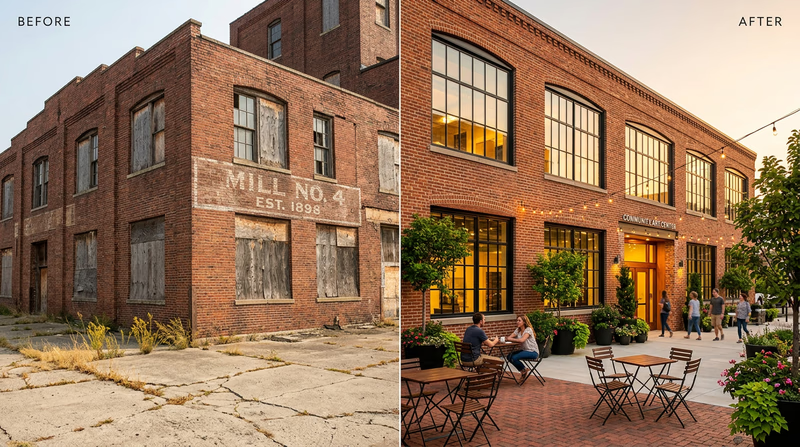
Adaptive reuse is the practice of taking an old building that no longer serves its original purpose and transforming it into something new — without tearing it down. This is one of the most sustainable things an architect can do, because the greenest building is often the one that already exists.
Why Reuse Instead of Demolish?
Demolishing a building sends tons of material to landfills and wastes all the energy that went into building it in the first place. That “embodied energy” — the energy used to manufacture, transport, and assemble every brick, beam, and window — is lost forever when a building is torn down. Adaptive reuse preserves that investment.
Famous Examples of Adaptive Reuse
- The High Line, New York City — An abandoned elevated railroad track was transformed into a 1.45-mile-long public park and walkway, attracting millions of visitors each year.
- Tate Modern, London — A decommissioned power station on the banks of the Thames became one of the world’s most visited modern art museums.
- Union Station, Denver — A historic train station was renovated into a mixed-use hub with restaurants, shops, a hotel, and a transit center — all while preserving its 1914 Beaux-Arts exterior.
- Local examples — Look around your own community. Old factories become loft apartments. Churches become community centers. Schools become office buildings. Fire stations become restaurants.
You have explored how architecture connects to the environment and sustainability. Next, you will step into the professional world of architecture.
Req 3 — Meet an Architect
This requirement gives you three options — you only need to complete one. Read through all three and choose the one that works best for your situation. Each option connects you with the professional side of architecture in a different way.
Option A: Visit an Architect’s Office
This option takes you inside an architect’s office — the place where buildings are born on paper (or on screen) before they become reality.
What to Expect
An architect’s office is part design studio, part engineering lab. You may see:
- Scale models — miniature versions of buildings made from cardboard, foam, wood, or 3D-printed plastic. These help clients visualize what the finished building will look like.
- Construction drawings (also called blueprints or construction documents) — highly detailed technical drawings that show builders exactly how to construct every part of a building, from the foundation to the rooftop.
- Material samples — pieces of brick, stone, glass, metal, and wood that the architect is considering for a project.
Questions to Ask
Questions for the Architect
Prepare these before your visit- What project are you working on right now? What stage is it in?
- How do you decide which materials to use for a building?
- What do the different types of drawings (floor plans, elevations, sections) show?
- How do you make sure all the pieces fit together when the building is constructed?
- What software do you use to design buildings?
- What is the most challenging part of your job?
Understanding Construction Drawings
Construction drawings include several types, each showing a different view of the building:
- Floor plans — A bird’s-eye view showing the layout of rooms, walls, doors, and windows on each level
- Elevations — Flat views of each exterior side of the building, showing height, materials, and window placement
- Sections — Slices through the building showing how floors, walls, and roofs are constructed internally
- Details — Close-up drawings showing exactly how specific components connect (for example, how a window frame attaches to the wall)
Option B: Visit a Construction Site
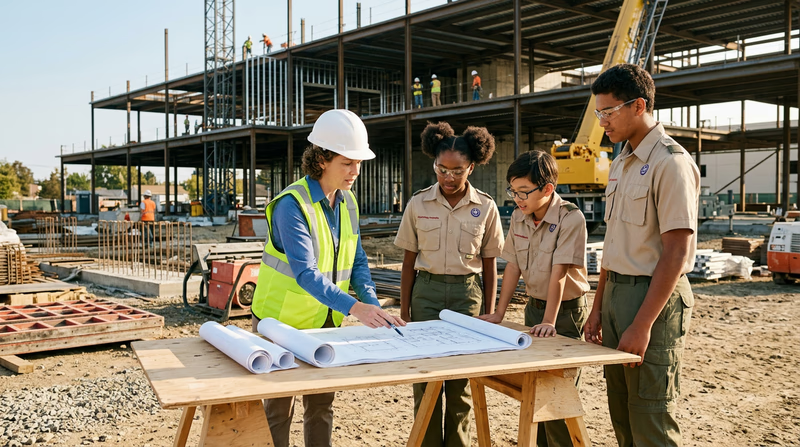
This option is the most hands-on. You get to see a building in the process of being built — with all the steel, concrete, and framing exposed before it gets covered up by walls and finishes.
What You Will See
Depending on what stage the construction is in, you might see:
- Foundation work — Concrete being poured into forms, rebar grids being tied together
- Structural framing — Steel beams, wood studs, or concrete columns forming the skeleton of the building
- Mechanical systems — Ductwork, plumbing pipes, and electrical conduit being installed inside walls and ceilings
- Exterior cladding — Brick, stone, glass, or metal panels being attached to the outside of the structure
What to Discuss
Ask the architect why specific materials were chosen for each part of the building. For example:
- Why steel beams instead of wood for the structure?
- Why brick on the exterior instead of siding?
- How are the walls attached to the foundation?
- How do the windows stay sealed against rain and wind?
Option C: Interview a Client
This option lets you step into the architect’s shoes. Instead of observing an architect, you become one — at least for this exercise. Your job is to interview a “client” and create an architectural program (a written document that lists everything the building needs to do).
What Is an Architectural Program?
In architecture, a program is not a computer program — it is a detailed written plan that describes what the building needs to include, how spaces should work together, and what goals the project should achieve. It is the first document an architect creates before drawing a single line.
Conducting the Interview
Pick someone who would be a realistic client — a parent thinking about a dream home, a neighbor who runs a business, or a community leader who wants a new meeting space. Ask them questions like:
Client Interview Questions
What to ask your prospective client- What is the purpose of this building? What will happen inside it?
- How many people will use it? At the same time or at different times?
- What rooms or spaces do you need? How big should each one be?
- How should the spaces connect to each other? (Should the kitchen be near the dining room? Should the office be away from noisy areas?)
- Do you need outdoor space? Parking? Storage?
- What is your budget range?
- Are there any special requirements? (Accessibility, energy efficiency, specific materials?)
- What style or feeling do you want the building to have?
Writing Your Program
After the interview, organize your notes into a short written program. Include:
- Project overview — One paragraph describing what the building is and who it is for
- Requirements list — Every room and space the client needs, with approximate sizes
- Functional relationships — How spaces relate to each other (a diagram showing connections works well)
- Project goals — What the client values most (budget, sustainability, aesthetics, accessibility, etc.)
How to Arrange Your Visit
No matter which option you choose, planning ahead is essential.
Visit Planning Checklist
Steps to set up your meeting- Talk to your merit badge counselor first — they may know architects in the area or have contacts
- Check with the American Institute of Architects (AIA) local chapter for volunteer architects
- Write a polite email or letter explaining who you are and what you are working on
- Get written permission from your parent or guardian
- Prepare your questions in advance
- Bring a notebook and pen to take notes
- Send a thank-you note after your visit
You have seen architecture from the professional side. Now it is your turn to pick up a pencil and create your own architectural drawing.
Req 4 — Floor Plan Drawing
What Is a Floor Plan?
A floor plan is a drawing of a room as seen from directly above — as if you removed the roof and looked straight down. It shows the shape of the room, the thickness of walls, and the locations of doors, windows, closets, and anything built into the room (like cabinets, counters, or shelving).
Floor plans are the most fundamental type of architectural drawing. Every building ever constructed started with one.
Step 1: Choose Your Room
Pick a room you can easily access and measure. Good choices include:
- Your bedroom
- Your living room or family room
- Your troop’s meeting room
- A classroom at school (with permission)
Simpler rooms (rectangular, fewer features) are easier for your first floor plan. A room with unusual angles, multiple closets, and lots of built-ins will be more challenging — but also more interesting.
Step 2: Gather Your Supplies
Floor Plan Supply List
What you will need- Tape measure (at least 25 feet long)
- Graph paper (with 1/4-inch grid squares)
- Pencil and eraser
- Ruler or straightedge (at least 12 inches)
- Notepad for recording measurements
- A helper to hold the other end of the tape measure
Step 3: Measure the Room
Accuracy matters. Take your time and double-check every measurement.
Walls
Measure each wall from corner to corner. Write down every measurement on your notepad as you go — do not try to remember them. For each wall, note:
- Total length
- Location and width of each door opening
- Location and width of each window
- Location and width of each closet opening
Doors and Windows
For doors, measure the width of the opening (not the door itself). Note which side the hinges are on and which direction the door swings — this affects the floor plan symbol you will use.
For windows, measure the width of the window opening. On a floor plan, windows are shown as thin breaks in the wall line.
Built-in Features
Measure any cabinets, counters, built-in shelves, or other features that are permanently attached to the room. Note their width, depth, and distance from the nearest wall or corner.
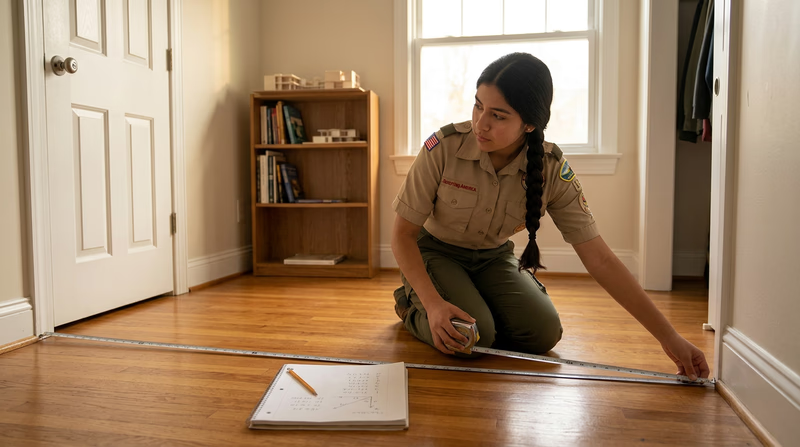
Step 4: Draw Your Floor Plan
Now transfer your measurements to paper using the 1/4 inch = 1 foot scale.
Drawing Conventions
Architects use standard symbols so that anyone reading a floor plan knows exactly what they are looking at:
Walls — Draw walls as two parallel lines with a small gap between them (about 1/16 inch apart on your drawing). This represents the thickness of the wall.
Doors — Show doors as a gap in the wall with a quarter-circle arc indicating the direction the door swings. The arc shows the space the door needs to open.
Windows — Show windows as a gap in the wall with three thin parallel lines across the opening.
Closets — Draw the closet walls, the door opening, and any shelving inside.
Built-in cabinets — Draw the outline of the cabinet or counter, showing its depth from the wall.
Drawing Steps
- Start by drawing the outline of the room — the exterior walls
- Add interior walls, closets, and alcoves
- Mark door openings and draw door swing arcs
- Mark window locations and draw window symbols
- Add built-in features (cabinets, counters, shelving)
- Double-check all dimensions against your measurements
- Add dimension lines showing key measurements
Step 5: Label Your Drawing
The requirement specifies four labels that must appear on your drawing:
Required Labels
Every floor plan must include these- Your name (who drew it)
- The date (when you drew it)
- What room you drew (e.g., “Living Room — 123 Oak Street”)
- The scale of the drawing (1/4" = 1’-0")
Architects typically place this information in a title block — a bordered box in the bottom-right corner of the drawing. Creating a title block for your floor plan is a professional touch that will impress your counselor.
Common Mistakes to Avoid
How to Draw a Floor Plan — Architectural Digest A step-by-step guide to creating floor plans, with tips on measuring rooms and using standard architectural symbols. Link: How to Draw a Floor Plan — Architectural Digest — https://www.architecturaldigest.com/story/how-to-draw-floor-plan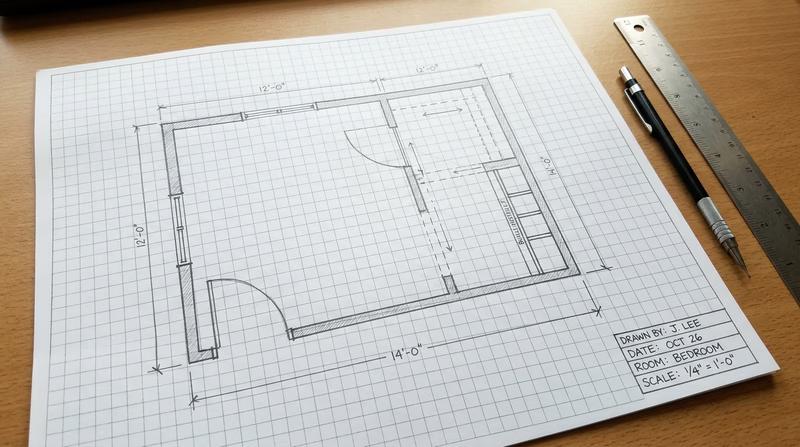
Your floor plan drawing puts you in the shoes of a real architect. Now let’s look at what it takes to make architecture your career.
Req 5 — Career Exploration
Careers in Architecture
Architecture is much more than just one job. The field includes a wide range of career paths — some focused on design, others on technology, construction, or the environment. Here are careers to explore for this requirement.
1. Architect
An architect designs buildings and oversees their construction. They work with clients to understand what a building needs to do, create designs that meet those needs, produce detailed construction documents, and visit construction sites to make sure the building is being constructed correctly.
Education: A professional degree in architecture (typically a 5-year Bachelor of Architecture or a Master of Architecture after a 4-year undergraduate degree). After graduating, architects must complete the Architectural Experience Program (AXP) — about 3,740 hours of supervised work — and pass the Architect Registration Examination (ARE), a series of six exams.
Skills: Design thinking, drawing and modeling (both by hand and with software like AutoCAD and Revit), knowledge of building codes and structural systems, communication, and project management.
Salary range: Median salary is approximately $82,000 per year, with experienced architects at large firms earning significantly more.
2. Landscape Architect
A landscape architect designs outdoor spaces — parks, campuses, residential gardens, public plazas, waterfront areas, and trail systems. They shape the land, select plantings, design water features, and plan how people move through outdoor environments.
Education: A Bachelor’s or Master’s degree in landscape architecture from an accredited program. Most states require licensing, which involves completing supervised experience and passing the Landscape Architect Registration Examination (LARE).
Skills: Knowledge of plants, soils, hydrology, and ecology; site planning and grading; CAD and geographic information systems (GIS); understanding of accessibility standards.
Salary range: Median salary is approximately $73,000 per year.
3. Interior Designer
An interior designer plans the layout and design of interior spaces. They choose materials, furniture, lighting, and color schemes to make rooms functional, safe, and attractive. Interior designers work on homes, offices, restaurants, hospitals, and retail spaces.
Education: A bachelor’s degree in interior design from an accredited program. Many states require certification or licensure. The National Council for Interior Design Qualification (NCIDQ) exam is the industry standard certification.
Skills: Space planning, color theory, material selection, building codes (especially fire safety and accessibility), CAD software, and client communication.
Salary range: Median salary is approximately $62,000 per year.
4. Urban Planner
An urban planner designs the layout of entire communities — not individual buildings, but neighborhoods, cities, and regions. They decide where to put roads, parks, schools, and commercial areas. They balance growth with preservation, transportation with walkability, and economic development with environmental protection.
Education: A Master’s degree in urban planning or a related field. Certification through the American Institute of Certified Planners (AICP) is common. Some entry-level positions accept a bachelor’s degree.
Skills: Data analysis, geographic information systems (GIS), public speaking and community engagement, knowledge of zoning laws and regulations, long-range strategic thinking.
Salary range: Median salary is approximately $79,000 per year.

5. Civil Engineer
A civil engineer designs the structural systems that keep buildings standing — foundations, beams, columns, and load-bearing walls. They also design infrastructure like bridges, roads, dams, and water systems. Architects and civil engineers work closely together on every major building project.
Education: A bachelor’s degree in civil engineering (4 years). Licensure as a Professional Engineer (PE) requires passing the Fundamentals of Engineering (FE) exam, gaining 4 years of supervised experience, and passing the PE exam.
Skills: Mathematics (especially physics and calculus), structural analysis, knowledge of building materials, CAD software, project management.
Salary range: Median salary is approximately $89,000 per year.
6. Construction Manager
A construction manager oversees the actual building process. They coordinate workers, manage budgets and schedules, order materials, ensure safety compliance, and solve problems that arise on the construction site. They are the link between the architect’s vision and the finished building.
Education: A bachelor’s degree in construction management, construction science, or a related field. Certification from the American Institute of Constructors (AIC) or as a Certified Construction Manager (CCM) is valued by employers.
Skills: Leadership, budgeting and cost estimation, scheduling, knowledge of building codes and safety regulations, communication, problem-solving under pressure.
Salary range: Median salary is approximately $101,000 per year.
Choosing One to Explore
After you have identified three careers, pick the one that interests you most and dig deeper. Use these questions to guide your research:
Career Deep Dive
Questions to answer about your chosen career- What degree or certification is required?
- How long does the education and training take from start to finish?
- What does a typical workday look like?
- What are the most rewarding parts of this job?
- What are the biggest challenges?
- What is the job outlook — is demand for this career growing?
- Why does this career interest you personally?
Preparing for Your Counselor Discussion
When you meet with your counselor, be ready to share:
- Three careers you researched (with a brief description of each)
- One career in depth — the education, training, and experience it requires
- Why it interests you — connect it to your own skills, interests, or experiences
Your counselor is not looking for a memorized list of facts. They want to hear your genuine thinking about what draws you to this career and whether you can see yourself pursuing it.
Congratulations — you have worked through all five requirements. But the learning does not have to stop here.
Extended Learning
A. Introduction
You have completed the requirements for the Architecture merit badge — congratulations! You now know how to identify architectural styles, understand sustainable building practices, read construction drawings, and create a scaled floor plan. But the world of architecture runs deep, and there is so much more to discover.
B. Deep Dive: How Buildings Stay Standing
Every building you see — from a garden shed to a 100-story skyscraper — must resist the forces that try to push it over, pull it apart, or crush it flat. Understanding these forces is what separates a structure that stands for centuries from one that collapses.
There are four main types of forces (called “loads”) that act on every building:
- Dead loads are the weight of the building itself — the walls, floors, roof, and all the permanent materials. A concrete floor slab, for example, is extremely heavy and the structure beneath it must be designed to carry that weight continuously.
- Live loads are the weight of everything temporary — people, furniture, equipment, and stored materials. A library floor must support far more live load than a bedroom floor because bookshelves full of books are incredibly heavy.
- Wind loads push against the sides of a building. Tall buildings and buildings in hurricane-prone areas need special bracing systems to resist being pushed sideways. Skyscrapers actually sway slightly in strong winds — engineers design this flexibility on purpose so the building bends instead of breaks.
- Seismic loads are forces created by earthquakes. In earthquake zones, buildings use special foundations, flexible joints, and reinforced frames that allow them to absorb and dissipate the shaking energy rather than cracking apart.
Architects and structural engineers use three primary structural systems to resist these forces. Post-and-beam construction uses vertical columns and horizontal beams — think of a table with four legs. Load-bearing walls distribute weight along entire wall surfaces rather than through individual columns — many brick and stone buildings use this approach. Frame construction uses a skeleton of steel or reinforced concrete that carries all the loads, allowing the exterior walls to be lightweight curtains of glass or thin panels. Most modern skyscrapers use frame construction, which is why they can have walls made almost entirely of glass.
The next time you walk past a construction site, look at the exposed structure before the walls go up. You are seeing the bones of the building — the system that will keep it standing for decades or centuries.
C. Deep Dive: The Architect’s Toolkit — From Pencil to Pixel
The tools architects use have changed dramatically over the centuries, but the goal remains the same: turn an idea in someone’s mind into a building you can walk through.
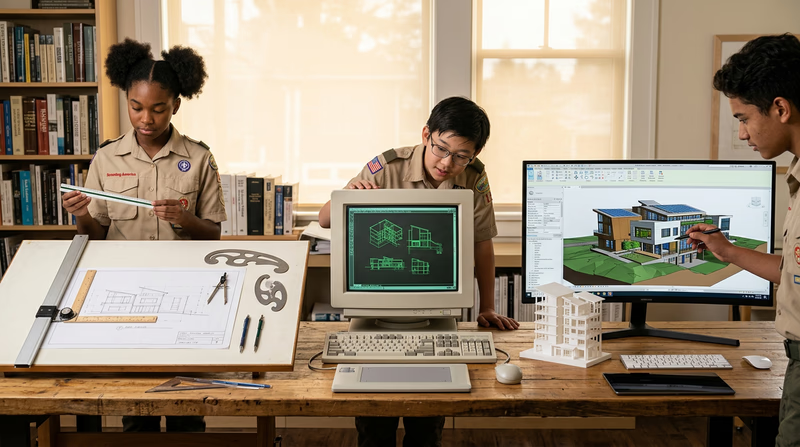
For most of architectural history, every drawing was done by hand. Architects used drafting tables, T-squares, triangles, compasses, and fine-point pencils to produce incredibly detailed construction drawings. A single set of drawings for a large building could take months to complete, and every copy had to be traced by hand or reproduced with a blueprint machine that used ammonia and UV light.
In the 1980s, Computer-Aided Design (CAD) software — most notably AutoCAD — revolutionized the profession. Architects could draw faster, edit without starting over, and share files electronically. But early CAD was essentially a digital drafting board — you were still drawing lines on a flat screen.
The real game-changer came with Building Information Modeling (BIM) software like Autodesk Revit. Instead of drawing a building, architects now model it in three dimensions. Every wall, window, pipe, and wire exists as a digital object with real-world properties — a wall knows its thickness, material, fire rating, and cost. When an architect changes a wall on one floor, BIM software automatically updates every drawing, schedule, and calculation in the entire project.
Today, architects also use 3D printing to create physical scale models in hours instead of weeks, virtual reality (VR) to let clients walk through a building before construction begins, and parametric design software to generate complex curved shapes that would be impossible to draw by hand. Some firms are even experimenting with AI-assisted design tools that can generate floor plan layouts based on a set of requirements.
Despite all this technology, most architects still start with pencil sketches. There is something about the speed and freedom of drawing by hand that helps ideas flow in ways that clicking a mouse cannot replicate.
D. Deep Dive: Architecture You Can Visit
Some buildings are worth a special trip. These architectural landmarks across the United States offer tours, exhibits, or open public access so you can experience great architecture firsthand.
Frank Lloyd Wright’s Fallingwater in Mill Run, Pennsylvania, is one of the most famous houses in the world. Built over a waterfall, it demonstrates Wright’s philosophy of “organic architecture” — designing buildings that harmonize with their natural surroundings. Guided tours let you walk through every room and see how the cantilevered terraces extend over the stream below.
The Guggenheim Museum in New York City, also designed by Frank Lloyd Wright, features a spiraling interior ramp that lets visitors view art while walking a continuous path from top to bottom. The building itself is as much a work of art as anything inside it.
The Gateway Arch in St. Louis, Missouri, designed by Eero Saarinen, is a 630-foot stainless steel catenary curve — the tallest monument in the United States. A tram system carries visitors to the top for views up to 30 miles in every direction.
The Chrysler Building in New York City is a masterpiece of Art Deco architecture. Its stainless steel crown, triangular windows, and eagle-head gargoyles at the corners make it one of the most recognizable skyscrapers in the world. While the upper floors are private offices, the lobby is open to the public and worth a visit for its stunning murals and marble.
E. Real-World Experiences
Tour a LEED-Certified Building
Visit Your City's Architecture Foundation
Attend an Open House Event
Explore a Historic Preservation District
Build with Habitat for Humanity
F. Organizations
The leading professional organization for architects in the United States, offering resources for students, career guidance, and community events.
Organization: American Institute of Architects (AIA) — https://www.aia.org/
A museum in Washington, D.C. dedicated to architecture, design, engineering, and construction, with exhibits, programs, and educational resources for all ages.
Organization: National Building Museum — https://www.nbm.org/
The organization behind the LEED green building certification system, offering education and resources about sustainable architecture and design.
Organization: U.S. Green Building Council — https://www.usgbc.org/
A nonprofit working to save and revitalize historic places across America, from grand landmarks to everyday buildings that tell the story of their communities.
Organization: National Trust for Historic Preservation — https://savingplaces.org/
A free, award-winning mentoring program that introduces high school students to careers in architecture, construction, and engineering through hands-on projects with industry professionals.
Organization: ACE Mentor Program — https://www.acementor.org/
An international nonprofit that brings people together to build homes, communities, and hope. Youth volunteer programs let Scouts gain real construction experience.
Organization: Habitat for Humanity — https://www.habitat.org/