Req 3 — Meet an Architect
This requirement gives you three options — you only need to complete one. Read through all three and choose the one that works best for your situation. Each option connects you with the professional side of architecture in a different way.
Option A: Visit an Architect’s Office
This option takes you inside an architect’s office — the place where buildings are born on paper (or on screen) before they become reality.
What to Expect
An architect’s office is part design studio, part engineering lab. You may see:
- Scale models — miniature versions of buildings made from cardboard, foam, wood, or 3D-printed plastic. These help clients visualize what the finished building will look like.
- Construction drawings (also called blueprints or construction documents) — highly detailed technical drawings that show builders exactly how to construct every part of a building, from the foundation to the rooftop.
- Material samples — pieces of brick, stone, glass, metal, and wood that the architect is considering for a project.
Questions to Ask
Questions for the Architect
Prepare these before your visit
- What project are you working on right now? What stage is it in?
- How do you decide which materials to use for a building?
- What do the different types of drawings (floor plans, elevations, sections) show?
- How do you make sure all the pieces fit together when the building is constructed?
- What software do you use to design buildings?
- What is the most challenging part of your job?
Understanding Construction Drawings
Construction drawings include several types, each showing a different view of the building:
- Floor plans — A bird’s-eye view showing the layout of rooms, walls, doors, and windows on each level
- Elevations — Flat views of each exterior side of the building, showing height, materials, and window placement
- Sections — Slices through the building showing how floors, walls, and roofs are constructed internally
- Details — Close-up drawings showing exactly how specific components connect (for example, how a window frame attaches to the wall)
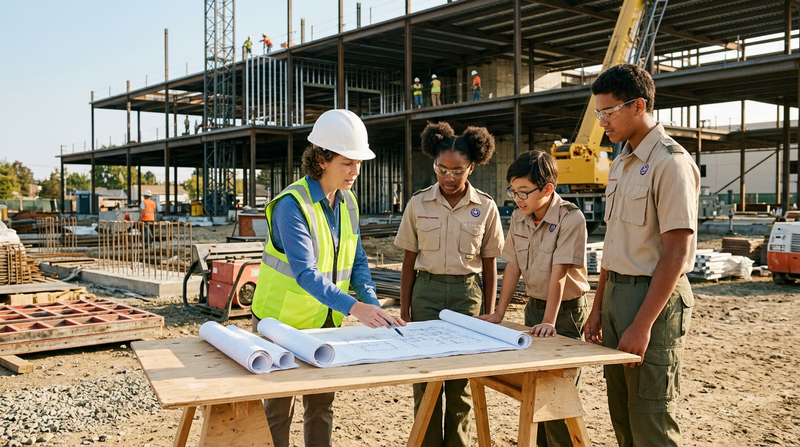
Option B: Visit a Construction Site
This option is the most hands-on. You get to see a building in the process of being built — with all the steel, concrete, and framing exposed before it gets covered up by walls and finishes.
What You Will See
Depending on what stage the construction is in, you might see:
- Foundation work — Concrete being poured into forms, rebar grids being tied together
- Structural framing — Steel beams, wood studs, or concrete columns forming the skeleton of the building
- Mechanical systems — Ductwork, plumbing pipes, and electrical conduit being installed inside walls and ceilings
- Exterior cladding — Brick, stone, glass, or metal panels being attached to the outside of the structure
What to Discuss
Ask the architect why specific materials were chosen for each part of the building. For example:
- Why steel beams instead of wood for the structure?
- Why brick on the exterior instead of siding?
- How are the walls attached to the foundation?
- How do the windows stay sealed against rain and wind?
Option C: Interview a Client
This option lets you step into the architect’s shoes. Instead of observing an architect, you become one — at least for this exercise. Your job is to interview a “client” and create an architectural program (a written document that lists everything the building needs to do).
What Is an Architectural Program?
In architecture, a program is not a computer program — it is a detailed written plan that describes what the building needs to include, how spaces should work together, and what goals the project should achieve. It is the first document an architect creates before drawing a single line.
Conducting the Interview
Pick someone who would be a realistic client — a parent thinking about a dream home, a neighbor who runs a business, or a community leader who wants a new meeting space. Ask them questions like:
Client Interview Questions
What to ask your prospective client
- What is the purpose of this building? What will happen inside it?
- How many people will use it? At the same time or at different times?
- What rooms or spaces do you need? How big should each one be?
- How should the spaces connect to each other? (Should the kitchen be near the dining room? Should the office be away from noisy areas?)
- Do you need outdoor space? Parking? Storage?
- What is your budget range?
- Are there any special requirements? (Accessibility, energy efficiency, specific materials?)
- What style or feeling do you want the building to have?
Writing Your Program
After the interview, organize your notes into a short written program. Include:
- Project overview — One paragraph describing what the building is and who it is for
- Requirements list — Every room and space the client needs, with approximate sizes
- Functional relationships — How spaces relate to each other (a diagram showing connections works well)
- Project goals — What the client values most (budget, sustainability, aesthetics, accessibility, etc.)
How to Arrange Your Visit
No matter which option you choose, planning ahead is essential.
Visit Planning Checklist
Steps to set up your meeting
- Talk to your merit badge counselor first — they may know architects in the area or have contacts
- Check with the American Institute of Architects (AIA) local chapter for volunteer architects
- Write a polite email or letter explaining who you are and what you are working on
- Get written permission from your parent or guardian
- Prepare your questions in advance
- Bring a notebook and pen to take notes
- Send a thank-you note after your visit
You have seen architecture from the professional side. Now it is your turn to pick up a pencil and create your own architectural drawing.