Extended Learning
A. Introduction
Congratulations — you have earned the Art merit badge! You have defined what art is, mastered the elements and principles, created works in multiple media, applied your skills to a real-world project, experienced art in person, and explored career opportunities. That is a serious accomplishment. But your journey as an artist is just beginning. Here are some ways to keep growing.
B. Deep Dive: Building a Sketchbook Habit
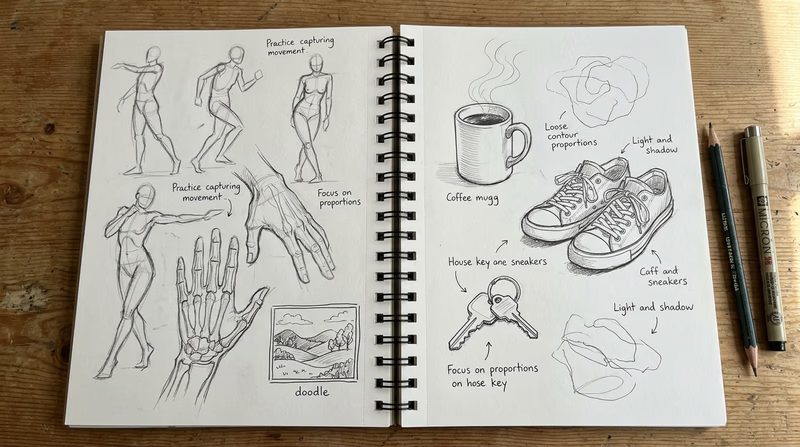
The single most effective thing you can do to improve as an artist is to draw regularly. Professional artists, illustrators, animators, and designers all maintain sketchbooks — not polished portfolios, but messy, honest, daily records of their observations and ideas. A sketchbook is where you practice, experiment, fail, and grow without pressure.
Start with a commitment you can keep. Five minutes a day is better than an hour once a month. Draw what you see: your breakfast, your dog, the view from your window, a stranger on a bus. Do not worry about making it “good.” The goal is to train your eye to observe and your hand to respond. Over time, you will notice your lines getting more confident, your proportions getting more accurate, and your shading getting more nuanced.
Try themed challenges to keep things interesting. “Inktober” is a popular October challenge where artists create one ink drawing per day based on daily prompts. “Sketch a Day” communities online share themes like “draw your shoe” or “draw something round.” These low-stakes challenges push you to draw subjects you would never choose on your own, which is exactly how you grow.
Keep every sketchbook you fill. In six months, flip back to your earliest pages. The improvement will be dramatic — and seeing your own progress is one of the most motivating things in the world. Your sketchbook is not a gallery; it is a gym. Nobody judges you for what you look like at the gym. They respect you for showing up.
C. Deep Dive: Understanding Color Mixing
In Requirement 4, you worked with paint — and you probably noticed that getting the right color is harder than it looks. Understanding how to mix colors from a limited palette is one of the most valuable skills a painter can develop, and it saves you from buying dozens of tubes of paint you do not need.
Start with a limited palette of just five colors: titanium white, ivory black, cadmium yellow, cadmium red (or a red like alizarin crimson), and ultramarine blue. From these five tubes, you can mix nearly every color you will ever need. This forces you to understand color relationships rather than just grabbing a pre-mixed color from the tube.
Practice making a color chart. Squeeze a small amount of each primary onto your palette. Mix yellow + blue to get green. Mix red + blue to get violet. Mix red + yellow to get orange. Then try adjusting each mixture: add more of one color to shift the hue. Add white to create a tint (lighter version). Add a tiny bit of the complementary color (the color across the color wheel) to create a more muted, natural tone. Earthy browns, olive greens, and subtle grays all come from mixing complementary colors together.
Pay attention to color temperature in your mixing. A warm yellow (leaning toward orange) mixed with a cool blue (leaning toward green) produces a different green than a cool yellow mixed with a warm blue. Every primary comes in warm and cool variations, and knowing which you are working with helps you predict the result. Eventually this becomes intuitive, but at first it helps to keep notes on what you mixed and how it turned out.
The most common beginner mistake is using too much paint and ending up with muddy colors. Start with small amounts. Add the darker color to the lighter one (it takes very little dark paint to shift a light color, but a lot of light paint to shift a dark one). Clean your brush between mixtures. And above all, experiment — happy accidents in color mixing are how you discover your most interesting palettes.
D. Deep Dive: Art and Technology
The line between traditional art and technology gets thinner every year. Understanding how digital tools expand your creative possibilities is essential for any artist growing up in the 21st century.
Digital painting software like Procreate, Krita, and Adobe Photoshop gives you access to unlimited colors, infinite layers, and an undo button that traditional media cannot match. Many professional illustrators and concept artists work entirely digitally, creating artwork for films, games, books, and advertisements. The skills you learned with physical paint — color mixing, value, composition — all transfer directly to digital tools. The medium changes, but the fundamentals stay the same.
3-D modeling opens up an entirely different dimension. Programs like Blender (free and open-source), ZBrush, and Tinkercad let you sculpt, texture, and light virtual objects. 3-D artists create characters for animated movies, design products for manufacturing, build virtual environments for video games, and even create models for 3-D printing. If you enjoyed thinking about form and space in Requirements 2 and 3, 3-D modeling is a natural next step.
Photography and photo editing combine artistic composition with technical knowledge of cameras, lighting, and software. Learning to use a DSLR camera or even mastering your phone’s manual mode teaches you about exposure, depth of field, and the relationship between light and image. Photo editing software like Adobe Lightroom or the free GIMP lets you fine-tune your images after capture.
Generative and AI-assisted art is a rapidly evolving field where artists use algorithms and artificial intelligence as creative tools. While this technology raises important questions about authorship and originality, understanding it gives you perspective on where art is heading. The most interesting work in this space comes from artists who combine AI tools with traditional skills and their own creative vision.
No matter which technology you explore, remember that the tool does not make the artist. A great artist with a pencil will always outperform a mediocre artist with the most expensive software. Master the fundamentals first — then let technology amplify what you already know.
E. Real-World Experiences
Take your art beyond the page and into the world. These experiences will challenge you, introduce you to other artists, and give you new perspectives.
Local Art Classes & Workshops
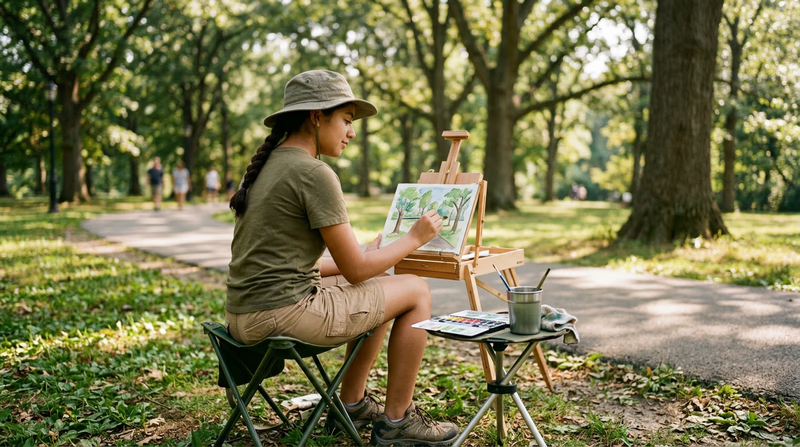
Plein Air Painting
Art Festivals & Fairs
Community Mural Projects
Open Studio Events
F. Organizations
These organizations support artists at all levels and offer resources, events, and communities to help you grow.
The nation’s leading nonprofit for advancing the arts in communities, schools, and civic life. Offers advocacy, research, and programs for young artists.
Promotes art education and supports art teachers and students across the country with resources, research, and professional development.
One of the world’s largest collections of American art, with extensive free online resources, virtual tours, and educational programs for students.
Free, world-class art history and art-making courses covering everything from ancient cave paintings to contemporary digital art.
A series that explores contemporary art, art history, and creative challenges. Great for discovering new artists and ideas.