Req 1 — Understanding Art
This requirement asks you to think deeply about three big questions. Your counselor is not looking for textbook answers — they want to hear your own thoughts, backed by what you have learned. Let’s explore each one.
What Is Art?
Ask ten people to define art and you will get ten different answers. That is part of what makes art so interesting. At its core, art is the use of skill and imagination to create something that communicates an idea, an emotion, or an experience. It can be visual (a painting), auditory (a piece of music), physical (a dance), or literary (a poem). For this merit badge, you will focus on the visual arts — the kind you can see and sometimes touch.
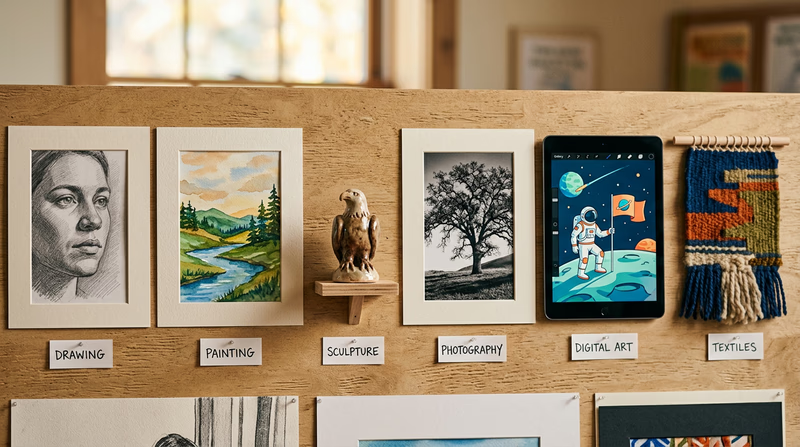
Here are some of the major forms of visual art:
- Drawing — Using pencils, pens, charcoal, or pastels to create images on paper
- Painting — Applying pigments (watercolors, oils, acrylics, tempera) to a surface
- Sculpture — Shaping three-dimensional forms from clay, stone, wood, metal, or other materials
- Printmaking — Creating images by pressing inked surfaces onto paper (think woodcuts or screen printing)
- Photography — Capturing images using a camera and creative choices about light and composition
- Digital Art — Creating images or animations with computers and software
- Architecture — Designing buildings and spaces that are both functional and beautiful
- Ceramics — Forming and firing clay into functional or decorative objects
- Textile Art — Creating art through weaving, embroidery, quilting, or fabric dyeing
Why Art Matters to Humankind
Art is not a luxury — it is a fundamental part of being human. Here are some of the reasons art has been important to people throughout history and remains essential today.
Art tells our stories. Before most people could read, art was how communities recorded their history. Medieval stained-glass windows taught Bible stories to churchgoers who could not read. Aztec codices recorded conquests and ceremonies. Today, murals in cities around the world tell the stories of neighborhoods and cultures.
Art helps us communicate. Sometimes words are not enough. A photograph of a war zone can change public opinion. A political cartoon can make a complex issue instantly understandable. The universal symbols you see every day — road signs, emojis, app icons — are all designed by artists.
Art builds empathy. When you look at a painting of someone from a different time, place, or background, you get a window into how they experienced the world. Art invites you to step into someone else’s shoes, even for a moment.
Art drives innovation. Many of the greatest inventions started as sketches. Leonardo da Vinci drew flying machines centuries before the airplane. Architects draft buildings. Engineers visualize bridges. Industrial designers shape the products you use every day. Art and science work together more often than you might think.
Art strengthens communities. Public art brings people together. A mural can transform a neglected wall into a source of neighborhood pride. Community theater, art festivals, and gallery openings create spaces for people to connect and celebrate.
What Art Means to You
This is the most personal part of the requirement — and there is no wrong answer. Your counselor wants to know how art fits into your life and how it makes you feel. Here are some questions to help you prepare:
- Is there a piece of art (a painting, a song, a movie scene, a video game world) that has stuck with you? Why?
- Have you ever created something — a drawing, a model, a photograph — that made you feel proud, calm, frustrated, or excited?
- Do certain colors or styles make you feel a particular way? Bright colors might feel energizing; dark, moody images might feel mysterious or sad.
- Does making art feel relaxing to you, or does it feel challenging? Both are valid.
Art can make people feel joy, peace, confusion, sadness, awe, curiosity, or even anger. All of those responses are valid. The important thing is that art makes you feel something — and being able to talk about that feeling is a skill that will serve you well beyond this merit badge.
Google Arts & Culture Explore thousands of artworks from museums around the world. Zoom in on brushstrokes, take virtual museum tours, and discover art from every era and culture. The Art Story — What Is Art? A clear, well-organized overview of how the definition of art has evolved over centuries.