Req 2 — Elements of Art
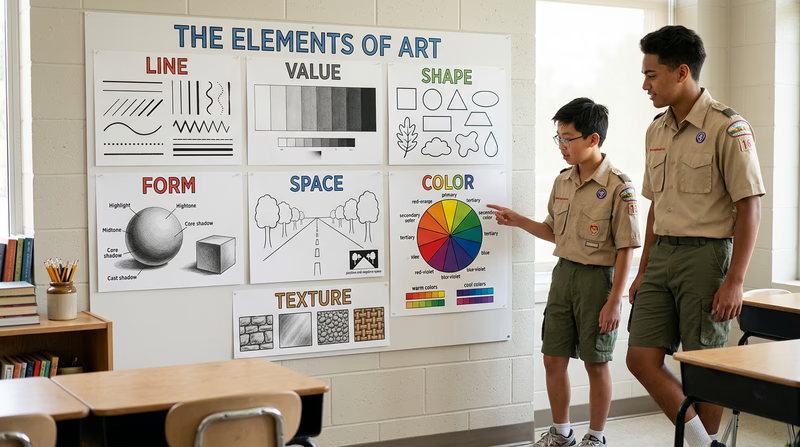
Think of the elements of art as the basic ingredients in a recipe. Just as every meal starts with individual ingredients — flour, salt, eggs — every piece of art is built from these seven fundamental elements. Once you can recognize them, you will start seeing them everywhere: in paintings, photographs, buildings, nature, and even your cereal box.
Your counselor will ask you to not only define these elements but also show examples. Look around your home, flip through a magazine, or search online to find real artwork that demonstrates each one. Bringing specific examples will show your counselor that you truly understand these concepts.
Line
A line is a mark that moves from one point to another. It is the most basic element of art — and also one of the most powerful. Lines can be straight, curved, thick, thin, jagged, smooth, horizontal, vertical, or diagonal. Every line communicates something different.
- Horizontal lines suggest calm and stability (think of a flat horizon)
- Vertical lines suggest strength and height (think of a tall building)
- Diagonal lines suggest movement and energy (think of a lightning bolt)
- Curved lines suggest softness and flow (think of rolling hills)
- Jagged lines suggest tension or chaos (think of a cracked windshield)
Artists use line to create outlines, define edges, show texture, suggest movement, and guide your eye through a composition. When you look at a drawing, the lines are doing most of the work.
Value
Value refers to how light or dark something is. Imagine a gradient that goes from pure white to pure black — every shade of gray in between is a different value. Value is what gives flat shapes the appearance of depth and volume.
When light hits an object, one side is bright (the highlight) and the other side fades into shadow. An artist recreates this effect by varying values — making some areas lighter and others darker. This is called shading, and it is one of the most important skills you will develop.
Shape
A shape is a flat, two-dimensional area defined by edges or boundaries. Shapes have height and width but no depth. They fall into two categories:
- Geometric shapes — Circles, squares, triangles, rectangles, and other shapes with precise mathematical properties. You see these in buildings, signs, and patterns.
- Organic shapes — Irregular, free-form shapes found in nature. Leaves, clouds, puddles, and coastlines are all organic shapes.
Every object you draw starts as a basic shape. A tree is a circle on top of a rectangle. A face is an oval. Learning to break complex subjects into simple shapes is one of the fastest ways to improve your drawing.
Form
Form is shape’s three-dimensional sibling. While a circle is a shape, a sphere is a form. While a square is a shape, a cube is a form. Forms have height, width, and depth. Sculptures are forms. Buildings are forms. The mug on your desk is a form.
In two-dimensional art (like a drawing or painting), artists create the illusion of form using value, shading, and perspective. When you shade a circle so it looks like a ball sitting on a table, you have turned a shape into a form.
Space
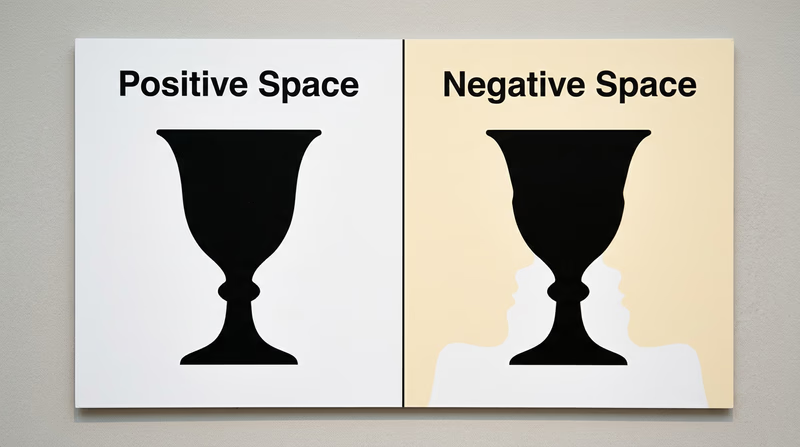
Space is the area around, between, and within objects in an artwork. Artists think about two types of space:
- Positive space — The main subject of the artwork. If you draw a tree, the tree is the positive space.
- Negative space — The empty area around and between subjects. The sky around the tree is the negative space.
Great artists pay just as much attention to negative space as they do to positive space. The empty areas in a composition are not wasted — they give the viewer’s eye a place to rest and help define the subject.
Perspective is an artist’s tool for creating the illusion of depth on a flat surface. Roads that narrow toward the horizon, buildings that shrink in the distance, and overlapping objects all use perspective to create a sense of space.
Color
Color is perhaps the most immediately powerful element of art. It catches your eye, sets a mood, and communicates meaning — sometimes without you even realizing it.
Every color has three properties:
- Hue — The name of the color (red, blue, yellow, green, etc.)
- Value — How light or dark the color is (light blue vs. dark blue)
- Intensity (or saturation) — How bright or dull the color is (vivid red vs. muted brick red)
The color wheel organizes colors by their relationships:
- Primary colors: Red, yellow, blue — these cannot be mixed from other colors
- Secondary colors: Orange, green, violet — made by mixing two primaries
- Tertiary colors: Red-orange, yellow-green, etc. — made by mixing a primary with a secondary
Artists also use color temperature. Warm colors (reds, oranges, yellows) tend to advance and feel energetic. Cool colors (blues, greens, violets) tend to recede and feel calm. Understanding these relationships helps you choose colors that work well together.
Texture
Texture is how a surface feels — or how it looks like it would feel. There are two types:
- Actual texture — The real, physical feel of a surface. A sculpture made of rough stone has actual texture. A woven basket has actual texture. You can touch it and feel it.
- Implied texture — The illusion of texture created on a flat surface. When an artist paints a brick wall so realistically that you want to reach out and touch it, that is implied texture.
Artists create implied texture through careful use of line, value, and pattern. Cross-hatching (many overlapping lines) can suggest rough surfaces. Smooth gradients suggest polished or soft surfaces. Learning to render different textures — fur, metal, fabric, wood, water — makes your artwork more believable and engaging.
Finding Examples
Where to look for the seven elements
- Line: Power lines, bridges, wrinkles on a face, cracks in a sidewalk
- Value: Black-and-white photographs, pencil shading, shadows on a sunny day
- Shape: Road signs, logos, windows, cookie cutters
- Form: Sports balls, furniture, fruit, rocks
- Space: Arches, doorways, windows, negative space in logos
- Color: Sunsets, flower gardens, neon signs, stained-glass windows
- Texture: Tree bark, knitted sweaters, sandpaper, water ripples