Req 3 — Principles of Design
If the elements of art are your ingredients, the principles of design are your recipe. They tell you how to arrange those ingredients — line, shape, color, value, form, space, and texture — into a composition that works. A painting might use beautiful colors, but if the composition feels lopsided, cluttered, or boring, something is off. The six principles of design help you figure out what.
Think of it this way: you already use these principles without thinking about it. When you arrange photos on your wall so they look balanced, you are using balance. When you wear a bright red shirt to stand out, you are using emphasis. This requirement helps you put names to things you already sense.
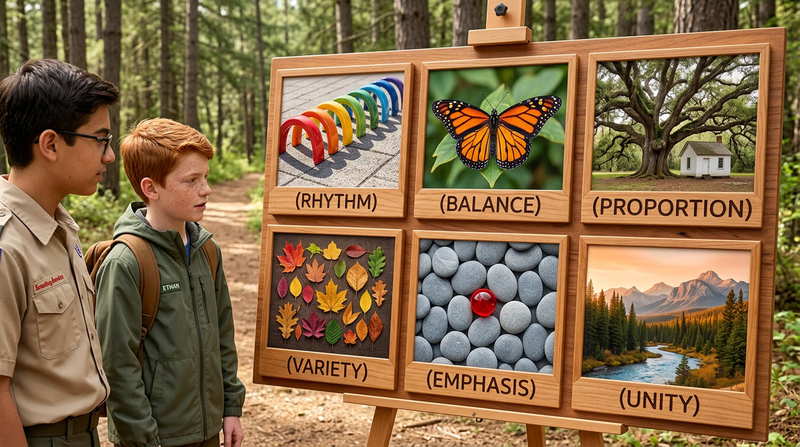
Rhythm
Rhythm in art works a lot like rhythm in music. In music, rhythm is the repeated pattern of beats that gives a song its groove. In art, rhythm is the repeated use of visual elements — colors, shapes, or lines — that creates a sense of movement and flow.
When you look at a row of columns on a building, you see rhythm. When you see a pattern of waves in a painting, you feel rhythm. The repetition draws your eye across the artwork, giving it energy and direction.
There are several types of visual rhythm:
- Regular rhythm — The same element repeats at equal intervals (like a picket fence)
- Alternating rhythm — Two or more elements take turns (like a checkerboard)
- Progressive rhythm — An element gradually changes in size, color, or spacing (like ripples spreading from a stone dropped in water)
- Random rhythm — Elements repeat without a predictable pattern (like scattered leaves on the ground)
Balance
Balance is how visual weight is distributed in a composition. A balanced artwork feels stable and “right.” An unbalanced artwork feels like it might tip over — which can be intentional or a mistake, depending on the artist’s goal.
There are three main types of balance:
- Symmetrical balance — Both sides of the composition are mirror images (or close to it). Think of a butterfly’s wings or the front of a Greek temple. Symmetry feels formal, calm, and orderly.
- Asymmetrical balance — The two sides are different but still feel balanced. A large object on one side might be balanced by several smaller objects on the other side, or by a bright color that draws equal attention. Asymmetry feels dynamic and interesting.
- Radial balance — Elements radiate outward from a central point, like the spokes of a wheel or the petals of a flower. Radial balance draws your eye to the center.
Proportion
Proportion is the size relationship between different parts of an artwork. When the parts feel like they belong together at the right sizes, we say the proportions are “correct” — though in art, there is no single correct answer.
Realistic proportion means drawing things at sizes that match reality. A person’s head is about one-seventh of their total height. A cat’s eyes are about one-third of the way down from the top of its head. Learning these ratios helps you draw more accurately.
But artists often break proportion on purpose for effect:
- Caricature artists exaggerate features (a huge nose, tiny eyes) for humor
- Ancient Egyptian artists drew important figures larger than less important ones
- Manga and anime use oversized eyes and small mouths to express emotion
The key is understanding the “normal” proportions first, so you can break them intentionally when you want to.
Variety
Variety is the use of different elements to create visual interest. A painting that uses only one color, one shape, and one line thickness would be monotonous. Adding variety — mixing thick and thin lines, warm and cool colors, large and small shapes — keeps the viewer’s eye engaged.
Variety works best when it is controlled. Too little variety creates boredom. Too much variety creates chaos. The goal is to have enough differences to keep things interesting while maintaining an overall sense of order. This is where variety works hand in hand with unity (which we will cover in a moment).
Think of it like a trail mix. If every piece were the same (all raisins), it would be boring. If every piece were wildly different (raisins, gummy bears, nails, marshmallows), it would be chaotic. A good trail mix has variety within reason — and so does a good artwork.
Emphasis
Emphasis is how an artist draws your attention to the most important part of the composition. That important area is called the focal point — it is where your eye goes first.
Artists create emphasis using several techniques:
- Contrast — Making the focal point a different color, value, or size from everything around it. A single red flower in a green field immediately stands out.
- Isolation — Placing the subject away from other elements so it is alone and therefore noticeable.
- Convergence — Arranging lines, shapes, or patterns so they all point toward the focal point, like arrows.
- Detail — Rendering the focal point with more detail than the surrounding areas, which may be blurred or simplified.
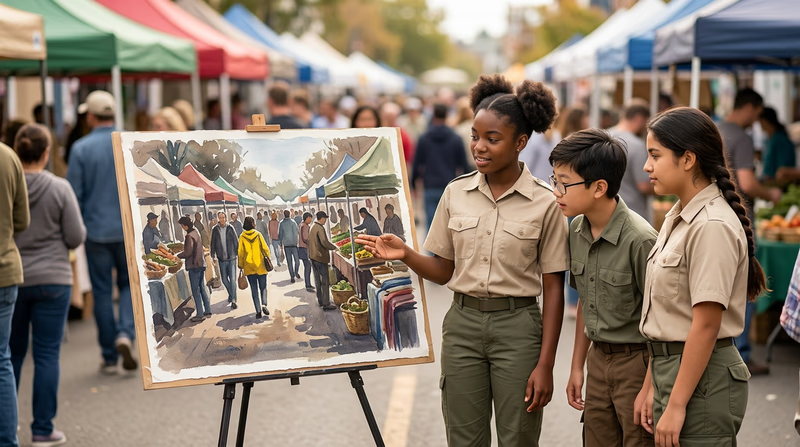
Unity
Unity is the glue that holds everything together. An artwork has unity when all of its parts — the colors, shapes, textures, and ideas — feel like they belong in the same composition. Nothing looks out of place. Everything works toward the same goal.
Artists achieve unity through:
- Repetition — Using the same color, shape, or texture throughout the piece ties it together
- Proximity — Placing related elements close together
- Continuation — Creating a visual path that flows smoothly through the composition
- Consistent style — Using the same brushstroke technique, line quality, or color palette throughout
Unity does not mean everything looks the same — that would kill variety. Unity means that even though the parts are different, they all feel like they belong to the same family.
Putting It All Together
The six principles do not work in isolation. Every successful artwork uses multiple principles at once. A well-designed poster might use emphasis to draw your eye to the headline, balance to keep the layout from feeling lopsided, proportion to make the text readable, variety to keep it visually interesting, rhythm to move your eye through the information, and unity to make the whole thing feel cohesive.
Preparation Checklist
Get ready for your counselor discussion
- Define each principle in your own words — do not just memorize definitions
- Find at least one real-world example of each principle (artwork, building, poster, website)
- Think about how principles work together — can you find one artwork that demonstrates at least three principles?
- Consider which principles are most important for the type of art you want to create