Req 5 — Applied Art Projects
This requirement bridges art and real-world application. You will pick one of the three options and carry it through from idea to finished product. All three options ask you to think like a designer — someone who uses art to solve a problem, tell a story, or communicate an identity.
Read through all three options before you choose. Think about which one fits your interests, your available materials, and the time you have.
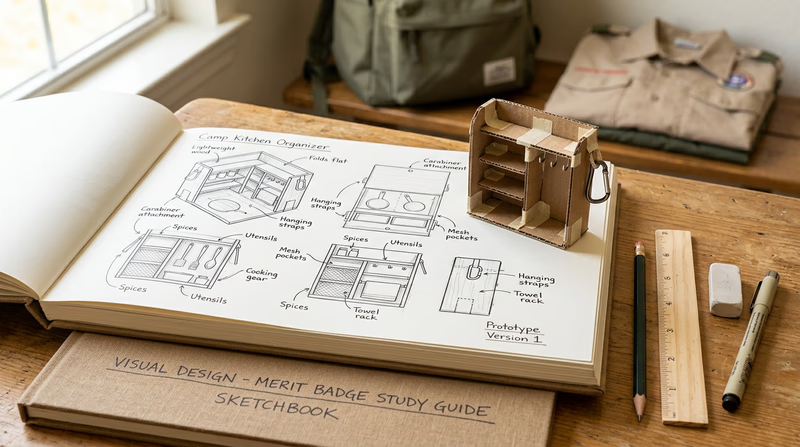
Option A: Design Something Useful
This option is about functional design — creating an object that serves a purpose. Think of the everyday items around you that were designed by someone: a water bottle, a camp chair, a phone case, a bookshelf, a tent. Every one of those objects started as a sketch in a designer’s notebook.
How to approach it:
- Identify a problem or need. What could be improved? What is missing? Look at your Scout gear, your room, your school supplies, or your camp equipment.
- Brainstorm solutions. Sketch several rough ideas quickly — do not worry about perfection. Get your ideas onto paper.
- Refine your best idea. Choose your strongest concept and create a detailed sketch or a 3-D model (using clay, cardboard, or foam board).
- Create a promotional piece. Design a poster, advertisement, or packaging that shows off your product. Include your design drawing and a description of what it does and why someone would want it.
Project ideas:
- A multi-tool holder for your camp kitchen
- A weather-resistant trail marker
- A new design for a merit badge sash or patch organizer
- A phone stand made from natural materials
- A better system for organizing your patrol box
Option B: Tell a Story with Pictures
This option is about narrative art — using images to communicate a sequence of events, an emotion, or an idea. Comic strips, graphic novels, illustrated children’s books, storyboards, and even cave paintings all tell stories through pictures.
How to approach it:
- Choose your story. It can be real or fictional. A Scouting adventure, a historical event, a family memory, or a completely imaginary tale all work.
- Plan your sequence. How many images do you need to tell the story? Sketch small thumbnails to map out the beginning, middle, and end.
- Create your final artwork. You can use any medium — pen and ink, watercolor, digital, or even 3-D sculpture. Make sure the story is clear without needing a lot of words.
- Consider adding captions or dialogue if they strengthen the storytelling, but let the images do most of the work.
Story formats to consider:
- Comic strip — 3–6 panels telling a short, complete story
- Single illustration — One powerful image that captures a moment and implies a larger story
- Triptych — Three images that show a progression (before, during, after)
- 3-D diorama — A scene built from clay, cardboard, or other materials
- Storyboard — A sequence of scenes like a movie director would plan
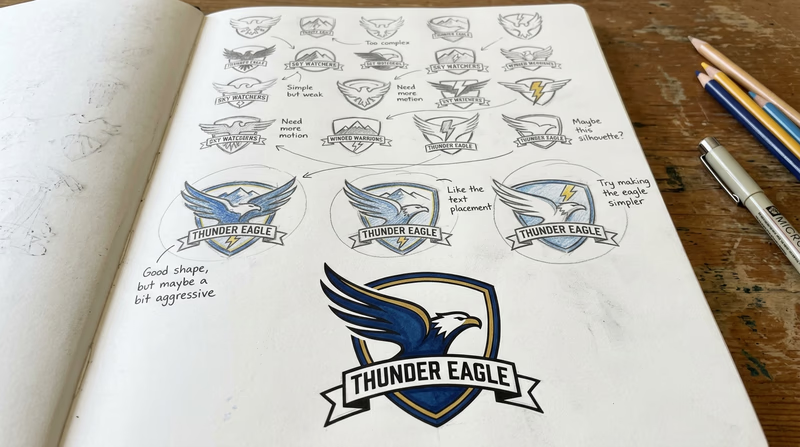
Option C: Design a Logo
This option is about graphic design and branding — creating a visual symbol that represents an identity. Logos are everywhere: on your shoes, your phone, your school, and your Scout uniform. A great logo is simple, memorable, and meaningful.
How to approach it:
- Choose what the logo represents. Your patrol, your troop, a school club, a family crest, a fictional company, or a personal brand.
- Research. Look at logos you admire. What makes them effective? Notice how the best logos work in one or two colors and are recognizable even at a small size.
- Brainstorm and sketch. Draw at least 10–15 rough concepts. Do not judge them yet — just get ideas flowing.
- Refine your best concept. Pick the strongest idea and create a clean, polished version.
- Explain the significance. Be ready to tell your counselor why you chose the shapes, colors, and symbols you used. What does each element represent?
- Apply it. With permission, put your logo on something real — a patrol flag, a piece of furniture, a ceramic mug, a T-shirt, a hat, or a piece of Scout equipment.
Logo Design Principles
What makes a great logo
- Simple: Can you draw it from memory? If not, simplify it.
- Memorable: Does it stick in your mind after seeing it once?
- Scalable: Does it look good both large (on a banner) and small (on a pin)?
- Versatile: Does it work in black and white as well as in color?
- Relevant: Does it connect to the thing it represents?
No Matter Which Option You Choose
All three options follow the same creative process:
- Research and brainstorm — Explore the problem space and generate many ideas
- Plan — Map out your approach before committing to a final direction
- Create — Execute your idea with care and craftsmanship
- Reflect — Be ready to discuss your choices, your process, and what you learned
This is how professional artists and designers work every day. The finished product matters, but your counselor is equally interested in your process — how you got from idea to finished piece.
Canva Design School Free lessons on graphic design fundamentals including logo design, color theory, and layout — useful for all three project options. Making Comics by Scott McCloud Scott McCloud is the world's leading expert on visual storytelling. His books on comics and sequential art are invaluable for Option B.