 Getting Started
Introduction & Overview
You are living in the age of artificial intelligence — and whether you realize it or not, you have been using it every single day. When your phone suggests the next word you want to type, when a streaming service recommends a show you end up loving, when a navigation app reroutes you around traffic — that is AI at work. The Artificial Intelligence merit badge is your chance to pull back the curtain and understand how this technology actually works, why it matters, and how you can use it responsibly.
AI is not science fiction. It is a set of tools built by people — people who started out just as curious as you are right now. This merit badge will help you understand the basics, think critically about the ethics, and even build something of your own.
Then and Now
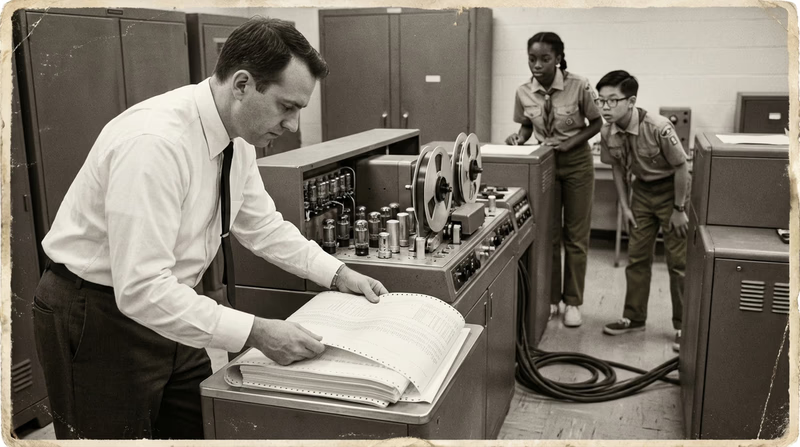
Then — The Dream of Thinking Machines
The idea of machines that can “think” is older than you might expect. In 1950, British mathematician Alan Turing published a paper asking a simple but profound question: “Can machines think?” He proposed a test — now called the Turing Test — where a human judge has a conversation with both a person and a machine. If the judge cannot reliably tell which is which, the machine passes the test.
- Purpose: Explore whether machines could replicate human thought
- Mindset: Theoretical, experimental — most people thought true AI was decades or even centuries away
Six years later, in 1956, a group of researchers gathered at Dartmouth College and officially coined the term “artificial intelligence.” They believed that every aspect of learning could, in principle, be described so precisely that a machine could be made to simulate it. The field of AI was born — but progress would prove much harder and slower than those early pioneers expected.
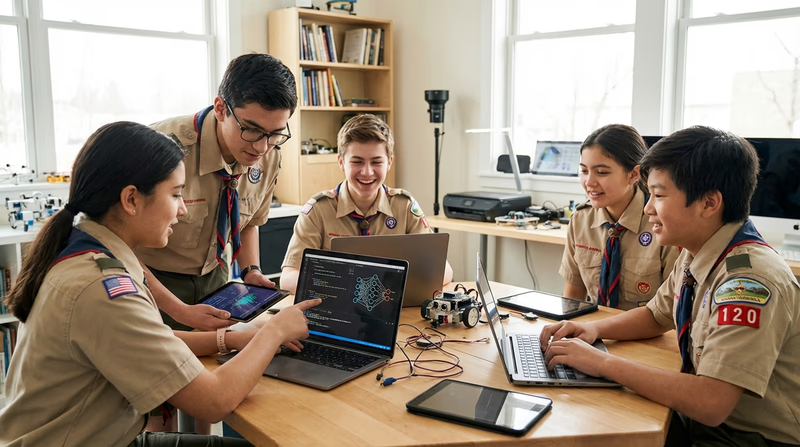
Now — AI Everywhere
Today, AI is not locked in a research lab. It is in your pocket, on your kitchen counter, and woven into nearly every app and website you use. Modern AI systems can recognize faces, translate languages in real time, drive cars, diagnose diseases, and generate text, images, and music.
- Purpose: Solve real-world problems at scale — from healthcare to entertainment to environmental science
- Mindset: AI is a tool for everyone, not just computer scientists. The question is no longer “Can machines think?” but “How should we use these powerful tools wisely?”

Get Ready! The world of artificial intelligence is waiting for you to explore it. You do not need to be a coding expert or a math genius to understand AI — you just need curiosity and the willingness to ask good questions. Let’s dive in!
Kinds of Artificial Intelligence
Before we jump into the requirements, let’s look at the major areas of AI. This is a field with many branches, and each one does something different.
Narrow AI (Weak AI)
This is the kind of AI you interact with every day. Narrow AI is designed to do one specific task really well. Your voice assistant (Siri, Alexa, Google Assistant) is narrow AI — it can answer questions and play music, but it cannot drive a car or write a novel. It does not “understand” what it is doing the way a human does; it follows patterns in data.
Machine Learning (ML)
Machine learning is a subset of AI where systems learn from data instead of being explicitly programmed with rules. Instead of a programmer writing “if the email contains these words, it is spam,” a machine learning system looks at thousands of examples of spam and non-spam emails and figures out the patterns on its own.
Natural Language Processing (NLP)
NLP is the branch of AI that deals with human language — reading, writing, speaking, and understanding it. When you talk to a voice assistant, use a translation app, or interact with a chatbot, you are using NLP. It is what allows AI to process the messy, complicated way humans communicate.
Computer Vision
Computer vision teaches machines to “see” and interpret images and video. It powers facial recognition on your phone, helps self-driving cars detect pedestrians, and allows doctors to spot tumors in medical scans. If NLP is about language, computer vision is about sight.
Robotics & AI
When AI meets the physical world, you get robots. AI-powered robots can assemble cars in factories, explore the surface of Mars, or vacuum your living room floor. The AI acts as the “brain,” making decisions based on what the robot’s sensors detect.
Generative AI
Generative AI is one of the newest and most exciting areas. These systems can create new content — text, images, music, code, and video — based on patterns they learned from enormous datasets. Tools like ChatGPT, DALL-E, and Midjourney are examples of generative AI. You give them a prompt, and they generate something new.
Now let’s explore the requirements for the Artificial Intelligence Merit Badge!