Extended Learning
A. Introduction
Congratulations — you have completed the requirements for the Artificial Intelligence merit badge! But your exploration of AI does not stop here. The field is evolving faster than any other area of technology, and the tools, ideas, and possibilities are expanding every day. This page is your launchpad for going deeper.
B. Deep Dive: How Neural Networks Actually Work
You learned in Requirement 6a that neural networks are inspired by the human brain. But how do they actually work? Let’s go a level deeper.
A neural network is made up of layers of nodes (also called neurons). Each node takes in numbers, does a simple calculation, and passes the result to the next layer. A typical neural network has three types of layers:
- Input layer — Receives the raw data. For an image classifier, each pixel’s color value becomes one input.
- Hidden layers — The “thinking” layers where patterns are detected. Early layers might detect simple features (edges, colors), while deeper layers recognize complex patterns (faces, objects). More hidden layers = a “deeper” network (this is where the term deep learning comes from).
- Output layer — Produces the final answer. For a cat-vs-dog classifier, the output layer gives a probability: “92% likely to be a cat.”
Each connection between nodes has a weight — a number that determines how much influence one node has on the next. During training, these weights are adjusted millions of times until the network produces accurate results. Think of it like tuning thousands of tiny dials until the picture comes into focus.
The key insight is that nobody programs these patterns by hand. The network discovers them on its own through exposure to enormous amounts of data. This is both the power and the mystery of deep learning — the networks often learn patterns that their own creators cannot fully explain.
3Blue1Brown — Neural Networks (YouTube) An outstanding visual explanation of how neural networks learn, using clear animations and math you can actually follow.C. Deep Dive: AI in Science and Discovery
AI is not just for tech companies — it is accelerating scientific discovery in ways that would have seemed like science fiction a decade ago.
- Protein folding: Google DeepMind’s AlphaFold predicted the 3D structure of virtually every known protein — a problem that stumped biologists for 50 years. This breakthrough is speeding up drug discovery and our understanding of diseases.
- Climate science: AI models analyze satellite imagery, ocean temperatures, and atmospheric data to improve climate predictions and track deforestation in real time.
- Astronomy: AI helps astronomers sift through telescope data to discover new exoplanets, classify galaxies, and detect gravitational waves.
- Materials science: Researchers use AI to design new materials with specific properties — stronger alloys, better batteries, and more efficient solar cells — by predicting how atoms will behave in different combinations.
- Archaeology: AI analyzes satellite images to discover ancient ruins hidden under vegetation or sand, and helps decipher damaged ancient texts.
D. Interactive AI Tools and Experiments
The best way to deepen your understanding of AI is to experiment with it. These free tools let you explore different aspects of AI hands-on:
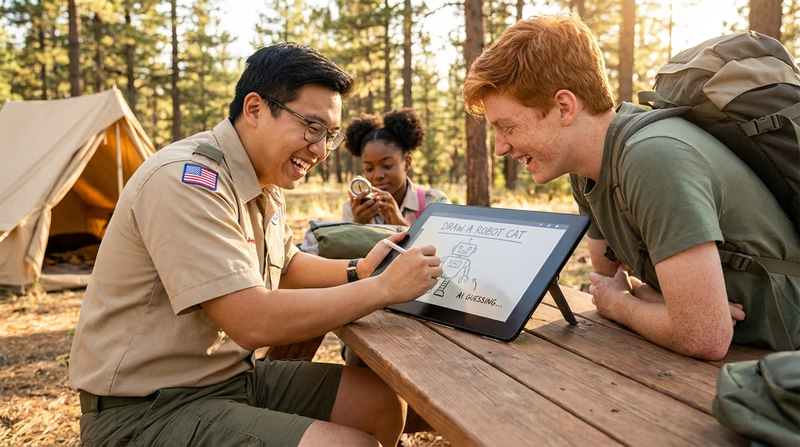
Google Teachable Machine
Quick, Draw!
Machine Learning for Kids
Google AI Experiments
MIT App Inventor with AI Extensions
Runway ML
E. AI Competitions and Challenges
Ready to test your skills against other students? These competitions are designed for middle and high school students:
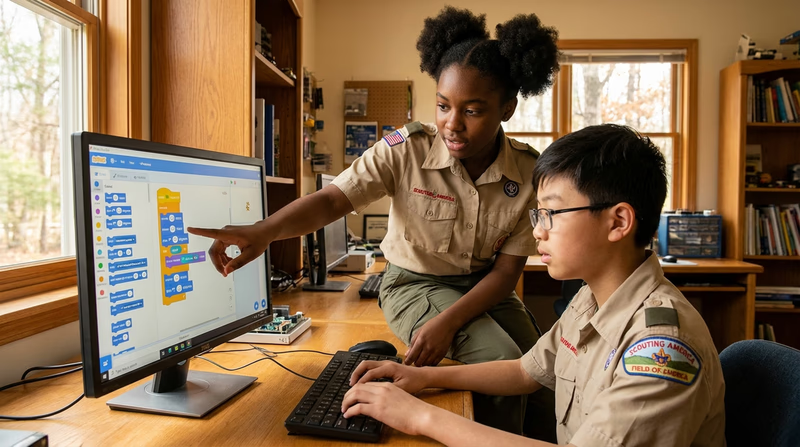
Technovation Girls
AI4ALL Summer Programs
Congressional App Challenge
Google Science Fair
F. Free Courses and Learning Paths
If this merit badge sparked your interest and you want to go further, these free resources can take you from beginner to advanced:
Code.org — How AI Works A free video series explaining machine learning, training data, bias, and AI decision-making in plain language. AI4K12 Resource Directory A curated collection of AI learning resources organized by grade level and topic, maintained by AI education researchers. Elements of AI (University of Helsinki) A free online course designed for non-experts that covers AI fundamentals, neural networks, and societal implications. Google — AI for Anyone A free Coursera course by Andrew Ng (one of the world's leading AI educators) that explains AI without requiring technical background. Scratch + AI Activities Combine Scratch visual programming with real machine learning models to build projects that classify text, images, and numbers.G. Organizations
These organizations are dedicated to making AI education accessible, diverse, and responsible. Many offer free programs, resources, and community connections for young people.
A nonprofit working to increase diversity and inclusion in AI education through summer programs, curriculum, and community building.
A national initiative developing guidelines and resources for teaching AI in K-12 schools, backed by AAAI and CSTA.
A nonprofit dedicated to expanding access to computer science education, with free AI and machine learning curriculum.
MIT’s initiative to develop AI literacy curricula and tools for K-12 students, with a focus on ethical AI.
A global tech education nonprofit that empowers young people to become leaders, creators, and problem-solvers using technology including AI.
A community of Black researchers and practitioners in AI, working to increase representation and address bias in the field.