Req 2a–c — AI All Around You
AI is not something that exists only in research labs or science fiction movies. It is already woven into the fabric of your daily life — you probably interact with AI dozens of times a day without even thinking about it. Requirements 2A, 2B, and 2C ask you to open your eyes and start noticing.
The goal here is not to hand you a list to memorize. It is to help you develop “AI awareness” — the ability to recognize when technology is using artificial intelligence behind the scenes. Once you start looking, you will find AI everywhere.
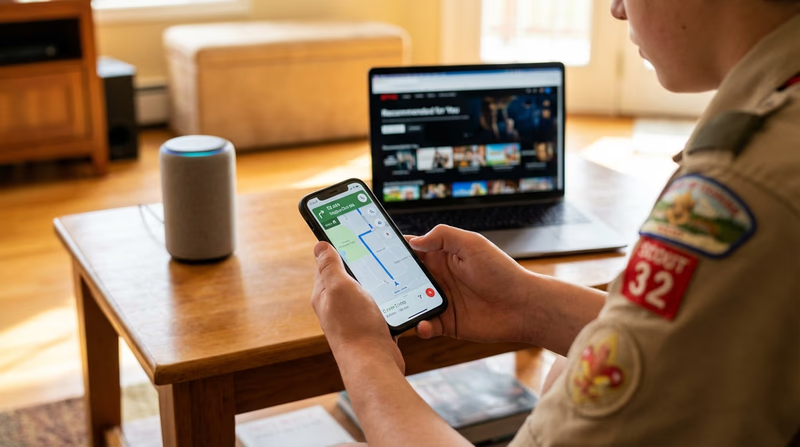
AI in Your Everyday Life
Here are categories where AI shows up in your day-to-day world. Use these as starting points, but challenge yourself to find your own examples too.
Voice Assistants
When you say “Hey Siri,” “Alexa,” or “OK Google,” you are activating an AI system that uses natural language processing to understand your words and respond. These systems convert your speech to text, interpret the meaning, find an answer, and speak it back to you — all in a second or two.
Recommendation Engines
Ever wonder how Netflix seems to know what show you want to watch next? Or how Spotify builds a playlist that matches your taste perfectly? These services use machine learning to analyze what you have watched or listened to, compare it with millions of other users, and predict what you will enjoy.
Navigation and Maps
Google Maps and Waze use AI to predict traffic patterns, calculate the fastest route, and reroute you in real time if there is an accident or road closure ahead. The system learns from the data of millions of other drivers on the road right now.
Smartphone Features
Your phone is packed with AI: autocorrect learns your typing habits, the camera uses AI to adjust lighting and focus, face recognition unlocks the screen, and photo apps can automatically organize your pictures by recognizing who is in them.
Social Media Feeds
The posts you see on Instagram, TikTok, or YouTube are not random. AI algorithms decide what to show you based on what you have liked, shared, watched, and how long you paused on each post. The goal is to keep you engaged — which is why understanding this is important.
Email Filtering
Your email’s spam filter is one of the oldest and most reliable uses of machine learning. It analyzes incoming messages and sorts them into your inbox, promotions, or spam folder based on patterns it has learned from billions of emails.
Online Shopping
When an online store says “Customers who bought this also bought…” — that is AI. These recommendation systems drive a significant portion of e-commerce sales by predicting what you might want based on your browsing and purchase history.
Video Games
Many video games use AI for non-player characters (NPCs) that react to your actions, difficulty systems that adjust to your skill level, and procedural generation that creates unique worlds every time you play.
Smart Home Devices
Robot vacuums like Roomba use AI to map your home and navigate around furniture. Smart thermostats like Nest learn your temperature preferences and schedule. Security cameras use AI to distinguish between a person, an animal, and a car.
Healthcare (Even for You)
If you have ever used a symptom checker app or a fitness tracker that monitors your heart rate for unusual patterns, you have used AI in healthcare. These tools use machine learning to spot things that might need attention.
AI in the Workplace
AI is transforming how adults work across nearly every industry. Here are areas to explore:
Customer Service
Many companies use AI chatbots to answer common questions 24 hours a day. More advanced systems can understand complex requests, look up account information, and resolve issues without a human ever getting involved.
Healthcare and Medicine
AI helps doctors read X-rays, MRIs, and CT scans by highlighting areas that might indicate disease. Some AI systems can detect certain cancers earlier than human radiologists. AI also accelerates the process of discovering and testing new medicines.
Manufacturing and Quality Control
In factories, AI-powered cameras inspect products on assembly lines, catching defects that human eyes might miss. AI also predicts when machines are about to break down, allowing companies to fix them before production stops.
Finance and Banking
Banks use AI to detect fraud by monitoring transactions in real time. If your parent’s credit card is suddenly used in a different country, AI flags that transaction instantly. AI also helps with loan decisions, investment analysis, and risk assessment.
Agriculture
Farmers use AI-equipped drones to survey crops, detect diseases, and determine exactly how much water and fertilizer each section of a field needs. This “precision agriculture” saves resources and increases food production.
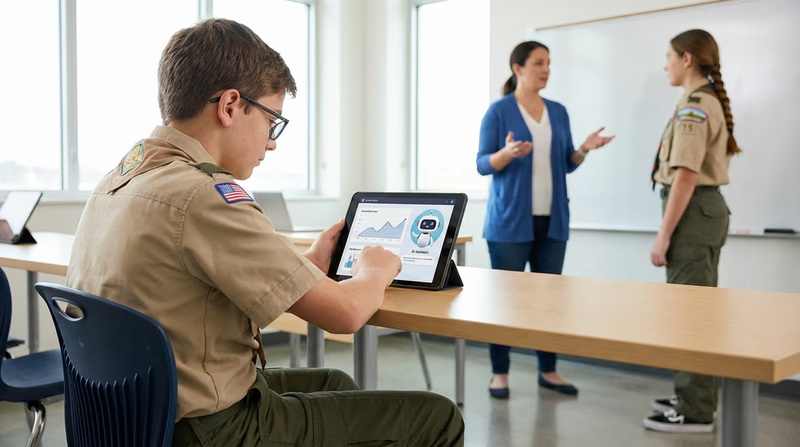
AI in Education
AI is already changing how students learn and how teachers teach. Here are examples relevant to your own school experience:
Personalized Learning Platforms
Tools like Khan Academy, Duolingo, and IXL use AI to adapt to your level. If you ace a set of math problems, the system gives you harder ones. If you struggle, it backs up and teaches the concept a different way. This means you get a learning experience tailored just for you.
Writing and Grammar Tools
Grammarly and similar tools use AI to catch spelling mistakes, suggest better word choices, and even flag unclear sentences. These tools go far beyond a simple spell-checker — they understand context and writing style.
Translation and Accessibility
AI-powered translation tools like Google Translate help students who speak different languages collaborate. Text-to-speech tools help students with visual impairments, and speech-to-text tools help students who have difficulty writing by hand.
Research Assistance
AI can help you find relevant sources for a research paper, summarize long articles, and even suggest related topics you might not have considered. However, you must always verify what AI tells you — it can make mistakes.
Tutoring and Homework Help
AI tutoring tools can explain concepts step by step, work through practice problems with you, and answer questions at any time of day. They supplement (but do not replace) your teachers.
AI4ALL — Open Learning Free AI education resources designed for students. Explore lessons, activities, and real-world AI examples. Google AI Experiments A collection of interactive AI experiments you can try right in your browser — including Quick, Draw! where AI tries to guess your doodles.