Req 2d — AI or Not?
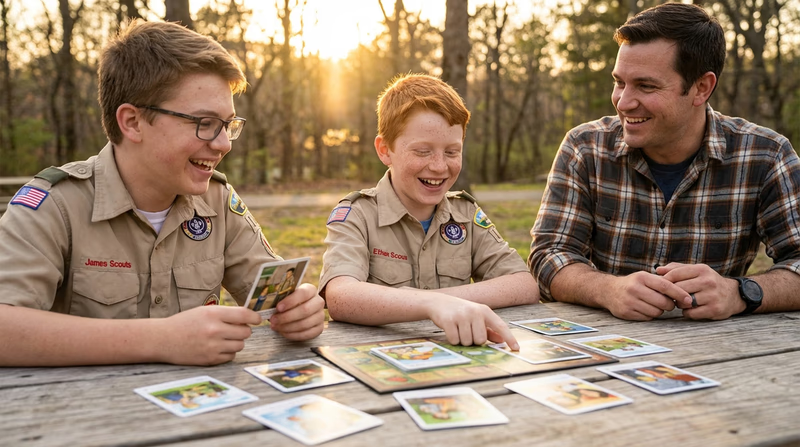
This is one of the most fun parts of the merit badge — and also one of the most educational. The “AI or Not?” game tests your ability to distinguish between technology that truly uses artificial intelligence and technology that simply follows fixed rules.
This distinction matters because the term “AI” gets thrown around a lot in marketing. Companies love to slap “AI-powered” on their products, but not everything labeled AI actually uses machine learning or intelligent decision-making. Developing a keen eye for what is and is not AI is a critical thinking skill that will serve you well.
The Key Question: Does It Learn?
Here is the simplest way to decide: Does the system learn from data and adapt, or does it follow a fixed set of rules that never change?
- AI: A photo app that gets better at recognizing your face over time → It learns from new photos.
- Not AI: A motion-sensor porch light that turns on when someone walks by → It follows a single fixed rule.
The Spectrum of “Smartness”
Not everything is black and white. Technology exists on a spectrum:
- Simple automation — Fixed rules, no learning. (Timer, thermostat set to 72°F)
- Complex automation — Many rules, but still no learning. (A calculator, an alarm system with zones)
- AI-assisted — Uses some machine learning, but mostly rule-based. (Basic spam filter)
- AI-powered — Machine learning is central to how it works. (Voice assistant, recommendation engine)
Practice Scenarios
Before your counselor meeting, sharpen your instincts with these practice scenarios. For each one, ask yourself: Does it learn? Does it adapt? Or is it following fixed rules?
Scenario 1: A Calculator App
You type 2 + 2 and it shows 4. AI or Not?
Not AI. A calculator follows mathematical rules. It does not learn or adapt. It gives the same answer every time for the same input — which is exactly what you want!
Scenario 2: A Music Playlist That Updates Weekly
Spotify’s “Discover Weekly” creates a new playlist for you every Monday based on what you have been listening to. AI or Not?
AI. Spotify uses machine learning to analyze your listening patterns, compare them with millions of other users, and predict songs you will enjoy. The playlist is different for every person and changes over time.
Scenario 3: A Crosswalk Signal
The “Walk” and “Don’t Walk” signs at an intersection change on a timer. AI or Not?
Not AI. It is a fixed-timer automation. It does not sense anything or learn anything — it just follows a programmed cycle.
Scenario 4: Your Phone’s Autocorrect
As you type, your phone predicts the next word and corrects misspellings. Over time, it learns words you use often (including names and slang). AI or Not?
AI. Modern autocorrect uses natural language processing and adapts to your personal typing patterns. It is not just checking a dictionary — it is predicting what you mean based on context.
Scenario 5: A Vending Machine
You insert money, press a button, and a snack drops out. AI or Not?
Not AI. This is basic automation — a mechanical process triggered by your input. No learning, no adaptation.
Tricky Ones to Watch For
Some scenarios will be harder to call. Here are common tricky cases:
- A thermostat set to 72°F → Not AI (fixed rule)
- A Nest thermostat that learns your schedule → AI (it adapts)
- A search engine showing results → AI (ranking uses machine learning)
- An alarm clock → Not AI (fixed time trigger)
- A car’s cruise control → Not AI (maintains set speed)
- A car’s adaptive cruise control that adjusts to traffic → AI-assisted (uses sensors and makes decisions)
The Gray Area
Some technologies sit right on the boundary. A modern washing machine with a “smart sensor” that adjusts water level based on load weight is using sensors and rules — but is it AI? Most experts would say no, because it is not learning from past laundry loads. It is measuring and reacting, which is sophisticated automation but not machine learning.
When you hit a gray area, the best approach is to explain your reasoning to your counselor. There is not always one right answer — the discussion is the point.
Machine Learning for Kids A free, hands-on tool where you can train your own simple AI models using Scratch. A great way to see the difference between AI and regular programming. Google Teachable Machine Train a machine learning model using your webcam, microphone, or images. No coding required — see AI learning in real time.