Req 3a–c — Automation All Around You
In Requirement 2, you explored where AI shows up in your life. Now we turn to its close relative: automation. While AI and automation are related, they are not the same thing. Understanding the difference is one of the key lessons of this merit badge.
Here is the simplest way to think about it:
- Automation = a machine performing a task without human help, following set rules
- AI = a machine that can learn, adapt, and make decisions from data
All AI involves automation, but not all automation involves AI. A dishwasher is automated — it follows a fixed cycle every time you press “Start.” But it is not AI because it does not learn anything or adapt to your dishes.
Automation in Your Everyday Life
Automation is everywhere — and it has been around much longer than AI. Here are categories to get you thinking:
Home Appliances
Your home is full of automation. A washing machine runs through a programmed cycle of fill, wash, rinse, and spin. A dishwasher heats water, sprays, drains, and dries. A programmable coffeemaker starts brewing at 6:30 AM every morning. None of these learn or adapt — they follow the same steps every time.
Thermostats and Climate Control
A basic thermostat turns the heater on when the temperature drops below a set point and off when it is reached. This is automation at its simplest: a trigger (temperature drops) and a response (turn on heat). Note that a “smart” thermostat like Nest crosses into AI territory because it learns your preferences.
Traffic Systems
Traffic lights run on automated timers or sensors embedded in the road. Some intersections have sensors that detect when a car is waiting and change the light accordingly. This is automation — it follows a program, but it does not learn.
Automatic Doors and Elevators
Motion-sensor doors at stores and automatic elevator systems respond to triggers (a person approaching, a button press) with a fixed response. No learning, no adaptation — just reliable, repeated action.
Sprinkler Systems
Many homes and parks use sprinkler systems on timers or moisture sensors. The system activates at a set time or when the soil gets dry enough. More advanced systems use weather data to skip watering if rain is expected — but this is still rule-based, not AI.
Banking
ATMs are one of the earliest examples of automation in daily life. You insert your card, enter a PIN, and the machine dispenses cash following a strict set of rules. Online bill pay, automatic savings transfers, and direct deposit are all forms of financial automation.
Alarms and Notifications
Your alarm clock, calendar reminders, and phone notifications are all automated triggers. They fire at a specific time or when a specific condition is met.
Self-Checkout Registers
The barcode scanner at a self-checkout reads a product code and looks up the price in a database. It follows a strict sequence of rules. However, some newer systems add AI features like computer vision to identify items without barcodes.
Automation in the Workplace
Automation transformed the workplace long before AI arrived. Here are key areas:
Manufacturing and Assembly Lines
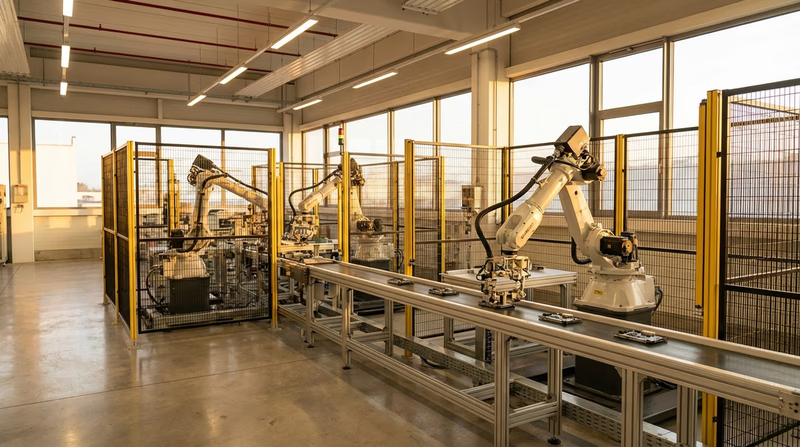
Robotic arms weld car bodies, paint surfaces, and package products. These robots perform the same motion thousands of times with perfect precision. They follow programmed instructions and do not learn or adapt — they just execute.
Shipping and Logistics
Warehouses use automated conveyor belts, sorting systems, and barcode scanners to move packages from storage to shipping trucks. Amazon’s fulfillment centers use a mix of automation (conveyor systems) and AI (robot navigation) to process millions of orders daily.

Accounting and Payroll
Payroll systems automatically calculate hours worked, apply tax rates, and deposit paychecks on a set schedule. Invoicing software can automatically generate and send bills when a job is completed. These follow fixed rules and formulas.
Email Auto-Responders
Many businesses set up automatic email replies: “Thank you for your message. We will get back to you within 24 hours.” This is simple automation — no AI is analyzing the message or deciding how to respond.
Document Workflows
When someone submits a form online (like a job application or insurance claim), automated workflows can route it to the right department, send confirmation emails, and flag incomplete fields — all without human intervention.
Automation in Education
Automation helps teachers and students save time on repetitive tasks:
Automatic Grading
Multiple-choice tests, quizzes, and some math assignments can be graded automatically by software. The system checks each answer against the answer key — no learning required, just comparison.
Learning Management Systems
Platforms like Google Classroom and Canvas automatically distribute assignments, track due dates, send reminders, and calculate grades. These systems follow rules set by teachers.
Attendance Systems
Some schools use card swipes, barcode scans, or check-in apps to automatically record attendance. The system does not need to “think” — it simply logs the data.
Library Systems
When you check out a book, the library system automatically updates the catalog, sets a due date, and sends you a reminder when the book is almost due. All automated, all rule-based.
Scheduled Communications
Schools use automated systems to send announcements, report cards, and emergency notifications to parents. These messages are triggered by events (end of grading period, weather emergency) and sent without anyone pressing “Send” each time.
Coursera — Automation vs. AI: Key Differences A clear comparison of automation and AI, with examples that help you understand where one ends and the other begins.