Req 3e — Automation Timeline
Automation did not start with computers. Humans have been building machines to do repetitive work for thousands of years. Your timeline for this requirement tells the story of how we went from water wheels to warehouse robots.
Just like with the AI timeline in Requirement 2e, pick the five milestones that interest you most and present them with a brief explanation of why each one mattered.
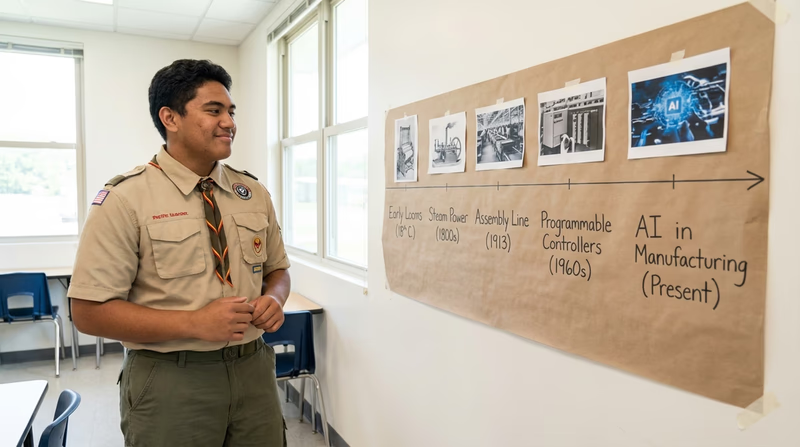
Major Milestones in Automation History
~270 BC — The Water Clock of Ctesibius
The ancient Greek inventor Ctesibius built one of the earliest known automatic devices: a water clock that kept time by regulating the flow of water through a mechanism. It required no human intervention to operate — the earliest concept of a self-running machine.
1784 — The Power Loom
Edmund Cartwright patented the power loom, which automated the weaving of cloth. Before this, fabric was woven entirely by hand on manual looms. The power loom was a key invention of the Industrial Revolution and dramatically increased textile production.
1913 — Henry Ford’s Assembly Line
Henry Ford did not invent the automobile, but he revolutionized how they were built. His moving assembly line at the Highland Park plant in Michigan reduced the time to build a Model T from over 12 hours to about 93 minutes. Each worker performed one specific task as the car moved past them. This was automation of process — breaking a complex job into repeatable steps.
1947 — The Transistor
Scientists at Bell Labs invented the transistor — a tiny electronic switch that could be turned on and off billions of times per second. Transistors replaced bulky vacuum tubes and made modern electronics possible. Without transistors, there would be no computers, no smartphones, and no digital automation of any kind.
1954 — The First Industrial Robot
George Devol patented “Unimate,” the first programmable industrial robot. In 1961, it was installed at a General Motors plant, where it lifted and stacked hot metal parts from a die-casting machine — a dangerous job that had been done by human workers. Unimate launched the era of robotic automation in manufacturing.
1969 — The Programmable Logic Controller (PLC)
The PLC was invented for General Motors to replace the complex relay systems that controlled factory equipment. PLCs allowed engineers to reprogram factory automation with software instead of rewiring physical circuits. Today, PLCs control everything from traffic lights to roller coasters to water treatment plants.
1971 — The First Email Auto-Responder
Shortly after email was invented, someone figured out how to make a computer automatically reply to messages. This was one of the first examples of software-based office automation — a concept that would grow into the massive workflow automation industry we see today.
2001 — Roomba, the Robot Vacuum
iRobot’s Roomba brought automation into people’s homes in a new way. It navigated rooms autonomously using sensors and pre-programmed movement patterns. While early Roombas were not AI-powered (they bounced off walls randomly), they showed millions of people what a personal robot could do.
2011 — IFTTT Launches
The app “If This, Then That” made automation accessible to everyone. For the first time, non-programmers could connect their apps and devices with simple trigger-and-action rules — like “If it rains tomorrow, send me a reminder to bring an umbrella.” IFTTT democratized automation.
2020s — Workflow Automation Everywhere
Tools like Zapier, Microsoft Power Automate, and Make.com allow businesses and individuals to automate complex multi-step workflows without writing code. A Scout leader could set up an automation that sends a reminder email three days before every meeting, updates a spreadsheet when someone RSVPs, and posts a notification in a group chat — all automatically.
Building Your Timeline
Automation Timeline Tips
Make your timeline stand out
- Span a wide range of time: Include at least one ancient or early industrial milestone and at least one modern one.
- Show the progression: Your milestones should illustrate how automation evolved from mechanical to electronic to software.
- Explain the impact: For each milestone, add a sentence about why it changed the world.
- Compare with your AI timeline: Notice how automation history is much older than AI history. Automation started with gears and levers; AI started with math and computers.
- Get creative with your format: A hand-drawn poster, a digital slideshow, or even a physical model all work great.