 Getting Started
Introduction & Overview
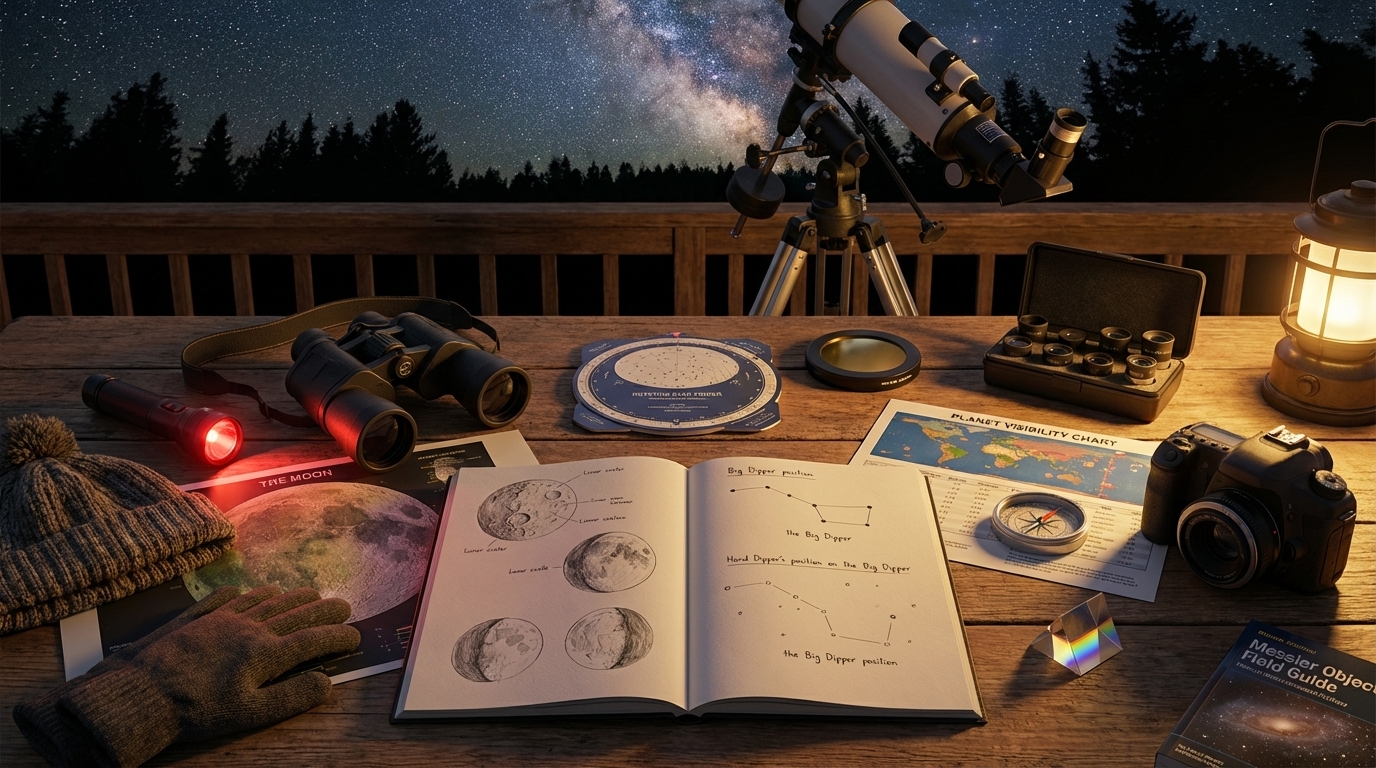
Look up on a clear night and you will see something that has fascinated humans for thousands of years — the universe itself. Stars, planets, the Moon, and distant galaxies are all on display, and the Astronomy merit badge is your guide to understanding what you are seeing. Whether you are camping under dark skies or stepping into your backyard, astronomy turns you into an explorer of the biggest frontier there is.
Astronomy is more than just stargazing. It is the science of everything beyond Earth’s atmosphere — from the dust on the Moon to the birth and death of stars billions of light-years away. This merit badge will teach you how to observe safely, use telescopes and binoculars, identify constellations and planets, and understand the forces that shape our solar system and beyond.
Then and Now
Then — Reading the Sky to Survive
Long before clocks, calendars, or GPS, humans relied on the sky to navigate and tell time. Ancient Babylonians tracked the movements of planets and recorded them on clay tablets over 3,000 years ago. Egyptian farmers watched for the star Sirius to rise before dawn because it signaled the annual flooding of the Nile — their entire agricultural season depended on it. Polynesian sailors crossed thousands of miles of open ocean using nothing but the positions of stars, the direction of waves, and the flight paths of birds.
- Purpose: Navigation, agriculture, timekeeping, religious ceremonies
- Mindset: The sky was a practical tool — read it correctly, and you could plant crops, find your way home, or predict the seasons
Now — Exploring the Universe with Technology
Today, astronomy is a high-tech science that pushes the boundaries of human knowledge. The James Webb Space Telescope orbits nearly a million miles from Earth and captures infrared images of galaxies that formed shortly after the Big Bang. Amateur astronomers contribute real scientific data by tracking asteroids, discovering comets, and monitoring variable stars from their own backyards. You can even control professional telescopes remotely through the internet.
- Purpose: Scientific discovery, exploration, education, personal wonder
- Mindset: The sky is a laboratory — every observation adds to our understanding of the universe, and anyone with curiosity can participate
Get Ready! The universe is waiting for you. All you need to begin is a clear night, your own eyes, and the willingness to look up. Let’s explore what is out there.
Kinds of Astronomy
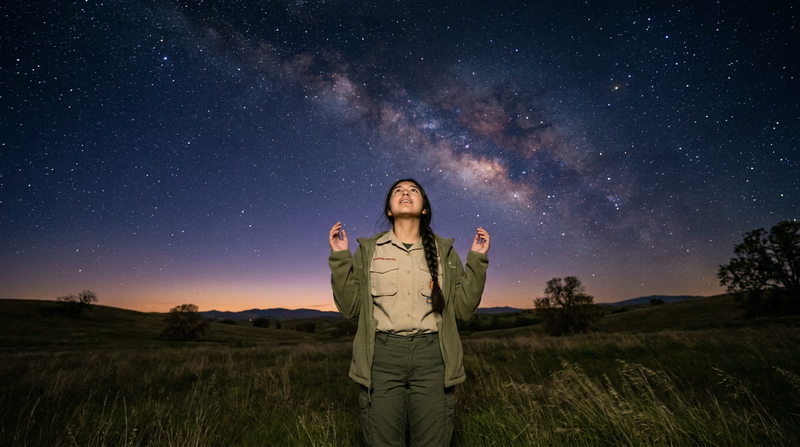
Astronomy is a huge field with many branches. Here is a look at the different ways people study and enjoy the night sky.
Observational Astronomy
This is the heart of what you will do for this merit badge — looking at the sky and recording what you see. Observational astronomers use their eyes, binoculars, and telescopes to study stars, planets, the Moon, and deep-sky objects like nebulae and galaxies. You do not need expensive equipment to get started. Your own eyes are powerful instruments that can identify constellations, track planets, and watch meteor showers.
Solar Astronomy
Solar astronomy focuses on the closest star to Earth — our Sun. Solar astronomers study sunspots, solar flares, and the Sun’s corona (the glowing outer atmosphere visible during a total eclipse). You will learn about the Sun in Requirement 7 of this badge.
Planetary Astronomy
Planetary astronomers study the planets, moons, asteroids, and comets in our solar system. With a small telescope, you can see the rings of Saturn, the cloud bands of Jupiter, and the phases of Venus. You will explore the planets in Requirement 5.
Stellar Astronomy
Stellar astronomers study the stars themselves — how they are born in clouds of gas and dust, how they live for millions or billions of years, and how they die in spectacular explosions called supernovae. In Requirement 7, you will learn about star colors and what they reveal about a star’s temperature and age.
Deep-Sky Astronomy
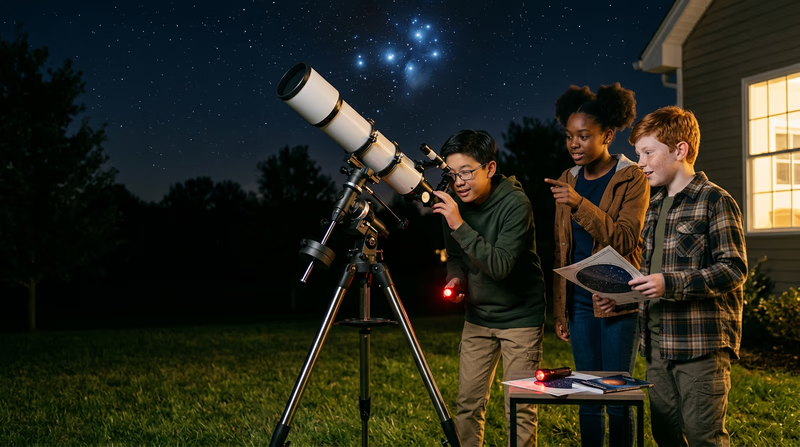
Deep-sky astronomy goes beyond our solar system to study objects like star clusters, nebulae (clouds of gas where stars are born), and distant galaxies. The famous Andromeda Galaxy — the nearest large galaxy to our own Milky Way — is actually visible to the naked eye on a dark night. Through a telescope, deep-sky objects reveal incredible detail and beauty.
Astrophotography
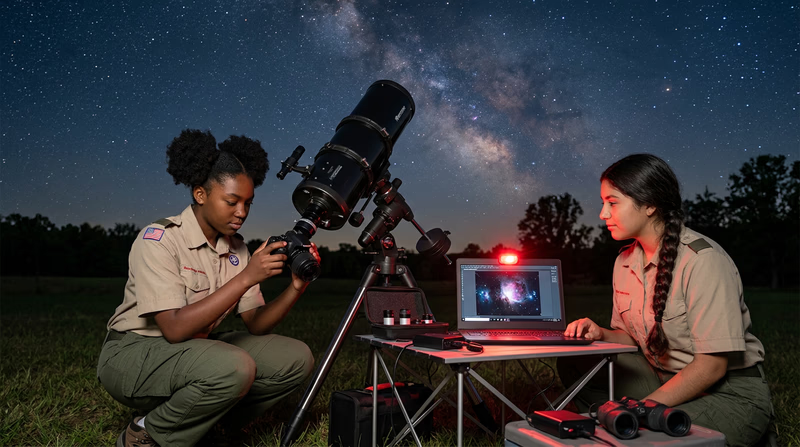
Astrophotography combines astronomy with photography to capture images of celestial objects. Modern cameras and smartphone adapters make it easier than ever to photograph the Moon, planets, star trails, and even faint nebulae. Some amateur astrophotographers produce images that rival those from professional observatories. You will have the chance to try astrophotography in Requirement 8.
Now that you have a sense of how vast and exciting astronomy can be, it is time to start your journey through the requirements.